


The clean team: Pine O Cleen, White King and Duck putting the sparkle in Aussie households
With the exception of those who subscribe to English writer Quentin Crisp’s philosophy that housework is unnecessary because the dirt doesn’t get any worse after four years, cleaning the house is an unavoidable fact of life for most of us. Indeed, the latest data from Roy Morgan reveals that three quarters of Australia’s 15.5 million grocery buyers purchase some kind of cleaning product in an average six months.
In a nationwide survey of grocery buyers conducted between July 2015 and June 2016, 74.7% of them (11.6 million people) bought at least one household cleaning product in an average six-month period.
Best-selling brands
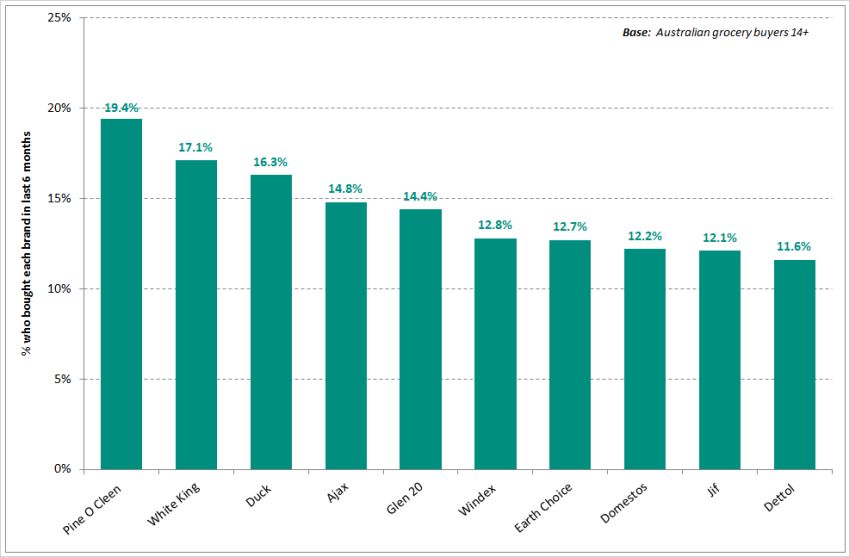
As the chart below reveals, the 10 best-selling household cleaning brands vary between those which offer a range of products for different cleaning purposes and those specialising in one type of product.
Best-selling household cleaner brands in Australia
Source: Roy Morgan Single Source (Australia), July 2015-June 2016, n=14,956 (including 6,172 grocery buyers)
Invented in Melbourne during World War II, Pine O Cleen is Australia’s best-selling household cleaning brand overall, purchased by 19.4% of grocery buyers in an average six months. With a range spanning floor cleaners, bathroom and multi-purpose sprays, disinfectant liquid and disinfecting wipes, Pine O Cleen’s popularity is understandable.
Second-most popular is White King (17.1%), also with a range of products for different cleaning needs, followed by toilet cleaner brand, Duck (16.3%).
Who’s more likely to buy household cleaners?
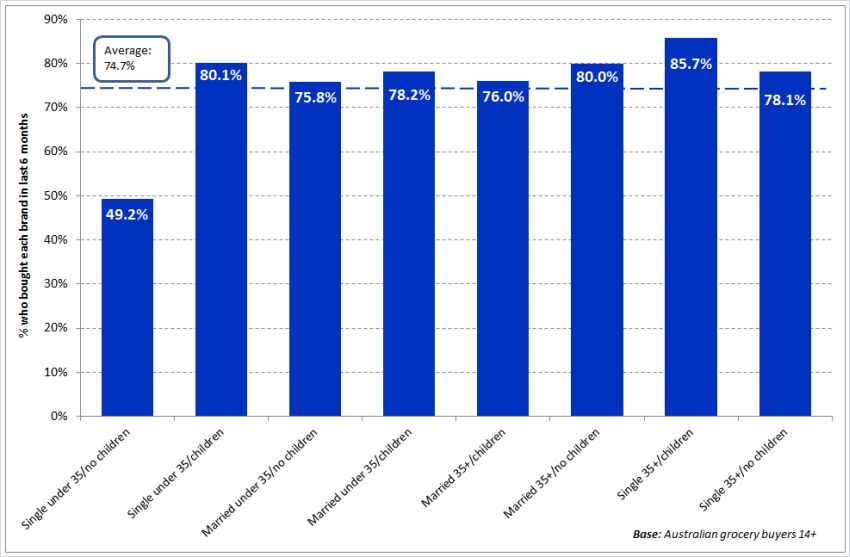
Not surprisingly, having kids increases a person’s likelihood of purchasing cleaning products: especially if they are a single parent, it seems. Roy Morgan data shows that 85.7% of single parents aged 35+ and 80.1% of single parents aged under 35 buy at least one such item in any given six months — compared with 76.0% and 78.2% respectively of their married peers.
Less than half (49.2%) of single grocery buyers aged under 35 purchase cleaning products in the same time period.
Household cleaners: purchase incidence by life stage
Source: Roy Morgan Single Source (Australia), July 2015-June 2016, n=14,956 (including 6,172 grocery buyers)
Sprays are the most popular type of household cleaning product among Aussie grocery buyers, purchased by more than half (51.3%) in an average six months. Liquid cleaners are also popular (44.9%), well ahead of cream cleaners (17.2%), wipes (14.6%), gel (8.8%) and powder (7.5%).
Cleaning wipes are especially popular among single and married parents aged under-35 years, with purchase incidence skyrocketing to 23.8% of grocery buyers in each group. Clearly, the ease and convenience of these products has been embraced by parents of young children. Meanwhile, childless singles aged under-35 come in well below average for every type of cleaner!
Norman Morris, Industry Communications Director, Roy Morgan Research, says:

“Cleaning products may not be the most exciting items in the supermarket, but as the latest findings from Roy Morgan show, they’re a household staple, purchased by the vast majority of Australian grocery buyers in an average six months. Parents are particularly likely to buy these products, and single parents even more so (being their household’s only grocery buyer, they have little choice). Kids can leave a trail of dirt, food scraps and mess behind them, increasing the need to stay on top of the household cleanliness situation.
“But life stage is just one way of identifying those consumers most likely to purchase your product. It can also be helpful to consider purchasing habits by consumer attitudes. For example, shoppers who agree with the statement, ‘I can’t relax until I know the house is clean and tidy’ are more likely to buy cleaning products (almost every brand measured by Roy Morgan, in fact). But those who admit ‘I’m more interested in my job than my house’ are consistently less likely to purchase cleaning products. Obviously, this kind of psychological insight allows cleaning product brands to hone their marketing efforts to attract the most receptive buyers.
“Despite Pine O Cleen’s overall market dominance, it is not the best-seller among all consumer groups. While it’s top of the pops among the aforementioned neat freaks, it’s not the first choice of young single parents (who are markedly more likely to opt for Glen 20, Duck and White King), or their older counterparts (who tend to prefer White King).
“Earth Choice is another interesting example: on one hand, it’s the top choice of young married couples without kids, but on the other, young parents (single and married) are well below average for purchasing the brand. This suggests that some doubt remains about the efficiency/disinfectant qualities of green cleaning products – a hurdle that must be overcome by these brands if they wish to expand their market.
“With its deep consumer data, Roy Morgan Single Source is an invaluable tool for cleaning product brands wishing to achieve cut-through in what is a very crowded market, by gaining a holistic understanding of who is more likely to buy what and why.”
For comments or more information please contact:
Roy Morgan - Enquiries
Office: +61 (03) 9224 5309
askroymorgan@roymorgan.com
Margin of Error
The margin of error to be allowed for in any estimate depends mainly on the number of interviews on which it is based. Margin of error gives indications of the likely range within which estimates would be 95% likely to fall, expressed as the number of percentage points above or below the actual estimate. Allowance for design effects (such as stratification and weighting) should be made as appropriate.
| Sample Size | Percentage Estimate |
| 40% – 60% | 25% or 75% | 10% or 90% | 5% or 95% | |
| 1,000 | ±3.0 | ±2.7 | ±1.9 | ±1.3 |
| 5,000 | ±1.4 | ±1.2 | ±0.8 | ±0.6 |
| 7,500 | ±1.1 | ±1.0 | ±0.7 | ±0.5 |
| 10,000 | ±1.0 | ±0.9 | ±0.6 | ±0.4 |
| 20,000 | ±0.7 | ±0.6 | ±0.4 | ±0.3 |
| 50,000 | ±0.4 | ±0.4 | ±0.3 | ±0.2 |

