


Roy Morgan Business Confidence drops 3pts to 98.7 in November after RBA leaves interest rates unchanged again
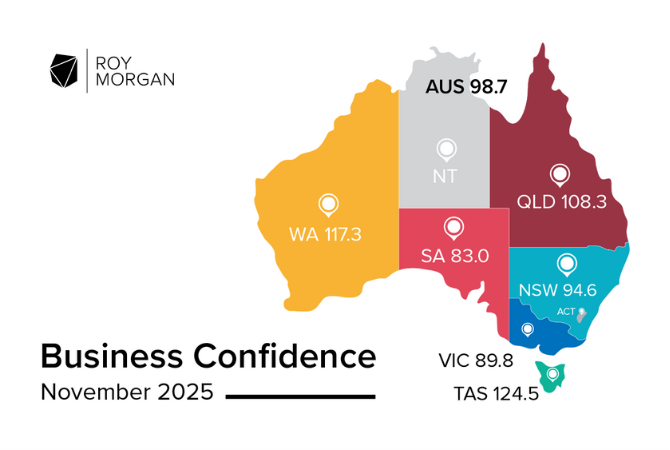
In November 2025 Roy Morgan Business Confidence dropped 3pts to 98.7, wiping out the gains made during September and October. The result followed the Reserve Bank’s decision to leave interest rates unchanged in late September, and again in early November, at 3.6%.
This is the first time this year the RBA has left interest rates unchanged at consecutive meetings.
A look at the component questions of the index showed a weakening in the questions related the businesses own prospects as well as for the broader Australian economy’s performance.
In November only 28% (down 2.6% points) of businesses say the business is ‘better off financially’ than this time last year and 40% (down 2.2% points) say they expect the business to be ‘better off financially’ this time next year.
In addition, a decreased majority of businesses, 54.2% (down 4% points), say they expect ‘good times’ for the Australian economy over the next year while a rising share of 43.7% (up 4.3% points) say they expect ‘bad times’ for the economy.
However, there was a positive move in terms of investing in growing the business with 39.7% (up 2.3% points) saying the next 12 months is a ‘good time to invest’ in growing the business compared to fewer than a third, 31.1% (down 3.8% points), that say the next 12 months is a ‘bad time to invest’.
Business Confidence is 11.1pts below the long-term average of 109.8, but still 13.2pts higher than the latest ANZ-Roy Morgan Consumer Confidence of 85.5 on November 24-30, 2025.
Roy Morgan Monthly Business Confidence -- Australia
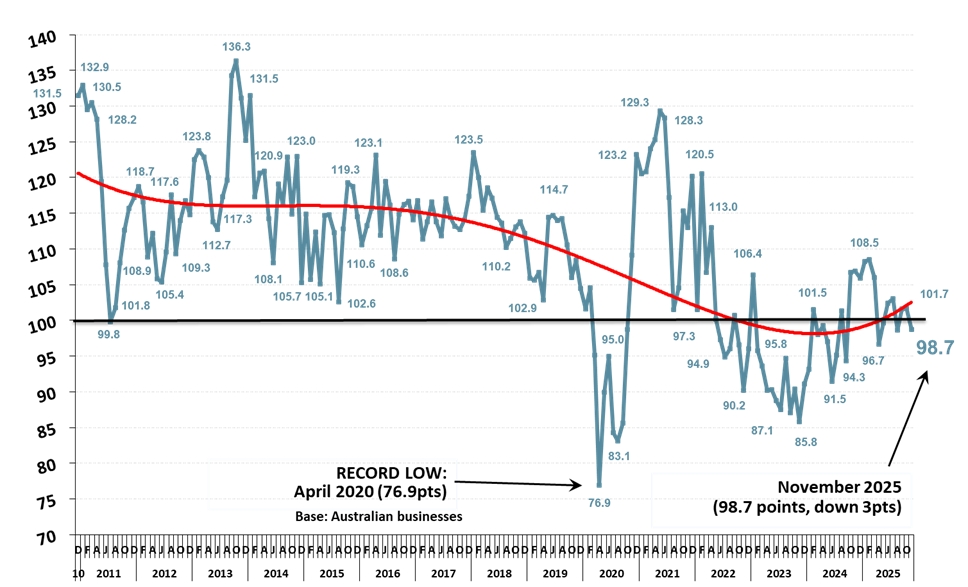
Source: Roy Morgan Business Single Source, Dec 2010-Nov 2025. Average monthly sample over the last 12 months = 1,363.
Compared to a year ago Business Confidence is down driven by falls in the largest States
In November, Business Confidence was down 8.2pts from November 2024. There were decreases in the three largest States of New South Wales, Victoria, and Queensland that drove the annual decline.
Business Confidence dropped by 12pts to 94.6 in New South Wales, was down by 4pts to 89.8 in Victoria, and was down by 15.3pts to 108.3 in Queensland.
However, the largest fall over the last year was in South Australia, with Business Confidence down 43.1pts to only 83.0 – clearly the lowest Business Confidence of any State. Importantly, South Australia is the next State to go to the polls with the State Election set to be held on Saturday March 21, 2026.
In contrast, Business Confidence increased in two States compared to a year ago – Western Australia and Tasmania. In Western Australia, Business Confidence was up 16.3pts from a year ago to 117.3.
There was also a large increase in Tasmania, up 37.3pts to 124.5, following the confirmation of the re-election of Liberal Premier Jeremy Rockliff’s Government in mid-August. The boost to Business Confidence came as Rockliff’s Government secured lower house support in early November for Hobart’s new stadium to be built. The Tasmanian upper house has now also voted to support the stadium – a huge ‘fillip’ to Tasmania’s economy.
Business Confidence by State in November 2024 vs November 2025
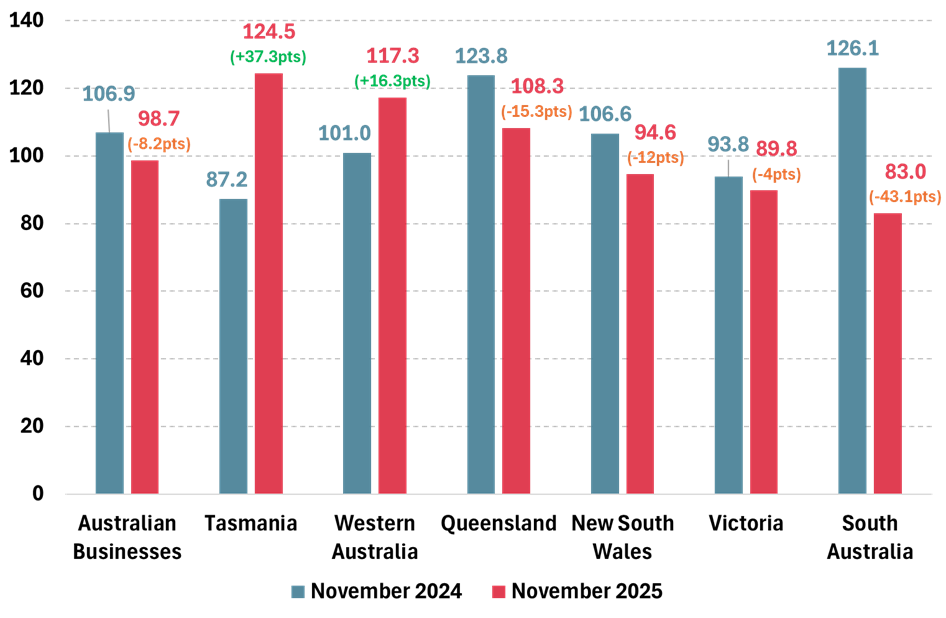
Source: Roy Morgan Business Single Source, November 2024, n=1,457, November 2025, n=1,233. Base: Australian businesses. *Tasmanian Business Confidence is measured over two months: Oct. & Nov. 2024 cf. Oct & Nov. 2025.
Mining, Financial & Insurance Services, Manufacturing and Public Administration & Safety are the four most confident industries during October & November 2025
Over the last two months there were 12 industries with Business Confidence in positive territory above 100 led by Mining, Financial & Insurance Services, Manufacturing, Public Administration & Safety, Professional, Scientific & Technical Services, Administration & Support Services, Accommodation & Food Services, Electricity, Gas, Water & Waste Services, Education & Training and Rental, Hiring & Real Estate Services..
There were five industries with confidence over 10pts above the average in October & November 2025 led by the Mining industry on 126.6, up 26pts on a year ago. The increased confidence in the Mining industry comes as Prime Minister Anthony Albanese signed a multi-billion-dollar deal with US President Donald Trump regarding Australia’s critical mineral and rare earth supplies in early October.
In second place is Financial & Insurance Services on 120.0, but down 17.5pts on a year ago ahead of Manufacturing on 114.2, up 14pts on a year ago, Public Administration & Support Services on 113.3, but down sharply by 24.2pts on a year ago, and in fifth place is Professional, Scientific & Technical Services on 111.8, and up marginally by 5.7pts on a year ago.
There were only two industries with Business Confidence deeply in negative territory below 80 during the last two months and the least confident industry is Wholesale Trade on only 77.3. Slightly higher is Agriculture, Forestry & Fishing on 79.3. Business Confidence in this industry has been at low levels for a significant period of time and averaged only 80.5 over the last three years – clearly the lowest of any industry.
Business Confidence for Top 5 and Bottom 5 Industries in October & November 2025
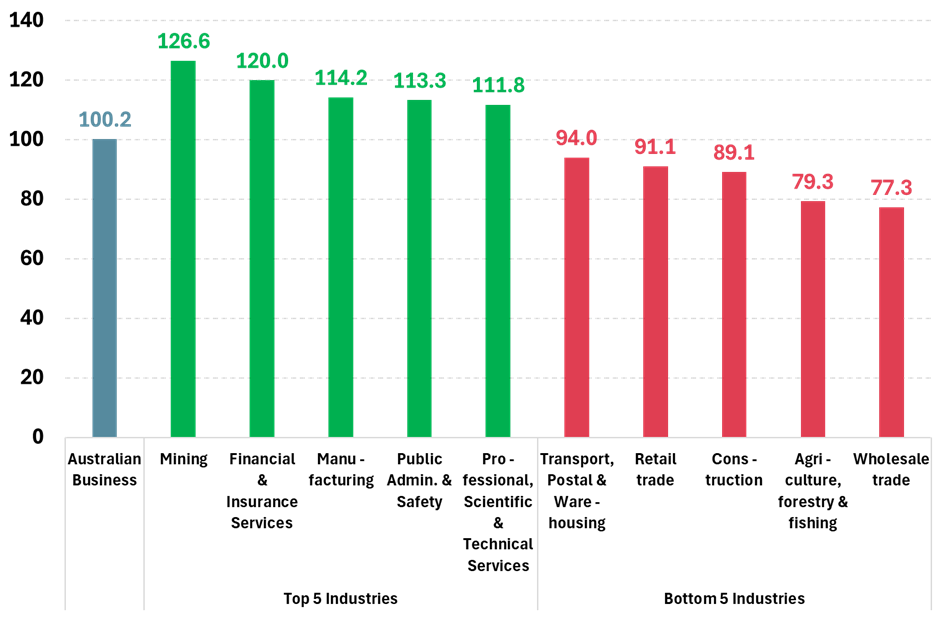
Source: Roy Morgan Business Single Source, October & November 2025, n=2,644. Base: Australian businesses.
Note: In the chart above, green bars represent Business Confidence in positive territory above the national average, red bars represent Business Confidence well below the national average and below the neutral level of 100 while the dark blue bar represents Business Confidence above the neutral level of 100 but still below the national average.
Business Confidence drops 3 points to 98.7 as business lose confidence about the Australian economy’s performance going forward and their own prospects:
- In November, just over a quarter of businesses, 28% (down 2.6ppts), said their business is ‘better off’ financially than a year ago, while far more, 39.6% (up 5.5ppts), said the business is ‘worse off’;
- Businesses’ net views on their prospects for the next year declined in November with 40% (down 2.2ppts) expecting the business will be ‘better off’ financially this time next year, while almost a quarter, 23.9% (up 1.6ppts), expect the business will be ‘worse off’;
- Confidence regarding the performance of the Australian economy over the next year also declined in November with 54.2% (down 4ppts) expecting ‘good times’ while 43.7% (up 4.3ppts) expect ‘bad times’ – the lowest net rating for this key question for over a year since September 2024;
- Businesses’ views on the long-term future of the Australian economy over the next five years were little changed on a net level in November with 32.2% (up 1.1ppts) expecting ‘good times’ over the next five years compared to 62.1% (up 1.7ppts) expecting ‘bad times’;
- In contrast, net sentiment on whether now is a ‘good or bad time to invest in growing the business’improved with 39.7% (up 2.3ppts) saying the next 12 months will be a ‘good time to invest’ in growing the business while 31.1% (down 3.8ppts) say the next 12 months will be a ‘bad time to invest’.
Michele Levine, CEO of Roy Morgan, says Business Confidence fell 3pts to 98.7 in November, following a hefty spike in inflation over the last few months and the Reserve Bank decision to leave interest rates unchanged at consecutive meetings in late September and early November at 3.6%:

“Roy Morgan Business Confidence dropped 3pts to 98.7 in November as rising inflation in recent months led to the Reserve Bank leaving interest rates unchanged at 3.6% at its meetings in both late September and on Melbourne Cup Day – despite prior expectations of further interest rate cuts.
“The rising inflation has been foreshadowed in the latest ANZ-Roy Morgan Inflation Expectations which increased to 5.6% in late November – its highest level for two years since December 2023. The official ABS Inflation figure, now released monthly, has increased from 1.9% in June 2025 and doubled to 3.8% in October 2025 – only four months later.
“The unexpected and sharp rise in inflation led the Reserve Bank (RBA) to leave interest unchanged at two consecutive meetings in September and November – the first time this year the RBA has left interest rates unchanged in consecutive meetings. The RBA cut interest rates by 0.25% in each of February, May and August by a total of 0.75% to 3.6%.
“The flow-on from these developments was a concerted fall in the ASX200 market which hit a closing high of 9,390.1 on October 21, 2025, and then fell by over 700 points to close at 8,686.3 on November 21, 2025 – a fall of 703.8 points (-7.5%) and almost qualifying as a ‘market correction’ (-10% fall).
“The impact of rising inflation, a halt to interest rate cuts, and falling equity markets is clearly being felt by businesses. In November a decreased majority of 54.2% (down 4% points) of businesses expected ‘good times’ for the Australian economy over the next 12 months and only two-fifths, 40% (down 2.2% points), expected the business to be ‘better off financially’ this time next year.
“However, in contrast to other indicators, businesses grew in confidence about investing in the business with 39.7% (up 2.3% points) of businesses saying the next 12 months is a ‘good time to invest’ in growing the business compared to 31.1% (down 3.8% points) say it is a ‘bad time to invest’.
“On a State-by-State basis Business Confidence was highest in Tasmania (124.5) after the re-election of Jeremy Rockliff’s Liberal Government and the Government’s successful push to secure Parliamentary approval of the construction of Hobart’s new stadium in early November.
“Business Confidence is also well into positive territory in both Western Australia (117.3) and Queensland (108.3) but has drifted below the neutral level of 100 in the two largest States of New South Wales (94.6) and Victoria (89.8) and is lowest of all in South Australia at just 83.0. Business Confidence is lower than a year ago in New South Wales, Victoria, Queensland and South Australia.
“At an industry level, the most confident industry is the Mining industry on 126.6 – over 25pts above the national average. The Mining industry was significantly boosted in October when Prime Minister Anthony Albanese signed a multi-billion-dollar deal with US President Donald Trump covering access to and development of Australia’s large critical minerals and rare earth resources.
“Other confident industries include Financial & Insurance Services on 120.0, Manufacturing on 114.2, Public Administration & Safety on 113.3 and Professional, Scientific & Technical Services on 111.8, all over 10pts higher than the national average.
“At the other end of the scale are Wholesale Trade on only 77.3 and Agriculture, Forestry & Fishing on just 79.3 and the lowest average Business Confidence over a sustained period of the last three years of only 80.5 – clearly the lowest average of any of the 18 industries over this extended period.”
The latest Roy Morgan Business Confidence results for November are based on 1,233 detailed interviews with a cross-section of Australian businesses from each State and Territory. Detailed findings are available to purchase on a monthly or annual subscription as part of the Roy Morgan Business Confidence Report.
For comments or more information please contact:
Michele Levine
CEO, Roy Morgan
Office: +61 (3) 9224 5215
Mobile: 0411 129 093
To learn more about Roy Morgan’s Business Confidence, Consumer Confidence and Inflation Expectations data call (+61) (3) 9224 5309 or email askroymorgan@roymorgan.com.
About Roy Morgan
Roy Morgan is Australia’s largest independent Australian research company, with offices in each state, as well as in the U.S. and U.K. A full-service research organisation, Roy Morgan has over 80 years’ experience collecting objective, independent information on consumers.
Margin of Error
The margin of error to be allowed for in any estimate depends mainly on the number of interviews on which it is based. Margin of error gives indications of the likely range within which estimates would be 95% likely to fall, expressed as the number of percentage points above or below the actual estimate. Allowance for design effects (such as stratification and weighting) should be made as appropriate.
| Sample Size | Percentage Estimate |
| 40% – 60% | 25% or 75% | 10% or 90% | 5% or 95% | |
| 1,000 | ±3.0 | ±2.7 | ±1.9 | ±1.3 |
| 5,000 | ±1.4 | ±1.2 | ±0.8 | ±0.6 |
| 7,500 | ±1.1 | ±1.0 | ±0.7 | ±0.5 |
| 10,000 | ±1.0 | ±0.9 | ±0.6 | ±0.4 |
| 20,000 | ±0.7 | ±0.6 | ±0.4 | ±0.3 |
| 50,000 | ±0.4 | ±0.4 | ±0.3 | ±0.2 |


