


2.5 million Young Australians aged 6-13 watch YouTube

The latest Roy Morgan Young Australian Survey (YAS) reveals YouTube viewing is near-universal among 6-13-year-olds with 89% of this age group, an estimated 2.5 million, watching YouTube with distinct content preference differences by sex and age.
This research is part of an ongoing programme of research into Young Australian life experiences, preferences, priorities and opinions. This programme has been operating since the early 2000s with the latest data collection on YouTube between April and December 2025 with a nationwide sample of 1,129 Young Australians aged 6-13.
Gaming and Animation are the leading video categories Australian kids are watching on YouTube
2.5 million Australian children aged 6-13 (89%) watched YouTube between April-December 2025. The leading YouTube video category is Gaming – watched by 1.33 million children aged 6-13 (53% of YouTube watchers in this age group), ahead of 930,000 watching the Animation category (37%), 900,000 watching Comedy (36%), and 850,000 watching the Animals and Music categories (34%).
Most popular video categories Young Australian YouTube viewers like to watch
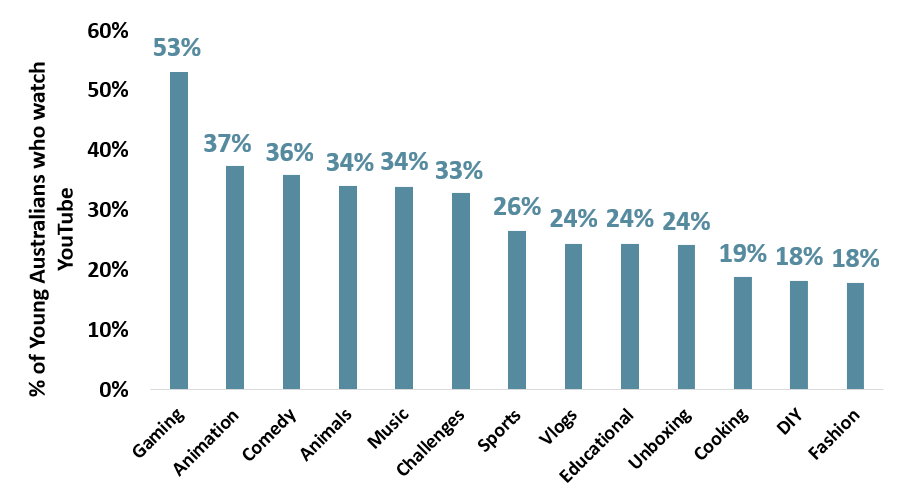
Source: Roy Morgan Preliminary Young Australian Survey, April 2025 – December 2025, n=1,129.
Base: Young Australians aged 6-13 years who watch YouTube.
Types of video categories kids aged 6-13 like to watch on YouTube by Gender
Boys are the primary drivers of the Gaming category (67% of boys aged 6-13 watching YouTube cf. 39% of girls aged 6-13 watching YouTube). Boys are also far more likely to watch the Sports category (36% cf. 17%).
In contrast, girls show a strong preference over boys for categories including Animals (44% of girls aged 6-13 watching YouTube cf. 25% of boys aged 6-13 watching YouTube), Music (41% cf. 27%), Fashion (31% cf. 5%), Unboxing (31% cf. 18%), DIY (25% cf. 11%), and Cooking (24% cf. 14%) reflecting girls’ more diverse lifestyle and creative preferences.
There are several categories with fairly even gender splits including Animation (38% of boys aged 6-13 watching YouTube cf. 36% of girls aged 6-13 watching YouTube), Comedy (36% cf. 35%), and Challenges (32% cf. 34%), Educational (22% cf. 26%).
Types of YouTube videos like to watch by Age
- YouTube viewing is near universal for ages 6-13 (89%), although marginally lower amongst kids aged 6-7 (84%), compared to those aged 8 and over (91%).
- Gaming is the #1 YouTube category for kids in every two-year age band, especially for kids aged 10-11 years old (nearly 60% of kids in this age group watching YouTube reported watching Gaming).
- Besides Gaming, popular categories for kids aged 6-9 that watch YouTube include Animation (40%), Animals (35%), and Challenges (32%), whereas for kids aged 10-13 watching YouTube favour Comedy (41%), ahead of Animation (35%), and Animals (33%).
Attitudes: YouTube watchers vs non-watchers (Aged 10-13)
Among 10-13 year olds, those who watch YouTube are more likely than those who don’t watch YouTube to prefer computer game than play outside, and to worry about war and terrorism to agree with the following attitudes:
- “I would rather play computer games than play outside” (55% cf. 36%);
- “I worry about wars” (67% cf. 45%);
- “I worry about terrorism” (33% cf. 23%).
In contrast, kids who don’t watch YouTube are more likely to enjoy reading and eating healthy food:
- “I enjoy reading” (85% cf. 65%);
- “I like to eat healthy foods” (83% cf. 71%).
MrBeast is by far the most popular YouTube channel for 6-13 year olds
When asked to nominate a single favourite channel, 15.2% of children aged 6-13 mentioned MrBeast, with the next nine channels each receiving only around 1% of mentions each.
In December 2025, Australia’s minimum-age restrictions require platforms to take reasonable steps to prevent under-16s from holding accounts. It has not affected YouTube Kids nor access to YouTube without an account, given these are outside the scope of the law. Australians under 16s are no longer able to sign into YouTube using their Google account, removing access to age appropriate safeguards applied to those accounts and preventing parents from creating supervised accounts for their children.
Several of the creators named as children’s number one favourites are not available within the YouTube Kids environment at all. E.g. Ben Azelart, IShowSpeed, Salish, Ryan Trahan, and FaZe.
Roy Morgan CEO Michele Levine says YouTube is used by the vast majority of Australian kids aged 6-13 (89%) – and the new social media ban deprives many kids in this age group of their favourite YouTube channels – at least until they turn 16:

“Australia’s world-first social-media ban for under 16 year olds came into force in mid-December and the latest Roy Morgan data shows 89%, an estimated 2.5 million Australians aged 6-13, who watch YouTube are potentially impacted by the ban – despite the availability of YouTube Kids for children aged under 13.
“Roy Morgan data from the Young Australians Survey (YAS) shows the most popular YouTube video categories for young YouTube watchers are Gaming (1.33 million watchers), Animation (930,000 watchers), Comedy (900,000 watchers), Music & Animals (850,000 watchers each).
“Boys in this age group are far more likely than girls to watch video categories such as Gaming and Sports, whereas girls drive viewership of a more diverse range of categories including Animals, Music, Fashion, DIY, Unboxing, and Cooking.
“For young YouTube watchers there is a clear stand-out channel with 15.2% watching the MrBeast channel – known for the challenges of the channel’s creator Jimmy Donaldson. The popularity of the channel is perhaps not surprising with the Challenges video category, one of the more gender balanced categories and watched by an estimated 820,000 kids aged 6-13.
“An interesting factor to emerge from the research is how YouTube watchers aged 10-13 have significantly different views on key statements than their counterparts who don’t watch YouTube
“Watchers of YouTube are far more likely than non-watchers to agree with the statements that ‘I worry about wars’ (67% cf. 45%), ‘I worry about terrorism’ (33% cf. 23%), and ‘I would rather play computer games than play outside’ (55% cf. 36%).”
For comments or more information about Roy Morgan’s Young Australians Survey please contact:
Roy Morgan Enquiries
Office: +61 (3) 9224 5309
askroymorgan@roymorgan.com
About Roy Morgan
Margin of Error
The margin of error to be allowed for in any estimate depends mainly on the number of interviews on which it is based. Margin of error gives indications of the likely range within which estimates would be 95% likely to fall, expressed as the number of percentage points above or below the actual estimate. Allowance for design effects (such as stratification and weighting) should be made as appropriate.
| Sample Size | Percentage Estimate |
| 40% – 60% | 25% or 75% | 10% or 90% | 5% or 95% | |
| 1,000 | ±3.0 | ±2.7 | ±1.9 | ±1.3 |
| 5,000 | ±1.4 | ±1.2 | ±0.8 | ±0.6 |
| 7,500 | ±1.1 | ±1.0 | ±0.7 | ±0.5 |
| 10,000 | ±1.0 | ±0.9 | ±0.6 | ±0.4 |
| 20,000 | ±0.7 | ±0.6 | ±0.4 | ±0.3 |
| 50,000 | ±0.4 | ±0.4 | ±0.3 | ±0.2 |


