


Rate of switching mobile phone service providers higher among ‘eSIM’ users’

New data from Roy Morgan shows that ‘eSIM’ users are more likely to have switched service providers in the last 12 months compared to an average mobile phone user.
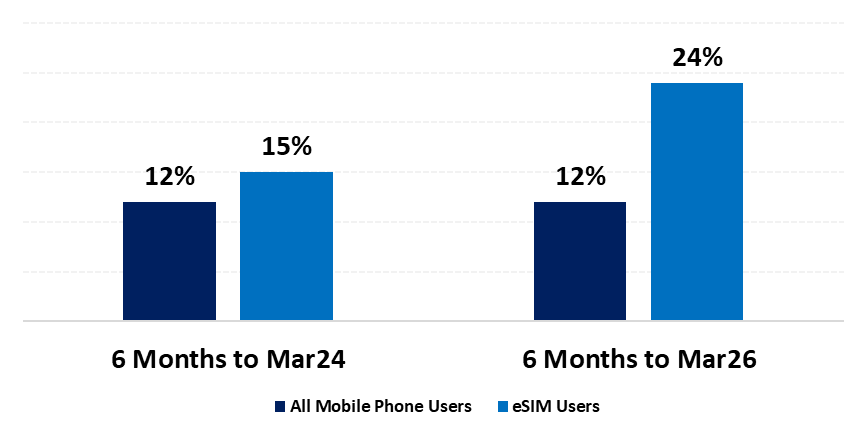
Of all eSIM users, 24% switched service provider in the last 12 months, meanwhile, among all mobile phone users, only 12% have switched in the last 12 months.
Embedded SIMs, known as eSIMs for short, were first introduced into the Australian market in 2019. Originally only available through mobile network operators Telstra, Optus, and Vodafone, today, eSIMs are offered by almost all notable players in the mobile phone service provider space.
eSIMs are pre-built into the physical hardware of mobile phone handsets, removing the need for a traditional physical SIM card. All flagship Apple, Google and Samsung handsets released after 2019 carry eSIM compatibility, with many models offering dual eSIM capability, allowing consumers to have two separate mobile phone services installed on one device without the use of a plastic SIM card.
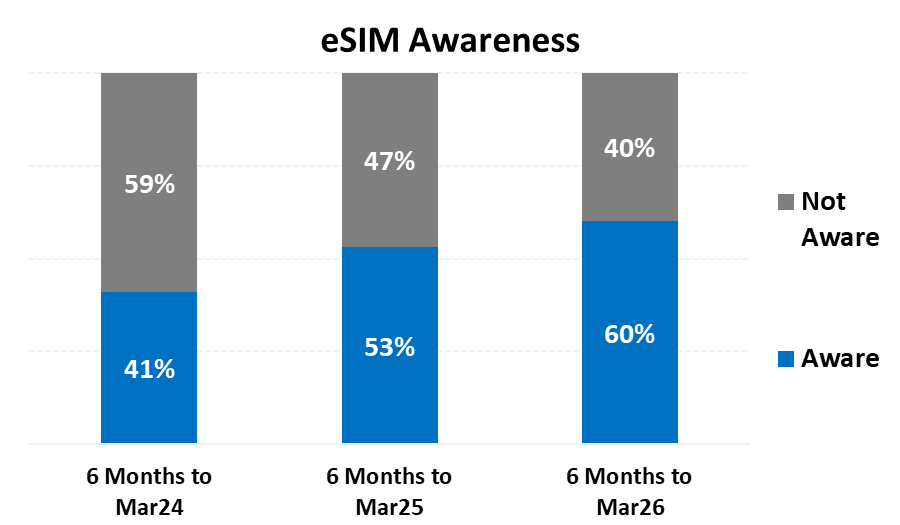
According to new data from Roy Morgan, awareness of this technology has grown strongly over the last three years, with six out of every ten mobile consumers (60%) aware of eSIMs as of March 2026.
There has been a substantial growth in awareness of eSIMs in recent years, from 41% for the period of six months to March 2024, jumping 12% pts to 53% in the period for the six months to March 2025 and increasing a further 7% points to 60% for the most recent period of the six months to March 2026.
Awareness of ‘Embedded SIMS’ (eSIMs) among mobile phone users
Source: Roy Morgan Single Source. October 2023 to March 2026
Base: Main Mobile Phone Users [Average 6-month sample n=30,282].
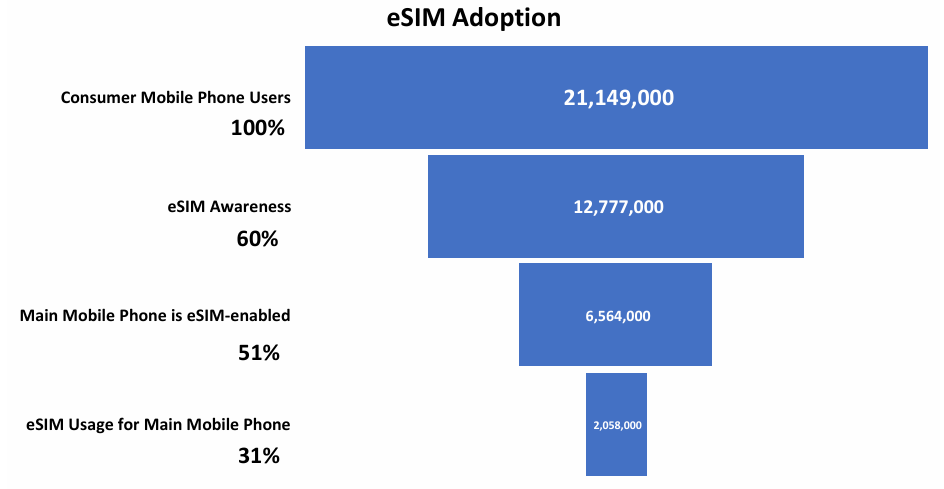
Roy Morgan data shows that as awareness grew, so did adoption with 51% of those aware of eSIM technology also acknowledging that their main mobile phone handset is eSIM-enabled. Among them, almost a third (31%) have their eSIM activated with their current mobile phone service provider.
Source: Roy Morgan Single Source. October 2025 – March 2026
Base: Main Mobile Phone Users [n=27,472].
One of the main reported benefits of utilizing eSIM technology is the ease in which consumers may change their mobile service provider. No longer having to rely on obtaining a new physical card to switch, greater freedom is afforded to consumers to search for the best possible deal.
An assessment conducted by the Australian Competition and Consumer Commission (ACCC) in 2019 predicted this switching behaviour, noting that “e-SIM technology has the potential to greatly increase competition and consumer choice in the mobile telecommunications market. eSIMs can reduce barriers to switching mobile service providers by giving consumers the ability to switch in their device, rather than having to physically procure and then switch SIM cards. In addition, eSIM technology has the potential to improve the competitive position of network resellers (known as mobile virtual network operators, or MVNOs) … supporting entry by alternative service providers (such as those that operate online only)”[1]
The higher rate of switching among eSIM users (24%) is now reported to be two times higher compared to the total mobile market (12%), and this gap has increased in the last couple of years.
In March 2024, switching rate among eSIM users was only 3% pts higher (15%) than the rate of switching among all mobile phone users (12%).
Service Provider Switching Rate in the Last 12 Months
Source: Roy Morgan Single Source. October 2023 – March 2024 and October 2025 – March 2026.
Base: Main Mobile Phone Users [Average 6-Month Sample n=28,563], eSIM Users [Average 6-Month Sample n=2,405].
Michele Levine, CEO, Roy Morgan, says:

“This latest Roy Morgan data gives us vast insights into the impact of technology on consumer behaviour. In this case, the versatility of the eSIM technology removes a traditional barrier to mobile phone service provider switching, and this clearly influences behaviour.
“Whilst offering eSIM technology may not necessarily be a selling point for a mobile service provider, as the vast majority of providers offer eSIM activation, the data shows that having an eSIM makes it easier for customers to switch mobile service provider.
“The convenience available to those with eSIMs would have been handy for customers during the Optus national outage in late 2023 which lasted nearly 14 hours. At the very least, the Optus outage may have contributed to the substantial increase in awareness levels for eSIM during this period (+12% pts).
“Those unaware of eSIM, or not having an eSIM-enabled handset, seem to resort to ‘sticking it out’ with their current provider with their switching rate remaining unchanged in the last two years.
“This brings to light the important role this technology plays in improving competition. Importantly, the data scientists at Roy Morgan have uncovered an interesting competitive landscape among ‘technology savvy switchers’ which differs from that of the ‘total switching market’. We will reveal these findings in the coming weeks.
“To find out the latest detailed data on customers switching behaviour in the mobile phone market, contact Roy Morgan.”
To learn more about Roy Morgan Single Source and more, call (+61) (3) 9224 5309 or email askroymorgan@roymorgan.com.
Please click on this link to the Roy Morgan Online Store to view additional in-depth reports and profiles on consumer data in the telecommunications and mobile phone industries.
About Roy Morgan
Roy Morgan is the largest independent Australian research company, with offices in each state of Australia, as well as in the United States and the United Kingdom. A full-service research organisation specialising in omnibus and syndicated data, Roy Morgan has over 80 years’ experience in collecting objective, independent information on consumers.
Margin of Error
The margin of error to be allowed for in any estimate depends mainly on the number of interviews on which it is based. Margin of error gives indications of the likely range within which estimates would be 95% likely to fall, expressed as the number of percentage points above or below the actual estimate. Allowance for design effects (such as stratification and weighting) should be made as appropriate.
| Sample Size | Percentage Estimate |
| 40% – 60% | 25% or 75% | 10% or 90% | 5% or 95% | |
| 1,000 | ±3.0 | ±2.7 | ±1.9 | ±1.3 |
| 5,000 | ±1.4 | ±1.2 | ±0.8 | ±0.6 |
| 7,500 | ±1.1 | ±1.0 | ±0.7 | ±0.5 |
| 10,000 | ±1.0 | ±0.9 | ±0.6 | ±0.4 |
| 20,000 | ±0.7 | ±0.6 | ±0.4 | ±0.3 |
| 50,000 | ±0.4 | ±0.4 | ±0.3 | ±0.2 |


