


13.6 million Australians now use AI tools like ChatGPT, Google Gemini, Microsoft Copilot, Canva Magic Studio and Claude

New research from Roy Morgan shows 13.6 million people, equivalent to 58% of Australians aged 14+, use ‘Artificial Intelligence’ (AI) tools in an average four weeks in the March quarter 2026.
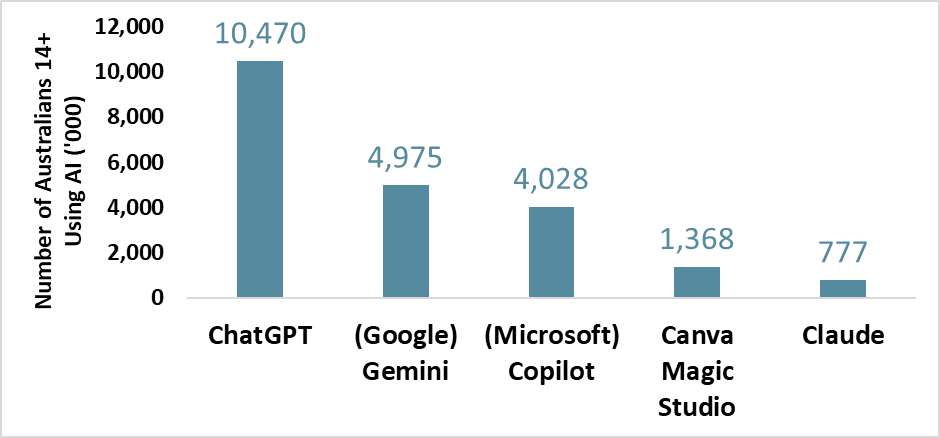
OpenAI’s ChatGPT is clearly the most popular AI tool with 10.5 million Australians (45%) using ChatGPT, more than twice as popular as the next most used AI tool.
Google Gemini is the second most used AI tool, used by 5 million Australians (21%). Usage of Gemini represents the active use of the tool, rather than the embedded use that comes with using Google Search.
Microsoft Copilot follows closely behind Google Gemini, used by an estimated 4 million Australians (17%).
Well behind the big three are Canva’s Magic Studio used by an estimated 1.4 million Australians (6%). Canva Magic Studio offers AI design tools allowing users to create images, videos or text from prompts. Anthropic’s Claude is used by an estimated 777,000 Australians (3%).
Top 5 AI Tools Used in an average four weeks
Source: Roy Morgan Single Source, January – March 2026. Base: Australians 14+, n=14,646.
Australians aged 25-49 are the most likely to use AI tools
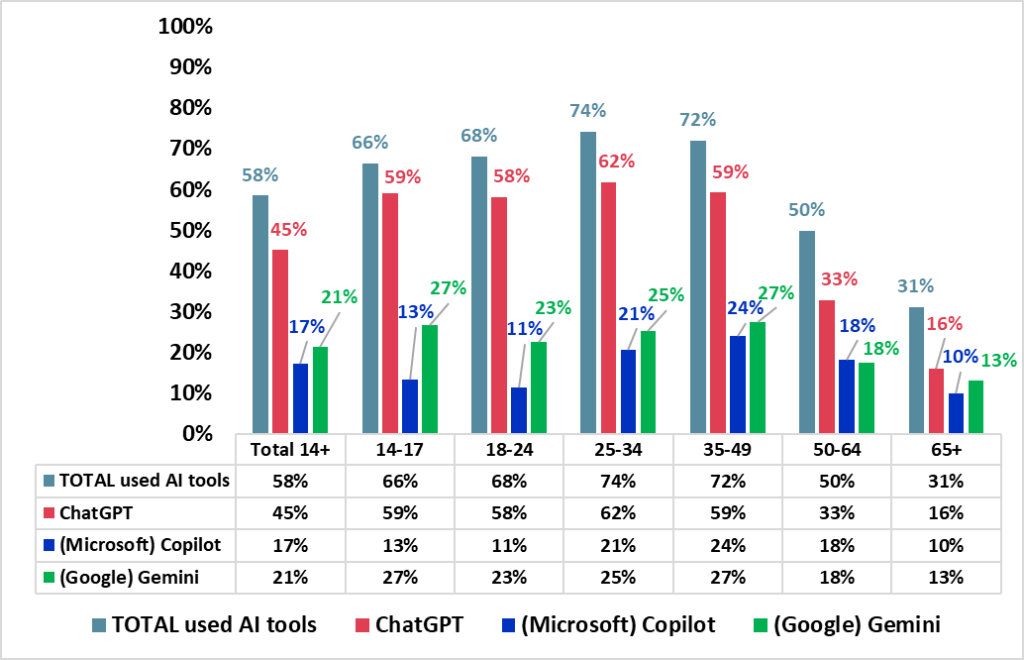
Analysis by age shows 74% of Australians aged 25-34 and 72% aged 35-49 use AI tools – the highest usage of any age groups. This is followed by people aged 18-24 (68%) and 14-17 (66%).
In contrast, only 50% of people aged 50-64 and just 31% of people aged 65+ use AI tools.
The most widely used AI tool, Open AI’s ChatGPT is used by 62% of people aged 25-34 – a higher rate than any other age group just ahead of people aged 14-17 (59%), 18-24 (58%) and 35-49 (59%).
Google Gemini is used by 27% of people aged 14-17 and 35-49, 25% of people aged 25-34, and 23% of people aged 18-24. Fewer than one-in-five people aged 50+ use Gemini.
The highest usage of Microsoft Copilot is by people aged 35-49 (24%), those aged 25-34 (21%) and 18% of people aged 50-64. This is the only major AI tool more likely to be used by people aged 50-64 than by people aged either 14-17 (13%) or 18-24 (11%).
Usage of AI tools including ChatGPT, Microsoft Copilot and Google Gemini by age group
Source: Roy Morgan Single Source, January – March 2026.
Base: Australians 14+, n=14,646.
Michele Levine, Roy Morgan CEO, says usage of AI tools has taken off in Australia over the last few years with over half of us now using these tools in an average four weeks:

“Artificial Intelligence (AI) software has taken the world by storm over the past few years, and the latest research from Roy Morgan shows 13.6 million Australians (58% of people aged 14+) are now using AI tools in an average four weeks.
“The most well-known AI tool, OpenAI’s ChatGPT is also the most widely used, with 10.5 million Australians now using ChatGPT in an average four weeks – more than double nearest rivals Google Gemini (5 million users) and Microsoft Copilot (4 million).
“Interestingly, it is Australians aged 25-34 (74%) and 35-49 (72%) that are the most likely to use AI tools – ahead of younger Australians aged 18-24 (68%) and 14-17 (66%). Usage of AI tools drops off for Australians aged 50-64 (50%) and especially for those aged 65+ (31%).”
For comments or more information about Roy Morgan’s extensive technology and AI related data please contact:
Roy Morgan Enquiries
Office: +61 (3) 9224 5309
askroymorgan@roymorgan.com
About Roy Morgan
Roy Morgan is the source of the most comprehensive data on Australians’ behaviour and attitudes, surveying over 1,000 people weekly in a continuous cycle that has been running for two decades. The company has more than 80 years’ experience collecting objective, independent information.
Margin of Error
The margin of error to be allowed for in any estimate depends mainly on the number of interviews on which it is based. Margin of error gives indications of the likely range within which estimates would be 95% likely to fall, expressed as the number of percentage points above or below the actual estimate. Allowance for design effects (such as stratification and weighting) should be made as appropriate.
| Sample Size | Percentage Estimate |
| 40% – 60% | 25% or 75% | 10% or 90% | 5% or 95% | |
| 1,000 | ±3.0 | ±2.7 | ±1.9 | ±1.3 |
| 5,000 | ±1.4 | ±1.2 | ±0.8 | ±0.6 |
| 7,500 | ±1.1 | ±1.0 | ±0.7 | ±0.5 |
| 10,000 | ±1.0 | ±0.9 | ±0.6 | ±0.4 |
| 20,000 | ±0.7 | ±0.6 | ±0.4 | ±0.3 |
| 50,000 | ±0.4 | ±0.4 | ±0.3 | ±0.2 |


