


In June Roy Morgan Business Confidence up slightly by 1.4 points to 77.5 – but still fourth lowest of all time
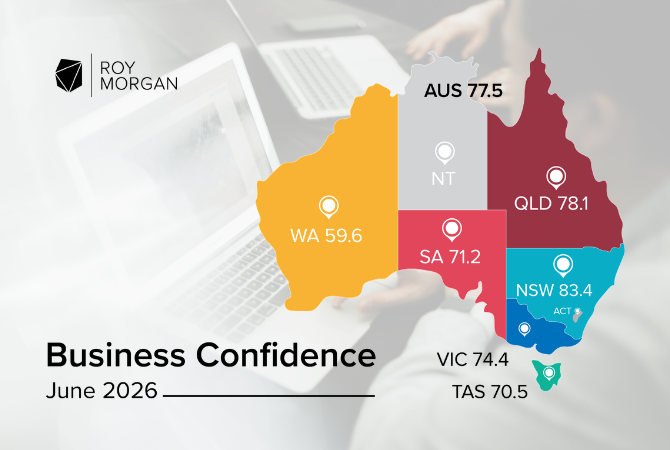
In June 2026 Roy Morgan Business Confidence increased 1.4 points to 77.5, a slight recovery from the all-time record low in May of 76.1.
Although the Reserve Bank (RBA) raised interest rates by +0.25% to 4.35% in early May, the RBA decided to leave interest rates unchanged in mid-June after inflation pressures eased.
Business Confidence during the June quarter 2026 was at a record low quarterly rating of only 76.7 – 7.6 points below the previous quarterly low from September quarter 2020 of 84.3.
Driving the small increase in June was more confidence about the next 12 months for business finances and for the wider Australian economy.
Now a third of businesses, 33.4% (up 4.4% points in June) expect to be ‘better off’ financially this time next year, and under a third, 31.5% (down 2.6% points) expect to be ‘worse off’.
In addition, now 41.6% (up 3.1% points) expect ‘good times’ for the Australian economy over the next year, while a reduced majority of 57.1% (down 1.9% points) expect ‘bad times’.
Roy Morgan Monthly Business Confidence -- Australia
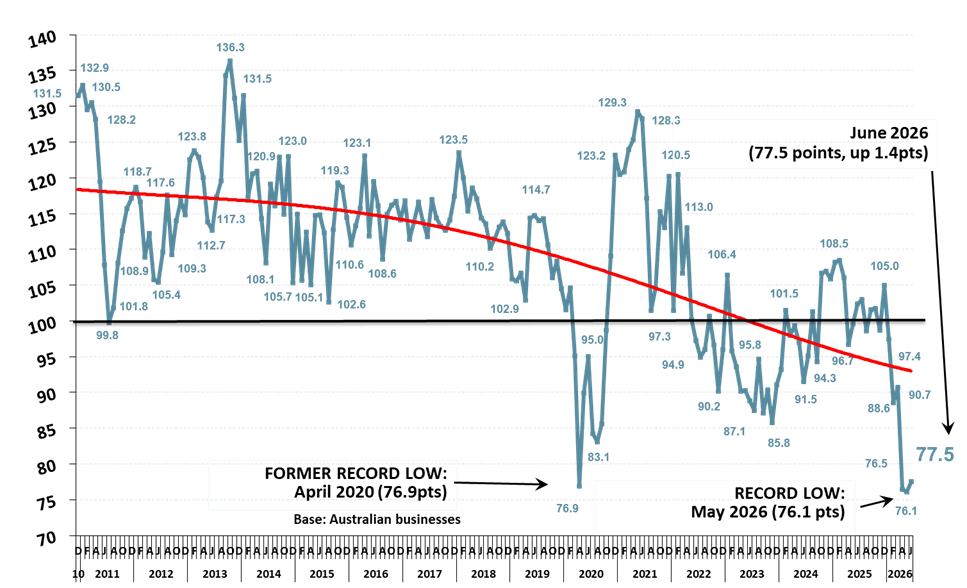
Source: Roy Morgan Business Single Source, Dec 2010-June 2026. Average monthly sample over the last 12 months = 1,180.
In June 2026 Business Confidence is below 90 in all six States for a second straight month
Year-on-year Business Confidence was down significantly (down 24.9 points from a year ago to 77.5).
All six States now have Business Confidence below the level of 90 for the second straight month, and the measure is down in all States from a year ago from between 9.5pts (New South Wales) and down by up to 45.2pts (Western Australia).
New South Wales now has the highest Business Confidence of any State – although still well into negative territory at only 83.4, down 9.5pts from a year ago. Business Confidence fell by 28.5pts in Queensland to only 78.1 and fell to 74.4 (down 32.2pts from a year ago) in Victoria.
Business Confidence fell by a large 20pts in the three other States. In South Australia, Business Confidence fell by 32.8pts to 71.2, in Tasmania the measure was down 22.5pts to 70.5, and in Western Australia, Business Confidence fell by 45.2pts to just 59.6 – the largest decline of any State.
Business Confidence by State in June 2025 vs June 2026
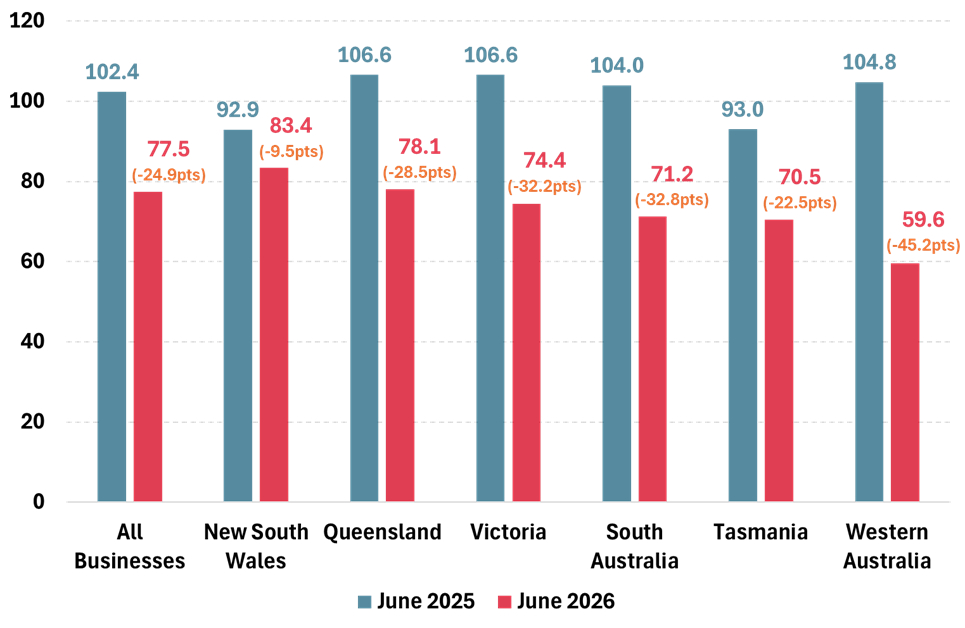
Source: Roy Morgan Business Single Source, June 2025, n=1,215, June 2026, n=1,109. Base: Australian businesses. *Tasmanian Business Confidence is measured over two months: May & June 2025 cf. May & June 2026.
Mining, Education & Training, Arts & Recreational Services and Electricity, Gas, Water & Waste Services are the most confident industries during the three months to June 2026
Over the last three months there was only one industry with Business Confidence in positive territory above 100 – Mining, which increased 31.2pts from a year ago to 114.9 is by far the most confident industry and the only industry to have higher Business Confidence than a year ago.
Other industries with higher-than-average Business Confidence, just below the neutral level of 100, are Education & Training on 98.7, down 11.9pts on a year ago, Arts & Recreational Services on 98.2, down 7.6pts, and Electricity, Gas, Water & Waste Services on 92.6, down 27.8pts.
There were five industries with Business Confidence below 70 including Accommodation & Food Services on 68.6, and down 56.7pts on a year ago, Construction on 66.7, down 27.3pts, Retail Trade on 66.5, down 41.4pts, Agriculture, Forestry & Fishing on 63.5, down 4.8pts, and Public Administration & Safety on only 63.2, down a massive 61pts on a year ago – clearly the largest decline of any industry.
Agriculture, Forestry & Fishing has had low Business Confidence for an extended period now with an average of only 79.5 since the beginning of 2023 – clearly the lowest of any industry.
Business Confidence for Top 5 and Bottom 5 Industries in April – June 2026
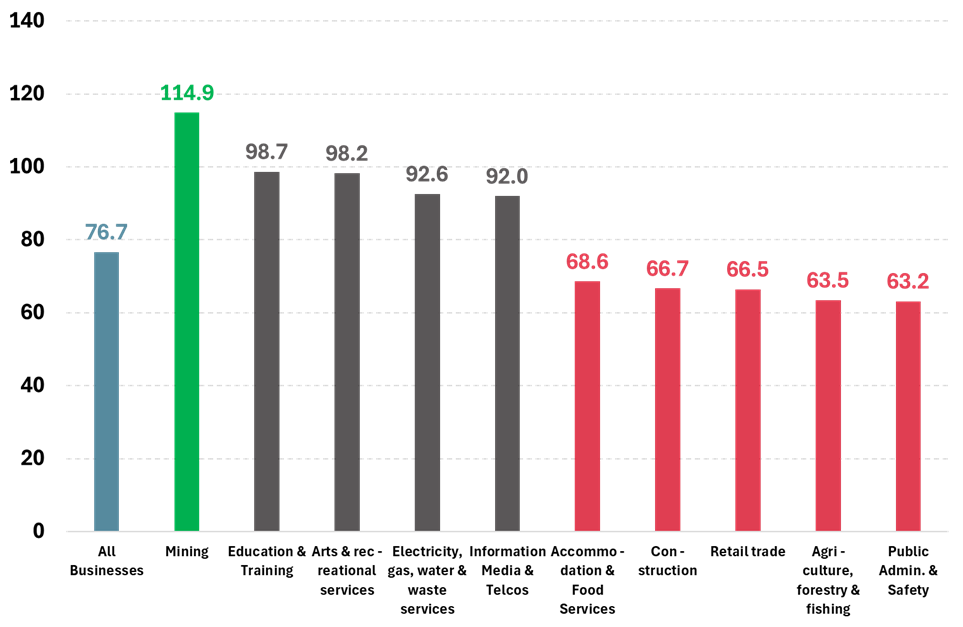
Source: Roy Morgan Business Single Source, April – June 2026, n=3,658. Base: Australian businesses.
Note: In the chart above, green bars represent Business Confidence in positive territory above the national average, red bars represent Business Confidence well below the national average and below the neutral level of 100 while the dark grey bar represents Business Confidence below the neutral level of 100 but still above the national average.
Business Confidence up marginally from all-time record low, up 1.4pts to 77.5 in June as businesses gained more confidence about the next 12 months:
- In June, over a quarter of businesses, 26.1% (up 0.9ppts), said their business is ‘better off’ financially than a year ago, while 51.4% (up 6.5ppts), said the business is ‘worse off’ (the highest figure for this indicator for over five years since October 2020);
- Businesses’ net views on their prospects for the next year improved in June with around a third, 33.4% (up 4.4ppts) expecting the business will be ‘better off’ financially this time next year, while under a third, 31.5% (down 2.6ppts), expect the business will be ‘worse off’;
- Confidence regarding the performance of the Australian economy over the next year improved with 41.6% (up 3.1ppts) expecting ‘good times’,while a majority of 57.1% (down 1.9ppts) expect ‘bad times’;
- Businesses’ views on the long-term future of the Australian economy over the next five years worsened slightly in June with just 18.7% (down 0.2ppts) expecting ‘good times’ over the next five years compared to a majority of 73.7% (up 1.7ppts) expecting ‘bad times’ (a record high for this indicator);
- Net sentiment on whether now is a ‘good or bad time to invest in growing the business’was improved slightly in June during the End Of Financial Year (EOFY) and Mid-Year Sales period with 29.4% (up 0.6ppts) saying the next 12 months will be a ‘good time to invest’ in growing the business while 47.8% (down 2.2ppts) say the next 12 months will be a ‘bad time to invest’.
Michele Levine, CEO of Roy Morgan, says Business Confidence stabilised in June, up 1.4pts to 77.5 after the Reserve Bank left interest rates unchanged at 4.35% in June, and inflation pressures in the economy continued to ease after spiking earlier in the year above 4% in March and April:

“Roy Morgan Business Confidence was up 1.4 points to 77.5 in June driven higher by more confidence about the next year for businesses’ own financial prospects as well as improving sentiment about the broader Australian economy.
“However, despite the small increase, Business Confidence in the June quarter 2026 is at a record low of 76.7, down 15.5pts from the March quarter 2026 (92.2). This is also below the previous record low of 84.3 during the September quarter 2020 amidst the COVID-19 pandemic.
“There was good news during June with the fragile ceasefire in the Middle East managing to hold and oil prices continuing to decline. Average retail petrol prices in June were at $1.67 a litre – the lowest monthly rate since January 2022 – before Russia’s invasion of Ukraine spiked prices.
“The fall in petrol prices has impacted Australian views on inflation. ANZ-Roy Morgan’s Inflation Expectations were at a record high of 7.3% in late March 2026 and have dropped by 1.7% points to 5.6% in the last week of June – indicating Australians are less worried about runaway inflation.
“In turn, the pressure on the Reserve Bank (RBA) to raise interest rates has abated after three successive rate increases early in 2026 the RBA left rates unchanged at 4.35% in mid-June.
“Businesses’ views on the Australian economy’s performance over the next year improved 5% points in June. Now 41.6% (up 3.1% points) of businesses expect ‘good times’ over the next year while 57.1% (down 1.9% points) of businesses expect ‘bad times’.
“In addition, views on businesses’ own prospects over the next year increased 7% points. Now a third of businesses, 33.4% (up 4.4% points) expect to be ‘better off’ this time next year compared to only 31.5% (down 2.6% points) that expect to be ‘worse off’.
“On a State-by-State basis Business Confidence is again below 90 in all six States. Business Confidence is at just 83.4 in New South Wales, and even lower in Queensland (78.1), Victoria (74.4), South Australia (71.2), Tasmania (70.5), and lowest of all in Western Australia at just 59.6.
“At an industry level, there is again only one industry (out of 18) with Business Confidence in positive territory above the neutral level of 100. By far the most confident industry over the last three months is the Mining industry on 114.9 – over 35 points above the national average.
“At the other end of the scale are several industries with low Business Confidence below 80 including Accommodation & Food Services (68.6), Construction (66.7), Retail Trade (66.5), Agriculture, Forestry & Fishing (63.5), and Public Administration & Safety (63.2).
“Confidence in the Agriculture, Forestry & Fishing industry has been at a sustained low level and has averaged only 79.5 since the start of 2023 – clearly the lowest average of any industry over this extended period.”
The latest Roy Morgan Business Confidence results for May are based on 1,181 detailed interviews with a cross-section of Australian businesses from each State and Territory. Detailed findings are available to purchase on a monthly or annual subscription as part of the Roy Morgan Business Confidence Report.
For comments or more information please contact:
Michele Levine
CEO, Roy Morgan
Office: +61 (3) 9224 5215
Mobile: 0411 129 093
To learn more about Roy Morgan’s Business Confidence, Consumer Confidence and Inflation Expectations data call (+61) (3) 9224 5309 or email askroymorgan@roymorgan.com.
About Roy Morgan
Roy Morgan is Australia’s largest independent Australian research company, with offices in each state, as well as in the U.S. and U.K. A full-service research organisation, Roy Morgan has over 80 years’ experience collecting objective, independent information on consumers.
Margin of Error
The margin of error to be allowed for in any estimate depends mainly on the number of interviews on which it is based. Margin of error gives indications of the likely range within which estimates would be 95% likely to fall, expressed as the number of percentage points above or below the actual estimate. Allowance for design effects (such as stratification and weighting) should be made as appropriate.
| Sample Size | Percentage Estimate |
| 40% – 60% | 25% or 75% | 10% or 90% | 5% or 95% | |
| 1,000 | ±3.0 | ±2.7 | ±1.9 | ±1.3 |
| 5,000 | ±1.4 | ±1.2 | ±0.8 | ±0.6 |
| 7,500 | ±1.1 | ±1.0 | ±0.7 | ±0.5 |
| 10,000 | ±1.0 | ±0.9 | ±0.6 | ±0.4 |
| 20,000 | ±0.7 | ±0.6 | ±0.4 | ±0.3 |
| 50,000 | ±0.4 | ±0.4 | ±0.3 | ±0.2 |


