


Magazine brands reach 14.5 million Australians across print and digital
More than 14.5 million Australian aged 14+ (62.2% of the population) now read magazines across print and digital according to the results released today from the Roy Morgan Australian Readership report for the 12 months to June 2026.
Print remains at the heart of the magazine ecosystem, reaching almost 10.9 million Australians, or 46.6% of the population, demonstrating the continuing ability of magazines to deliver audiences at scale.
The latest results are from the Roy Morgan Single Source survey of 59,959 Australians aged 14+ in the 12 months to June 2026.
Leading magazines Woman’s Day, Better Homes and Gardens, New Idea and The Australian Women’s Weekly all clearly exceed 1.6 million people in total cross-platform audiences**
Eight Australian magazines have total cross-platform audiences of over 1 million people led by Are Media’s Woman’s Day and Better Homes & Gardens, both mastheads with total cross platform audiences of well over 2.1 million people.
Filling out the top four, New Idea and The Australian Women’s Weekly both have cross-platform audiences of over 1.6 million. Take 5 (weekly) and TV Week also reach large audiences of over 1.5 million people. It is important to note The Australian Women's Weekly has launched its own stand-alone website offering a premium lifestyle experience for users which will supercharge the brand for content commerce.
Other magazines with large cross-platform audiences include Take 5 Bumper Monthly and National Geographic with total cross-platform audiences above 1.3 million, House & Garden and Vogue Australia** with exceptional cross-platform audiences of over 800,000.
Top 10 Magazines – Total Cross-Platform Audience*
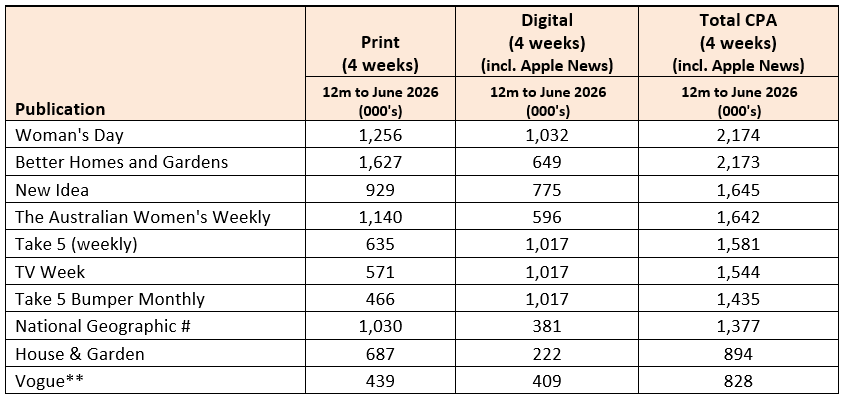
*Total cross-platform audience includes print (average issue readership) and digital (website visitation and app usage), in an average 4 weeks 12m to June 2026. All people 14+. **Vogue Australia digital numbers Roy Morgan iris from Jan 23; #National Geographic digital numbers Roy Morgan methodology; all other digital numbers Roy Morgan iris from Oct 25.
Seven magazine categories have a print readership of at least 1 million people
Food & Entertainment is by far Australia’s largest magazine category, reaching 6.3 million Australians, over 2 million ahead of any other category and reaching well over one-in-four Australians.
Home & Garden and General Interest magazines each reach around 4 million Australians, while Mass Women's magazines reach more than 2.3 million.
Business, Financial & Airline magazines reach almost 1.5 million Australians, followed by Health & Family at more than 1.2 million and Motoring at almost 1.1 million and up 10.5 per cent on a year ago.
There were increases in readership for Sports Magazines, up 17.9 per cent to 593,000, and Men’s Lifestyle Magazines, 27.3 per cent to 68,000 – powered by the increase for Esquire Australia magazine which is aimed squarely at well-educated and high-income younger men.
Better Homes and Gardens, The Australian Women’s Weekly and National Geographic are Australia’s most widely read paid magazines – each with over 1 million readers
Better Homes & Gardens is Australia's most widely read paid magazine, with a print readership of 1.627 million, followed by The Australian Women's Weekly, 1.14 million, and National Geographic, 1.03 million.
Filling out the top ten paid magazines are House & Garden with a readership of 687,000, Australian Geographic on 615,000, and up a large 20 per cent on a year ago, Woman’s Day on 582,000, That’s Life Mega Monthly on 476,000, Take 5 Bumper Monthly on 466,000, Gardening Australia on 458,000, up 0.7 per cent on a year ago, and Vogue Australia with on 439,000, and up 1.9 per cent on a year ago.
Coles Magazine & Fresh Ideas are again the most widely read magazines again in mid-2026
Australia's two most widely read free magazines are Coles Magazine and Fresh Ideas. Coles has a print readership of 4,465,000 ahead of Fresh Ideas (from Woolworths) with a print readership of 4,041,000.
Bunnings Magazine is the third most widely read free magazine with a print readership of 1,740,000 ahead of the NRMA’s Open Road with a readership of 1,226,000.
Other magazines to increase their print readership are Qantas Magazine, up 12.8 per cent to 607,000, Home Beautiful, up 9.8 per cent to 395,000, Forbes Australia, up a large 26.5 per cent to 386,000, Street Machine, up 0.9 per cent to 344,000, Diabetic Living, up 2.4 per cent to 322,000, Australian Gourmet Traveller, up 16.5 per cent to 321,000, and the Big Issue, up 15.6 per cent to a readership of 306,000.
The seven most read categories of magazines by print readership
- Food & Entertainment (6,316,000 Australians, 27.1% of the population);
- Home & Garden (3,996,000 Australians, 17.1% of the population);
- General Interest (3,965,000 Australians, 17.0% of the population);
- Mass Women’s (2,308,000 Australians, 9.9% of the population);
- Business, Financial & Airline (1,499,000 Australians, 6.4% of the population).
- Health & Family (1,215,000 Australians, 5.2% of the population);
- Motoring (1,080,000 Australians, 4.6% of the population).
Top 25 Magazines by print readership – June 2026 (Magazines in bold are up on a year ago)
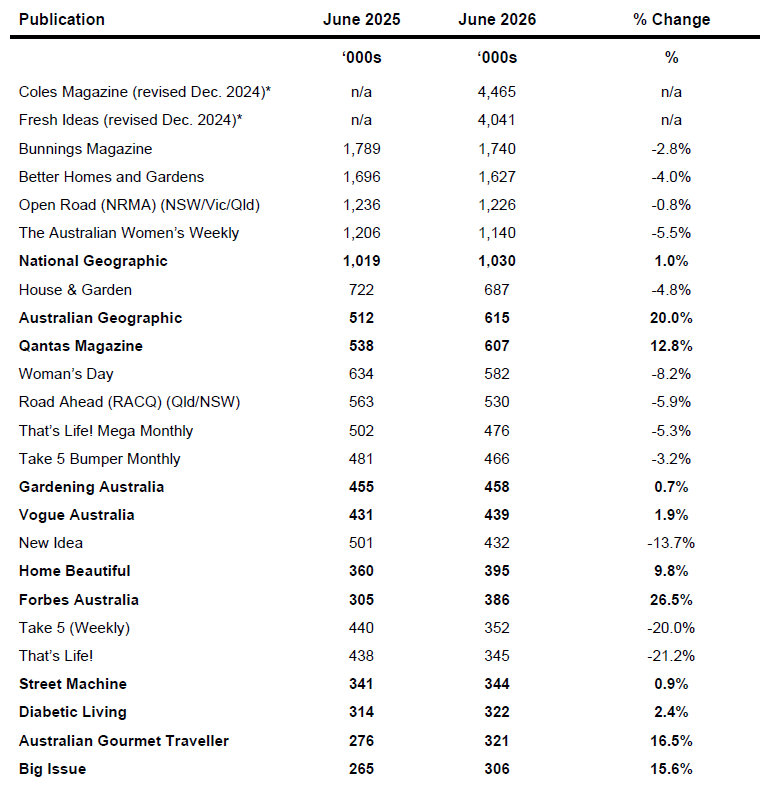
*The methodology revision in December 2024 means the figures for these magazines are not directly comparable year-over-year.
Overall, a total of 11 of the top 25 (top 23 comparable year-over-year – around half) most widely read magazines increased their readership over the last year.
Michele Levine, CEO, Roy Morgan, says over 62% of Australians read magazines in print or online – including eight magazines with cross-platform audiences of over 1 million people:

“The latest Roy Morgan results demonstrate the continuing strength and breadth of magazine audiences in Australia.
“More than 14.5 million Australians – almost two-thirds of the population – engage with magazine brands across print and digital, while print alone continues to reach almost 10.9 million Australians.
“There are standout results for several magazines with eight magazines reaching over 1 million people via their cross-platform audiences. Woman’s Day, Better Homes and Gardens, New Idea and The Australian Women’s Weekly are standouts each with cross-platform audiences over 1.6 million.
“For advertisers, the combination of mass reach, highly engaged audiences and clearly defined areas of interest continues to make magazine brands an important part of Australia’s media landscape. The strength of their digital audiences extends that opportunity further, with eight magazine brands now reaching more than one million Australians across print and digital.”
To learn more about Roy Morgan’s Readership research, call (+61) (3) 9224 5309 or email askroymorgan@roymorgan.com.
About Roy Morgan
Roy Morgan is Australia’s largest independent Australian research company, with offices in each state, as well as in the U.S. and U.K. A full-service research organisation, Roy Morgan has over 80 years’ experience collecting objective, independent information on consumers.
Margin of Error
The margin of error to be allowed for in any estimate depends mainly on the number of interviews on which it is based. Margin of error gives indications of the likely range within which estimates would be 95% likely to fall, expressed as the number of percentage points above or below the actual estimate. Allowance for design effects (such as stratification and weighting) should be made as appropriate.
| Sample Size | Percentage Estimate |
| 40% – 60% | 25% or 75% | 10% or 90% | 5% or 95% | |
| 1,000 | ±3.0 | ±2.7 | ±1.9 | ±1.3 |
| 5,000 | ±1.4 | ±1.2 | ±0.8 | ±0.6 |
| 7,500 | ±1.1 | ±1.0 | ±0.7 | ±0.5 |
| 10,000 | ±1.0 | ±0.9 | ±0.6 | ±0.4 |
| 20,000 | ±0.7 | ±0.6 | ±0.4 | ±0.3 |
| 50,000 | ±0.4 | ±0.4 | ±0.3 | ±0.2 |


