


In mid-2026 over 2.5 million New Zealanders read newspapers and more than 1.6 million read magazines

Roy Morgan readership results for New Zealand’s newspapers and magazines for the 12 months to June 2026.
Of New Zealanders aged 14+ - 57.4%, an estimated 2.52 million, now read or access newspapers in an average 7-day period via print or online (website or app) platforms. In addition, 37.6% - an estimated 1.65 million New Zealanders aged 14+, read magazines whether in print or online either via the web or an app.
These are the latest findings from the Roy Morgan New Zealand Single Source survey of 6,410 New Zealanders aged 14+ over the 12 months to June 2026.
New Zealand Herald is most widely read, over four times the audience of second placed The Post
In the 12 months to June 2026 New Zealand’s most widely read publication is the New Zealand Herald with a total cross-platform audience of 1,742,000, over four times the audience of any other newspaper. In second place, reaching an audience of 395,000, is The Post, following an increase of 40,000 (+11.2%) on a year ago.
The third placed The Press reaches a total cross-platform audience of 279,000, following an increase of 12,000 (+4.7%) on a year ago ahead of the fourth-placed Otago Daily Times, with an audience of 264,000, and the Waikato Times with a total cross-platform audience of 196,000.
Other widely read titles include the Sunday Star-Times with an audience of 173,000, the Bay of Plenty Times with an audience of 141,000, Hawke’s Bay Today with an audience of 133,000, the Northern Advocate with an audience of 127,000, and the Taranaki Daily News with an audience of 111,000.
Just outside the top ten most widely read newspapers is the Manawatu Standard with an audience of 107,000 following an impressive increase of 11,000 (+11.4%) on a year ago.
Top 10 Newspapers – Total 7 Day Cross-Platform Audience (Print & Online)
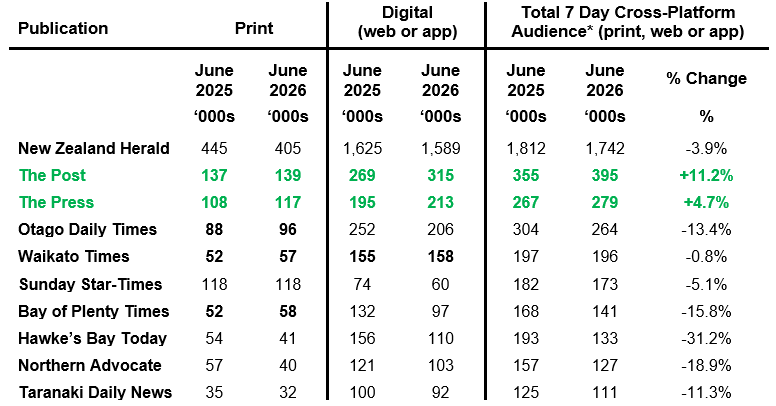
*Cross-Platform Audience is the number of New Zealanders who have read or accessed individual newspaper content via print or online. Print is net readership in an average 7 days. Online is net readership online in an average 7 days.
22 magazines increased their ‘average issue print readership’ in the year to June 2026
Roy Morgan New Zealand’s latest figures show that 23 of the 45 magazines measured increased their print readership during the year to June 2026 compared to a year earlier.
New Zealand’s most widely read magazine is the driving magazine AA Directions which had an average issue readership of 397,000 in the year to June 2026, following an increase of 30,000 (+8.1%) on a year ago – almost 200,000 ahead of any other magazine.
In a clear second place for print readership was the New Zealand Listener with an average issue readership of 198,000.
In third place is Fish & Game NZ with a print readership of 147,000, following an impressive increase of 32,000 (+27.4%) on a year ago, just ahead of Kia Ora (Air New Zealand’s inflight magazine) with a print readership of 132,000 after an increase of 9,000 (+7.6%) on a year ago.
There are three other magazines with a print readership of 100,000 or more including NZ Woman’s Day with a print readership of 122,000, Dish on 103,000, and the TV Guide on 100,000.
Filling out the top ten most widely read magazines is Cuisine with a print readership of 99,000, up 4,000 (+4%) on a year ago, Habitat with a print readership of 90,000, and Consumer, with a print readership of 85,000, and up a large 36,000 (+72.3%) on a year ago, the largest increase of any magazine.
Other magazines to grow their readership significantly included National Geographic, up 19,000 to a print readership of 59,000, NZ Autocar, up 16,000 to 30,000, NZ Fishing News, up 13,000 to 31,000, and NZ Classic Car, up 12,000 to 26,000.
There were 13 other magazines with increases to their average issue print readership led by Mindfood, up 4,000 to a print readership of 77,000, Heritage NZ, up 2,000 to 65,000, Bunnings Magazine, up 4,000 to 60,000, Home NZ, up 7,000 to 52,000, Your Home & Garden, up 8,000 to 51,000, NZ Geographic, up 3,000 to 48,000, That’s Life, up 3,000 to 41,000, Kiwi Gardener, up 1,000 to 40,000, Time, up 7,000 to 37,000, Wilderness, up 9,000 to 19,000, The Shed, up 4,000 to 18,000, Healthy Food Guide, up 1,000 to 17,000 and NZ Motorhomes, Caravans & Destinations, up 5,000 to 15,000.
New Zealand’s Top 10 Magazines by Average Issue Print Readership
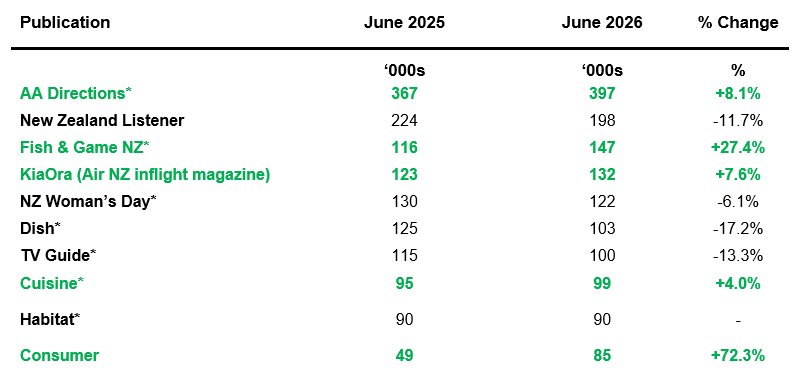
*Roy Morgan has measured additional readership for this magazine via Cross-Platform Audiences – see next section.
11 magazines in New Zealand have total cross-platform audiences of over 100,000
Roy Morgan’s latest total cross-platform audience figures for 15 leading magazines show that 11 of these magazines have total cross-platform audiences of over 100,000.
AA Directions is still easily New Zealand’s most widely read magazine with a market-leading total cross-platform audience of 486,000, more than double that of any other magazine.
There is one other magazine with an audience of over 200,000, Fish & Game NZ, with a total cross-platform audience of 205,000, following an increase of 7,000 (+3.5%) on a year ago.
There are four other magazines with total cross-platform audiences of at least 150,000 led by Dish with a total cross-platform of 188,000, ahead of fourth placed NZ Woman’s Day on 171,000, NZ Gardener on 162,000.
Filling out the top ten magazines with the largest cross-platform audiences are Habitat and Australian Women’s Weekly NZ Edition both with total cross-platform audiences of 142,000, ahead of NZ Woman’s Weekly on 137,000, and in tenth place overall is Mindfood with a total cross-platform audience of 133,000.
Notably, another widely read magazine is Kiwi Gardener with a total cross-platform audience of 109,000, and there was a significant increase in audience for Time magazine, up 8,000 (+13.8%) to 63,000.
Top 10 Magazines – Total Cross-Platform Audience (Print & Online)
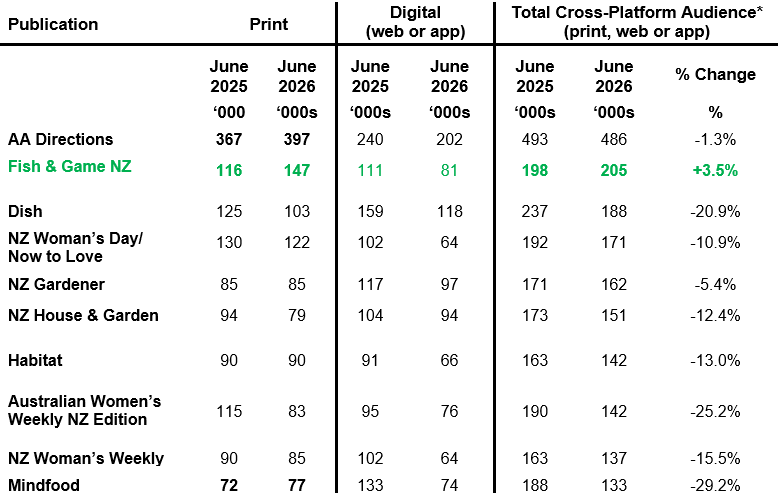
*Cross-platform audience is the number of New Zealanders who have read or accessed individual magazine content via print or online. Print is average issue readership. Digital is average website visitation and app usage (if available) in last 7 days for weekly titles (New Idea, New Zealand Listener, NZ Woman's Day, NZ Woman's Weekly, Property Press, That's Life, Time, TV Guide) and last 4 weeks for all other non-weekly titles.
Canvas is again easily the most widely read Newspaper Inserted Magazine in mid-2026
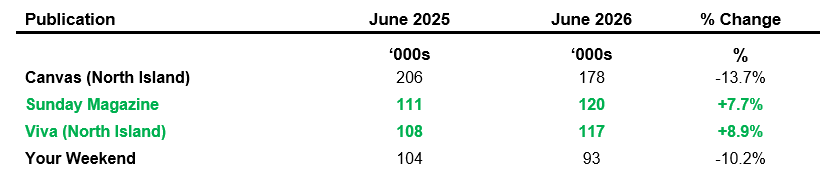
The New Zealand Herald’s Canvas(North Island) was clearly the most widely read Newspaper Inserted Magazine over the past year with a readership of 178,000.
In second place is the widely read Sunday Magazine with a readership of 120,000 following an increase of 9,000 (+7.7%) on a year ago just ahead of Viva (North Island) with a readership of 117,000, after an increase of 9,000 (+8.9%) on a year ago, and Your Weekend with a readership of 93,000.
New Zealand’s Leading Newspaper Inserted Magazines by Print Readership
Michele Levine, Chief Executive Officer, Roy Morgan, says:

“The latest Roy Morgan readership figures for New Zealand show over 2.5 million New Zealanders, (57.4% of the population aged 14+), now read or access newspapers in an average 7-day period via print or online (website or app).
“The leading newspaper is the NZ Herald with a total cross-platform audience of 1,742,000. The Herald is read by over four times as many people as the second placed The Post – read by 395,000, up 40,000 (+11.2%) on a year ago.
“Other widely read newspapers are The Press with a total cross-platform audience of 279,000, an increase of 12,000 (+4.7%) on a year ago, Otago Daily Times with an audience of 264,000, the Waikato Times with an audience of 196,000, and Sunday Star-Times with an audience of 173,000.
“Readership of print magazines is over 1.5 million representing more than a third of New Zealanders (35.9% of the population aged 14+). In addition, the total cross-platform audience of magazines is even higher at 1.65 million (37.6% of the population aged 14+).
“There were several outstanding performers over the last year with print readership increases for nearly half of the magazines measured – 23/45. In an impressive result, the print readership of over a quarter of New Zealand magazines (12/45) increased by over 15% from a year ago.
“By far the most widely read magazine in New Zealand is AA Directions, the quarterly magazine from Automobile Association with a print readership of 397,000, following an increase of 30,000 (+8.1%) on a year ago, and a cross-platform audience of almost half-a-million – 486,000.
“In second place is Fish & Game NZ with a print readership of 147,000, and a cross-platform audience of 205,000 following an increase of 7,000 (+3.5%) on a year ago, and in third place is the bi-monthly Dish with a print readership of 103,000, and cross-platform audience of 188,000.
“Importantly, there were several leading magazines to increase their print readership over the last year including Kia Ora (Air New Zealand’s inflight magazine) with a print readership of 132,000 after an increase of 9,000 (+7.6%) on a year ago, Cuisine on 99,000, up 4,000 (+4%) on a year ago, Consumer on 85,000, after an increase of 36,000 (+72.3%) on a year ago – the largest increase of any magazine, and National Geographic, up 19,000 (+48.2%) to 59,000.
“These results demonstrate the continuing strength and resilience of magazine readership in New Zealand. Nearly half of the magazines measured increased their print readership over the past year, with a number recording substantial growth.
“More broadly, newspapers and magazines continue to reach millions of New Zealanders, demonstrating the enduring value of these channels in an increasingly fragmented media landscape.”
Related research findings
Download our latest profiles of New Zealanders who read different Newspapers or Magazines.
To learn more about Roy Morgan’s Readership results for New Zealand call +61 (3) 9224 5309 or email askroymorgan@roymorgan.com.
About Roy Morgan
Roy Morgan is Australia’s largest independent Australian research company, with offices in each state, as well as in the U.S. and U.K. A full-service research organisation, Roy Morgan has over 80 years’ experience collecting objective, independent information on consumers.
Margin of Error
The margin of error to be allowed for in any estimate depends mainly on the number of interviews on which it is based. Margin of error gives indications of the likely range within which estimates would be 95% likely to fall, expressed as the number of percentage points above or below the actual estimate. Allowance for design effects (such as stratification and weighting) should be made as appropriate.
| Sample Size | Percentage Estimate |
| 40% – 60% | 25% or 75% | 10% or 90% | 5% or 95% | |
| 1,000 | ±3.0 | ±2.7 | ±1.9 | ±1.3 |
| 5,000 | ±1.4 | ±1.2 | ±0.8 | ±0.6 |
| 7,500 | ±1.1 | ±1.0 | ±0.7 | ±0.5 |
| 10,000 | ±1.0 | ±0.9 | ±0.6 | ±0.4 |
| 20,000 | ±0.7 | ±0.6 | ±0.4 | ±0.3 |
| 50,000 | ±0.4 | ±0.4 | ±0.3 | ±0.2 |


