


Australian ‘real unemployment’ drops 1.1% to 10.6%, driven by an increase in employment and a decline in the workforce
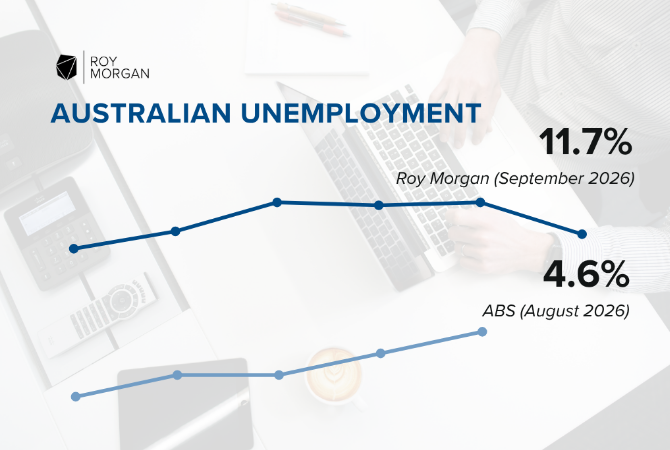
In September 2026, Roy Morgan estimates Australia’s ‘real unemployment’ dropped 1.1% to 10.6% (down 181,000 to 1,667,000) – the lowest for five months since April 2026.
In addition, there was an increase in employment, up 49,000 to 14,005,000, driven by a strong increase in part-time employment, up 102,000 to 5,046,000, although full-time employment fell 53,000 to 8,969,000.
The overall result of these changes was a decline in the overall workforce size (which adds together the employed and unemployed) to just under 15.7 million – 15,672,000 to be exact, down 132,000 on a month ago, and representing 66.6% (down 0.7% from August) of Australians aged 14+.
Overall employment represents 59.5% (up 0.1% from August) of Australians aged 14+.
In addition to the decrease in Australia’s ‘real unemployment’, down 181,000 to 1,667,000 (10.6% of the workforce, down 1.1%), under-employment decreased 71,000 to 1,374,000 (down 0.3% to 8.8%).
Detailed Roy Morgan Employment Estimates in September 2026:
- Australian workforce contracted in September as employment rose and people left the workforce:
In September the Australian workforce dropped 132,000 to 15,672,000 driven by a drop in ‘real unemployment’, down 181,000 to 1,667,000. In good news, employment increased 49,000 to 14,005,000.
- Increase in part-time employment drives overall rise in employment in September:
Overall employment increased 49,000 to 14,005,000 in September. The increase was driven by a rise in part-time employment, up 102,000 to 5,046,000, and equivalent to 36% of employed Australians. In contrast, full-time employment was down 53,000 to 8,959,000, equivalent to 64% of employed Australians.
- Unemployment dropped 1.1% to 10.6%, the lowest level for five months since April 2026:
In September, 1,667,000 Australians were unemployed (10.6% of the workforce, down 1.1%), down 181,000 from August. This decrease was driven by fewer people looking for both full-time work, down 43,000 to 692,000, and part-time work, down 138,000 to 975,000.
- Under-employment decreased 0.3% to 8.8% in September, down 71,000 to 1.37 million:
In addition to the unemployed, a further 1.37 million Australians (8.8% of the workforce, down 0.3%) were under-employed, i.e. working part-time but looking for more work, down 71,000. In total 3.04 million Australians (19.4% of the workforce, down 1.4%) were either unemployed or under-employed in September.
The September Roy Morgan Unemployment estimates were obtained by surveying an Australia-wide cross section of people aged 14+. A person is classified as unemployed if they are not employed and are looking for work, no matter when. The ‘real’ unemployment rate is presented as a percentage of the workforce (employed & unemployed).
Michele Levine, CEO Roy Morgan, says the latest Roy Morgan employment estimates for September shows some improvement in the labour markets with employment up, and both unemployment and under-employment down, but still a weak state overall:

“The latest Roy Morgan employment estimates for September show overall Australian unemployment and under-employment down 252,000 to 3,041,000 (19.4% of the workforce, down 1.4%). However, despite this good news, overall labour under-utilisation has now been above 3 million Australians for 22 straight months since late 2024.
“The fall in overall labour under-utilisation was due to decreases in ‘real employment’, down 181,000 to 1,667,000 (10.6% of the workforce, down 1.1%) and a drop in under-unemployment’, down 71,000 to 1,374,000 (8.8% of the workforce, down 0.3%).
“Helping drive the decline in labour under-utilisation was a rise in overall employment, up 49,000 to 14,005,000 – the largest increase for over six months after several falls in recent months. The main factor in rising employment was the increase in part-time employment, up 102,000 to 5,046,000, although full-time employment was down 53,000 to 8,959,000.
“The Roy Morgan ‘real unemployment’ estimate of 10.6% is more than double the latest official ABS unemployment estimate of 4.6% for August 2026 – but aligns more closely with broader official estimates of unemployment. The ABS Potential Workers survey shows 1.7 million Australians are not working but wanting to work – the ‘potential workers’ – an almost identical figure to Roy Morgan’s monthly estimate of 1.67 million.
“The weakness in the Australian labour market hasn’t been helped by the elevated inflation which has led to the Reserve Bank increasing interest rates four times so far this year by a total of 1% to a 15-year high of 4.6% – including a recent interest rate increase of +0.25% in late September.
“The latest ABS Inflation estimates for the 12 months to August 2026 show inflation at 4%, still clearly above the Reserve Bank’s target range of 2-3%. The continuing high inflation has led many to speculate that the Reserve Bank may well raise interest rates again before the end of the year.
“If the Reserve Bank decides to increase interest rates again this will add further pressure to an already weak labour market which has been struggling to grow during the last 12 months.”
This Roy Morgan survey on Australia’s unemployment and ‘under-employed’* is based on weekly interviews of 997,976 Australians aged 14 and over from January 2010 to September 2026 and includes 6,099 telephone and online interviews in September 2026. *The ‘under-employed’ are those people who are in part-time work or freelancers who are looking for more work.
To learn more about Roy Morgan’s mortgage data, call (+61) (3) 9224 5309 or email askroymorgan@roymorgan.com. Please click on this link to the Roy Morgan Online Store.
About Roy Morgan
Roy Morgan is Australia’s largest independent Australian research company, with offices in each state, as well as in the U.S. and U.K. A full-service research organisation, Roy Morgan has over 80 years’ experience collecting objective, independent information on consumers.
Margin of Error
The margin of error to be allowed for in any estimate depends mainly on the number of interviews on which it is based. Margin of error gives indications of the likely range within which estimates would be 95% likely to fall, expressed as the number of percentage points above or below the actual estimate. Allowance for design effects (such as stratification and weighting) should be made as appropriate.
| Sample Size | Percentage Estimate |
| 40% – 60% | 25% or 75% | 10% or 90% | 5% or 95% | |
| 1,000 | ±3.0 | ±2.7 | ±1.9 | ±1.3 |
| 5,000 | ±1.4 | ±1.2 | ±0.8 | ±0.6 |
| 7,500 | ±1.1 | ±1.0 | ±0.7 | ±0.5 |
| 10,000 | ±1.0 | ±0.9 | ±0.6 | ±0.4 |
| 20,000 | ±0.7 | ±0.6 | ±0.4 | ±0.3 |
| 50,000 | ±0.4 | ±0.4 | ±0.3 | ±0.2 |


