


Online retailers are leading Australia’s low-price perception shift, with cheap becoming even cheaper

As we head into peak retail season, new Roy Morgan research reveals that global online retailers are reshaping Australians’ perceptions of value, with “cheap” becoming even cheaper as most traditional discount stores lose their hold on price perception.
Who Owns the ‘Low Price’ Perception?
Kmart and Big W continue to lead on low-price perception, with 58% and 45% of Australians respectively associating these brands with the statement “has low prices”.
However, over the past five years, most traditional discount retailers have seen declines in this measure, while Amazon, Temu, and Shein have recorded notable gains.
- The Reject Shop: down 18% points since 2020.
- Big W: down 10% points.
- Target: down 7% points.
- Amazon: up 7% points over the same period.
The entry and rapid growth of Temu and Shein have accelerated this change. Since October 2024:
- Temu’s “low price” association has risen from 34% to 41% (+7% points) in the recent year, surpassing The Reject Shop.
- Shein has risen from 23% to 27% (+4% points) during this same period, now sitting on par with Bunnings & Target.
% of Australians 14+ who associate each store with ‘Has low prices’
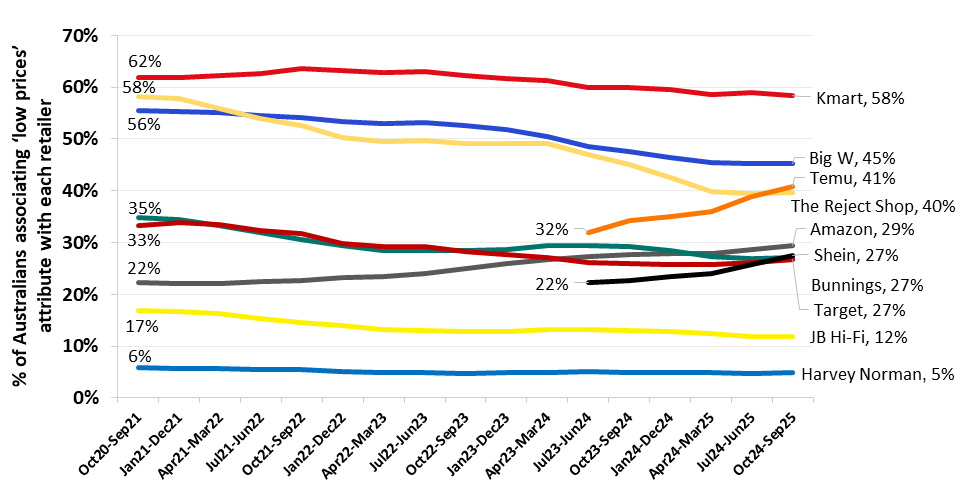
Source: Roy Morgan Single Source (Australia), October 2020 – September 2025. Average number of interviews for each 12 -month period, n=65,752. Base: Australians 14+. Question: Which, if any, of the following statements do you associate with each store – “Has low prices.”
The Reject Shop’s recent acquisition by Canadian retailer Dollarama is set to inject new competition into this segment, bringing deeper global sourcing capabilities and a sharper low-price focus to the market. However, Dollarama will be entering a far more competitive environment than The Reject Shop has competed, with online players now firmly reshaping what Australians perceive as ‘cheap.’
Catherine Jolley, Roy Morgan’s Head of Retail & Consumer Products says:

“Cheap is getting even cheaper. The rise of ultra-low-cost online marketplaces is recalibrating what consumers now consider a ‘normal’ price. The traditional price anchors, those mental reference points we all have for how much something should cost, have collapsed in some categories.
“Players like Temu, Shein, Amazon and soon Dollarama, are resetting those anchors and dragging price expectations down across the board.
“But there’s a caveat. This isn’t uniform. It’s most pronounced in discretionary categories like clothing, while other segments such as hardware have held their ground. The result? Pricing and positioning strategies are under real pressure, and it’s forcing many retailers to rethink where and how they compete.”
These are the latest insights from the Roy Morgan Single Source Retail Information: To understand where this price perception ‘recalibration’ is occurring, which brands are at greatest risk, and which consumers are still willing to pay more for the right product, and service mix, contact Catherine Jolley.
For comments or more information about Roy Morgan’s Retail data and insights please contact:
Roy Morgan Enquiries
Office: +61 (3) 9224 5309
askroymorgan@roymorgan.com
About Roy Morgan
Roy Morgan is Australia’s largest independent Australian research company, with offices in each state, as well as in the U.S. and U.K. A full-service research organisation, Roy Morgan has over 80 years’ experience collecting objective, independent information on consumers.
Margin of Error
The margin of error to be allowed for in any estimate depends mainly on the number of interviews on which it is based. Margin of error gives indications of the likely range within which estimates would be 95% likely to fall, expressed as the number of percentage points above or below the actual estimate. Allowance for design effects (such as stratification and weighting) should be made as appropriate.
| Sample Size | Percentage Estimate |
| 40% – 60% | 25% or 75% | 10% or 90% | 5% or 95% | |
| 1,000 | ±3.0 | ±2.7 | ±1.9 | ±1.3 |
| 5,000 | ±1.4 | ±1.2 | ±0.8 | ±0.6 |
| 7,500 | ±1.1 | ±1.0 | ±0.7 | ±0.5 |
| 10,000 | ±1.0 | ±0.9 | ±0.6 | ±0.4 |
| 20,000 | ±0.7 | ±0.6 | ±0.4 | ±0.3 |
| 50,000 | ±0.4 | ±0.4 | ±0.3 | ±0.2 |


