


Overall Australian unemployment and under-employment at 3.34 million in November – 12 months straight above 3 million
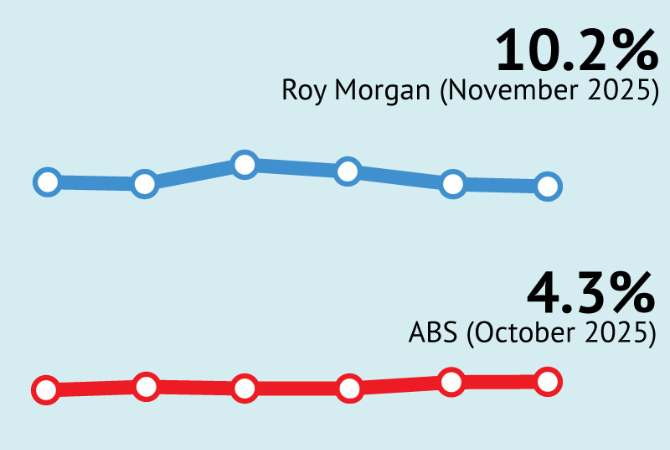
In November 2025, Australian ‘real’ unemployment was virtually unchanged at 1,628,000 (10.2% of the workforce), but under-employment increased 63,000 to 1,709,000 (up 0.3% to 10.7%).
Roy Morgan estimates the overall workforce size (which adds together the employed and unemployed) at just under 16 million in October – 15,967,000 to be exact, up 110,000 on a month ago, and representing 68.8% of Australians aged 14+.
The increase in the workforce was by a rise in employment, up 119,000 to 14,339,000. The good news is that full-time employment increased significantly, up 210,000 to 9,203,000, although part-time employment was down 91,000 to 5,136,000. Now overall employment represents 61.8% of Australians aged 14+.
Detailed Roy Morgan Employment Estimates in November:
- Australian workforce increased by 110,000 in November to just under 16 million:
In November the Australian workforce increased 110,000 to 15,967,000 driven by rising employment, up 119,000 to 14,339,000 with unemployment virtually unchanged at 1,628,000, down 9,000.
- Overall employment increased in November driven by a jump in full-time employment:
Australian employment increased 119,000 to 14,339,000 driven by a jump in full-time employment, up 210,000 to 9,203,000, and equivalent to 64.2% of employed Australians. However, part-time employment dropped by 91,000 to 5,136,000, and equivalent to 35.8% of employed Australians.
- Unemployment was virtually unchanged in November at 10.2%:
1,628,000 Australians were unemployed (10.2% of the workforce, down 0.1%), down 9,000 from October. There were fewer people looking for full-time work, down 89,000 to 599,000, which was largely offset by the rise in people looking for part-time work, up 80,000 to 1,029,000.
- Under-employment was up in November; overall unemployment and under-employed at 20.9%:
In addition to the unemployed, a further 1.71 million Australians (10.7% of the workforce, up 0.3%) were under-employed, i.e. working part-time but looking for more work, up 63,000 from October. In total 3.34 million Australians (20.9% of the workforce) were either unemployed or under-employed in November.
- Comparisons with three years ago, during the early days of the Albanese Government (Nov. 2022), show a rapidly increasing population and workforce driving employment growth:
The Australian population aged 14+ in November 2025 was estimated at 23,220,000 (up 1,809,000 from November 2022 – more than double the pre-pandemic average growth of 840,000 over a three-year period). The workforce in November 2025 was 15,967,000 (up 1,049,000 from three years ago) – comprising 14,339,000 employed Australians (up 759,000) and 1,628,000 unemployed Australians (up 290,000).
The November Roy Morgan Unemployment estimates were obtained by surveying an Australia-wide cross section of people aged 14+. A person is classified as unemployed if they are looking for work, no matter when. The ‘real’ unemployment rate is presented as a percentage of the workforce (employed & unemployed).
Roy Morgan Unemployment & Under-employment (2019-2025)
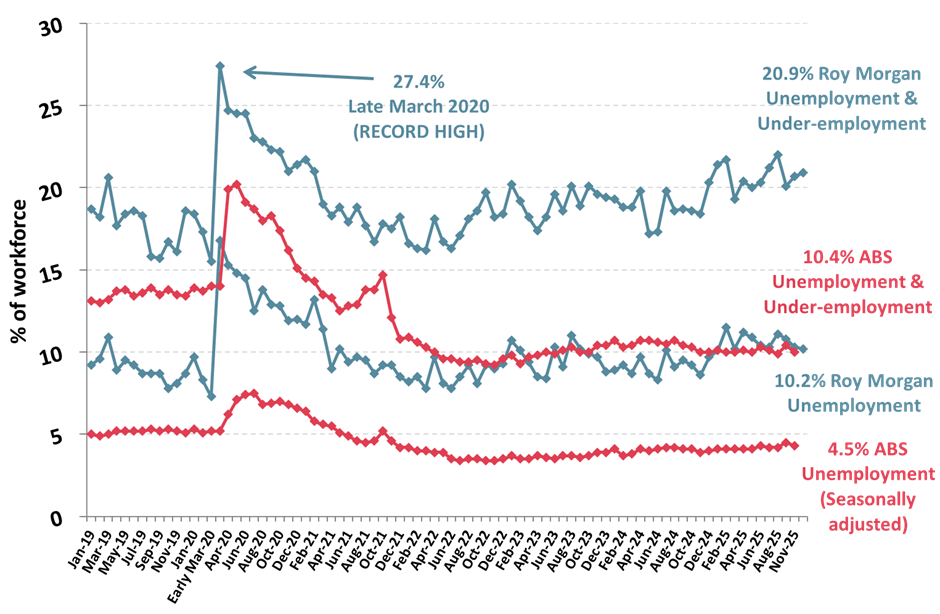
Source: Roy Morgan Single Source January 2019 – November 2025. Average monthly interviews 5,000.
Note: Roy Morgan unemployment estimates are actual data while the ABS estimates are seasonally adjusted.
Michele Levine, CEO Roy Morgan, says the latest Roy Morgan employment estimates for November show combined unemployment and under-employment continuing at a high level above 3 million for a 12th straight month:

“The latest Roy Morgan employment estimates for November show overall Australian unemployment and under-employment increasing 54,000 to 3,337,000 (20.9% of the workforce, up 0.2%). Concerningly, overall unemployment and under-employment have been above 3 million for a year.
“The increase in labour under-utilisation in November was driven by an increase in under-employment, up 63,000 to 1,709,000 (10.7% of the workforce, up 0.3%). Unemployment was 1,628,000 (10.2% of the workforce, down 0.1%).
“A look at the employment market over the last year shows little change in the overall picture with employment down from a year ago by 91,000 to 14,339,000. Full-time employment is down 64,000 to 9,203,000, and part-time employment is down 27,000 to 5,136,000 from a year ago indicating the economy has struggled to create new jobs over this period.
“Both unemployment and under-employment have increased markedly from a year ago with unemployment up 165,000 to 1,709,000 (10.7% of the workforce, up 0.9%) and under-employment is up 266,000 to 1,628,000 (10.2% of the workforce, up 1.6%). This means overall unemployment and under-employment has increased significantly by 431,000 to 3,337,000 (20.9%, up 2.5%).
“The sluggish labour market – with no net jobs created compared to a year ago – shows the low level of productivity in the Australian economy is stifling growth and leading to labour market stagnation.
“The latest ABS Inflation estimates for October 2025 showed official CPI jumping to 3.8% – the highest level of inflation for over a year since June 2024 (3.8%). Official estimates of inflation have doubled in only four months, up from 1.9% in June 2025.
“The biggest driver of inflation in the Australian economy is public spending – from Federal and State Governments – which crowds out private investment and reduces economic productivity. The solution to low productivity in Australia is for the Federal and State Governments to cut public spending which will reduce inflationary pressures in the economy and allow the Reserve Bank to cut interest rates.
“In the United States, the Federal Reserve cut interest rates in September and October and ‘across the ditch’ the Reserve Bank of New Zealand has cut interest rates nine times since August 2024 – including in both October 2025 (-0.5% to 2.5%), and November 2025 (-0.25% to 2.25%).
“In contrast, the Reserve Bank of Australia left interest rates on hold as inflation has accelerated.
“As the latest Roy Morgan employment and unemployment estimates show, the Australian economy needs the chance to grow and increase productivity that can be provided by a cut to Government spending, and lower interest rates throughout the economy.
“As long as the Albanese Government continues to increase public spending the economy will remain sluggish and over 3 million Australians will continue to be unemployed or under-employed.”
This Roy Morgan survey on Australia’s unemployment and ‘under-employed’* is based on weekly interviews of 993,449 Australians aged 14 and over between December 2008 and November 2025 and includes 7,079 telephone and online interviews in November 2025. *The ‘under-employed’ are those people who are in part-time work or freelancers who are looking for more work.
To learn more about Roy Morgan’s mortgage data, call (+61) (3) 9224 5309 or email askroymorgan@roymorgan.com. Please click on this link to the Roy Morgan Online Store.
About Roy Morgan
Roy Morgan is Australia’s largest independent Australian research company, with offices in each state, as well as in the U.S. and U.K. A full-service research organisation, Roy Morgan has over 80 years’ experience collecting objective, independent information on consumers.
Margin of Error
The margin of error to be allowed for in any estimate depends mainly on the number of interviews on which it is based. Margin of error gives indications of the likely range within which estimates would be 95% likely to fall, expressed as the number of percentage points above or below the actual estimate. Allowance for design effects (such as stratification and weighting) should be made as appropriate.
| Sample Size | Percentage Estimate |
| 40% – 60% | 25% or 75% | 10% or 90% | 5% or 95% | |
| 1,000 | ±3.0 | ±2.7 | ±1.9 | ±1.3 |
| 5,000 | ±1.4 | ±1.2 | ±0.8 | ±0.6 |
| 7,500 | ±1.1 | ±1.0 | ±0.7 | ±0.5 |
| 10,000 | ±1.0 | ±0.9 | ±0.6 | ±0.4 |
| 20,000 | ±0.7 | ±0.6 | ±0.4 | ±0.3 |
| 50,000 | ±0.4 | ±0.4 | ±0.3 | ±0.2 |


