


Risk of mortgage stress up 1.4% points in April after the Reserve Bank raised interest rates in February and March

New research from Roy Morgan shows 28.2% of mortgage holders ‘At Risk’ of ‘mortgage stress’ in the three months to April 2026, up 1.4% points from March 2026, after the Reserve Bank raised interest rates in February 2026 (+0.25%) and March 2026 (+0.25%) to 4.1% in March.
A share of 28.2% of mortgage holders ‘At Risk’ of mortgage stress is equivalent to 1,473,000 people – up 26,000 on a month ago. The record high of 35.6% of mortgage holders ‘At Risk’ of mortgage stress was reached back in mid-2008 during the Global Financial Crisis (GFC).
The number of Australians ‘At Risk’ of mortgage stress is marginally up on a year ago
The number of Australians ‘At Risk’ of mortgage stress is marginally up on a year ago after the Reserve Bank cut interest rates in May 2025 (-0.25%) and August 2025 (-0.25%) but then raised them back up in February 2026 (+0.25%) and again in March 2026 (+0.25%). As a result of these changes, interest rates were at 4.1% in March 2026 and identical to a year earlier.
The number of Australians considered ‘Extremely At Risk’, is now numbered at 1,069,000 (20.5% of mortgage holders) which is significantly above the long-term average over the last two decades of 16.3%.
Mortgage Stress – % of Owner-Occupied Mortgage-Holders
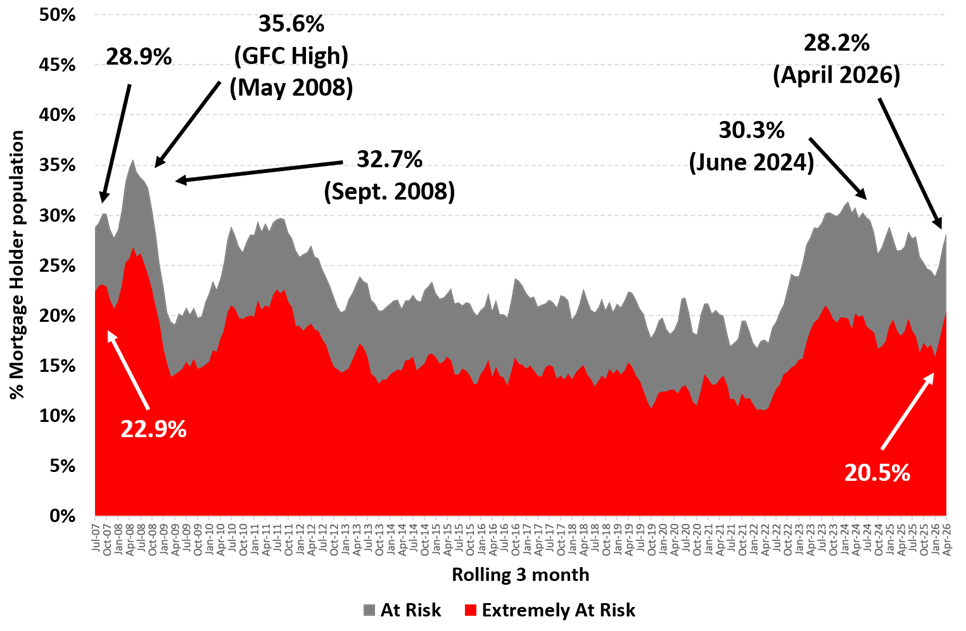
Source: Roy Morgan Single Source (Australia), average interviews per 3 month period April 2007 – April 2026, n=2,891. Base: Australians 14+ with owner occupied home loan.
Mortgages ‘At Risk’ is set to rise if the Reserve Bank increases interest rates in June
The Reserve Bank raised interest rates in February, March and again in May by a total of 0.75% to 4.35%. These increases were due to the official ABS annual inflation rate more than doubling from 1.9% in the year to June 2025 to 4.6% in the year to March 2026.
Because of this, Roy Morgan modelled the impact of the RBA interest rate increase in May (+0.25% to 4.35%) and a potential RBA interest rate increase at its June 2026 meeting (+0.25% to 4.6%).
In April, 28.2% of mortgage holders (1,473,000) were considered ‘At Risk’. Following the RBA’s decision to increase interest rates in May the share ‘At Risk’ is set to increase to an estimated 29.8% (up 1.6% points from April) in May and equivalent to 1,552,000 mortgage holders (up 79,000).
If the RBA raises rates in June by 0.25% to 4.6% the share of mortgage holders ‘At Risk’ would increase to 30.2% – up 2% points from now and equivalent to 1,577,000 mortgage holders, up 104,000 from now.
Looking forward, the share of mortgage holders ‘At Risk’ would increase to 30.7% in July – up 2.5% points from now and equivalent to 1,599,000 mortgage holders, up 126,000 from now.
Mortgage Risk projections based on an interest rate increase in June 2026 by 0.25% to 4.6%
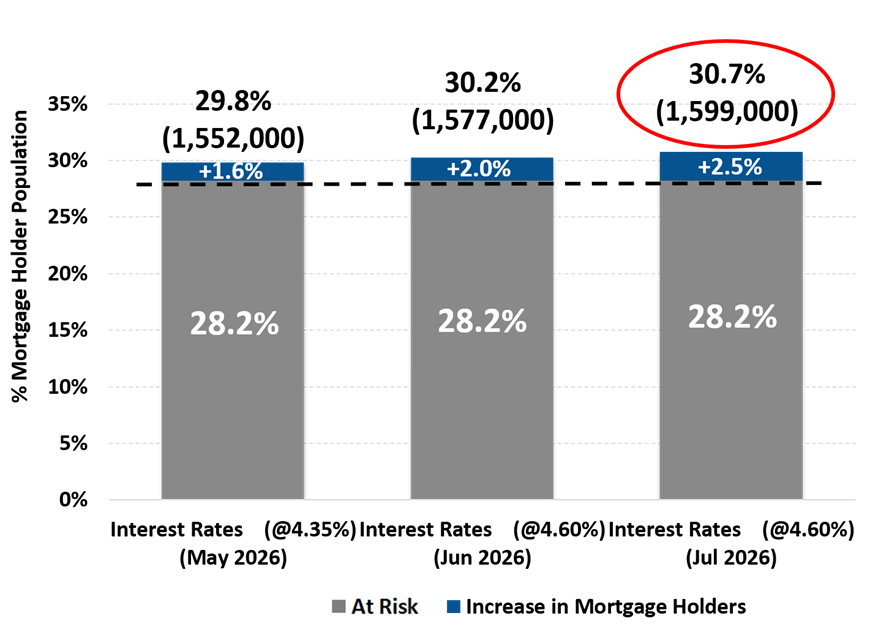
Source: Roy Morgan Single Source (Australia), February 2026 – April 2026, n=3,442.
Base: Australians 14+ with owner occupied home loan.
How are mortgage holders considered ‘At Risk’ or ‘Extremely At Risk’ determined?
Roy Morgan considers the risk of ‘mortgage stress’ among mortgage holders in two ways:
Mortgage holders are considered ‘At Risk’[1] if their mortgage repayments are greater than a certain percentage of household income – depending on income and spending.
Mortgage holders are considered ‘Extremely at Risk’[2] if even the ‘interest only’ is over a certain proportion of household income.
Unemployment is the key factor which has the largest impact on income and mortgage stress
It is worth understanding that Roy Morgan uses a conservative forecasting model, essentially assuming all other factors apart from interest rates remain the same.
The latest Roy Morgan unemployment estimates show over one-in-five Australian workers are either unemployed or under-employed – 3,274,000 (20.3% of the workforce); (In April, overall Australian unemployment and under-employment was at 3.27 million, ‘Real unemployment’ at 1.63 million).
Although the Reserve Bank’s decision to cut interest rates three times last year had a positive impact and helped lower mortgage stress, since the turn of the year the Reserve Bank has reversed course and has now increased interest rates on three occasions already this year in February, March, and most recently in May.
Despite the actions of the Reserve Bank, the fact remains the greatest impact on an individual, or household’s, ability to pay the mortgage is not interest rates, it’s if they lose their job or main source of income. In addition, the intense economic uncertainty provided by the renewed conflict in the Middle East has pushed energy prices higher in recent months and will add further pressure to inflation throughout the remainder of the year.
Michele Levine, CEO Roy Morgan, says the Reserve Bank’s decision to raise interest rates three times this year has already reversed the three cuts made last year and increased the rate of mortgage stress significantly in the last few months:

“The latest Roy Morgan data shows mortgage stress in April 2026 rising for a third straight month after hitting a three-year low, up 1.4% points from March to 28.2% of mortgage holders (equivalent to 1,473,000) ‘At Risk’ – up 26,000 from a month ago, 1,447,000).
“The rise in mortgage stress was caused by the Reserve Bank’s decision to raise interest rates by +0.25% in February and by +0.25% in March to a total of 4.1% which followed the rate of official inflation more than doubling from 1.9% in the year to June 2025 to 4.6% in the year to March 2026.
“The Reserve Bank’s decision to raise interest rates again in May by +0.25% to 4.35% is set to increase mortgage stress even further to 29.8% in May 2026, equivalent to 1,552,000 mortgage holders.
“In addition, Roy Morgan has modelled a potential interest rate increase in June of +0.25% to 4.6% – which would be the highest level of interest rates for nearly 15 years since November 2011. If the RBA does raise interest rates again in June, the level of mortgage stress would rise to 1,599,000 (30.7% of mortgage holders) by July 2026.
‘The conflict in the Middle East which began after Israel and the US attacked Iran and led to the closure of the Strait of Hormuz, through which a large share of the world’s energy usually transits, has introduced a considerable amount of uncertainty into global economic forecasts.
“The official ABS Consumer Price Index for March 2026, the first month of the conflict, showed a sharp jump in official inflation from 3.7% (February 2026) up to 4.6% (March 2026) – an increase of 0.9% points in the first month of the war. The rising inflation is set to put additional pressure on the Reserve Bank to raise interest rates again in the months ahead.
“The good news is that the inflationary pressures have lessened since March with the three-month cut to the fuel excise until June 30 helping to send average retail petrol prices down by around 70 cents per litre since peaking in late March at over $2.50 per litre.
“Finally, it is important to appreciate that interest rates are only one of the variables that determines whether a mortgage holder is considered ‘At Risk’ – the largest impact on whether a borrower falls into the ‘At Risk’ category is related to household income – which is directly related to employment.
“The employment market has been strong over the last four years (Roy Morgan estimates show over 1.2 million new jobs have been created since the Albanese Government was elected in May 2022) and this has provided support to household incomes which have helped to moderate levels of mortgage stress despite interest rates being significantly higher than in May 2022.”
[1] "At Risk" is based on those paying more than a certain proportion of their after-tax household income (25% to 45% depending on income and spending) into their home loan, based on the appropriate Standard Variable Rate reported by the RBA and the amount they initially borrowed.
[2] "Extremely at Risk" is also based on those paying more than a certain proportion of their after-tax household income (25% to 45% depending on income and spending) into their home loan, based on the Standard Variable Rate set by the RBA and the amount now outstanding on their home loan.
To learn more about Roy Morgan’s mortgage data, call (+61) (3) 9224 5309 or email askroymorgan@roymorgan.com. Please click on this link to the Roy Morgan Online Store.
About Roy Morgan
Roy Morgan is Australia’s largest independent Australian research company, with offices in each state, as well as in the U.S. and U.K. A full-service research organisation, Roy Morgan has over 80 years’ experience collecting objective, independent information on consumers.
Margin of Error
The margin of error to be allowed for in any estimate depends mainly on the number of interviews on which it is based. Margin of error gives indications of the likely range within which estimates would be 95% likely to fall, expressed as the number of percentage points above or below the actual estimate. Allowance for design effects (such as stratification and weighting) should be made as appropriate.
| Sample Size | Percentage Estimate |
| 40% – 60% | 25% or 75% | 10% or 90% | 5% or 95% | |
| 1,000 | ±3.0 | ±2.7 | ±1.9 | ±1.3 |
| 5,000 | ±1.4 | ±1.2 | ±0.8 | ±0.6 |
| 7,500 | ±1.1 | ±1.0 | ±0.7 | ±0.5 |
| 10,000 | ±1.0 | ±0.9 | ±0.6 | ±0.4 |
| 20,000 | ±0.7 | ±0.6 | ±0.4 | ±0.3 |
| 50,000 | ±0.4 | ±0.4 | ±0.3 | ±0.2 |


