


June ‘Real Unemployment’ in Australia up 1% to 11.7%
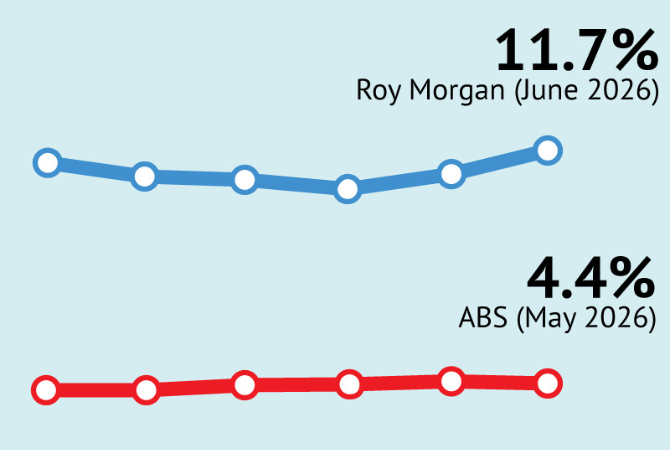
In June 2026, Australian ‘real’ unemployment increased 156,000 to 1,860,000 (11.7% of the workforce, up 1%), and under-employment dropped 15,000 to 1,488,000 (down 0.1% to 9.4%).
Roy Morgan estimates the overall workforce size (which adds together the employed and unemployed) at just under 15.9 million in June – 15,888,000 to be exact, up 28,000 on a month ago, and representing 67.7% of Australians aged 14+.
The workforce increase was driven by a rise in unemployment, up 156,000 to 1,860,000. There were increases for full-time unemployment, up 93,000 to 693,000, and part-time unemployment, up 63,000 to 1,167,000. In contrast, overall employment was down 128,000 to 14,028,000. Overall employment now represents 59.7% of Australians aged 14+.
Detailed Roy Morgan Employment Estimates in June 2026:
- Australian workforce increased by 28,000 in June to just under 15.9 million:
In June the Australian workforce increased 28,000 to 15,888,000 driven by the increase in unemployment, which was up 156,000 to 1,860,000. In contrast, overall employment decreased 128,000 to 14,028,000.
- Full-time employment increased and part-time employment decreased in June:
Overall employment was down 128,000 to 14,028,000 in June. The fall was driven by a fall in part-time employment, down 279,000 to 4,956,000, and equivalent to 35.3% of employed Australians. In contrast, full-time employment was up 151,000 to 9,072,000, equivalent to 64.7% of employed Australians.
- Unemployment increased 1% to 11.7% driven by increases in full and part-time unemployment:
In June, 1,860,000 Australians were unemployed (11.7% of the workforce, up 1%), up 156,000 from May. This increase was driven by more people looking for part-time work, up 63,000 to 1,167,000, and more people looking for full-time work, up 93,000 to 693,000.
- Under-employment was virtually unchanged at 9.4% in June:
In addition to the unemployed, a further 1.49 million Australians (9.4% of the workforce, down 0.1%) were under-employed, i.e. working part-time but looking for more work, down 15,000 from May. In total 3.35 million Australians (21.1% of the workforce) were either unemployed or under-employed in June.
The June Roy Morgan Unemployment estimates were obtained by surveying an Australia-wide cross section of people aged 14+. A person is classified as unemployed if they are looking for work, no matter when. The ‘real’ unemployment rate is presented as a percentage of the workforce (employed & unemployed).
Michele Levine, CEO Roy Morgan, says the latest Roy Morgan employment estimates for June show continued weakness in the labour markets with combined unemployment and under-employment continuing at a high level above 3 million for a 19th straight month:

“The latest Roy Morgan employment estimates for June show overall Australian unemployment and under-employment up 141,000 to 3,348,000 (21.1% of the workforce, up 0.9%). Labour under-utilisation has now been above 3 million Australians for 19 straight months since late 2024.
“The increase in labour under-utilisation was due to a rise in unemployment, up 156,000 to 1,860,000 (11.7% of the workforce, up 1%). In contrast, under-employment decreased slightly by15,000 to 1,488,000 (9.4% of the workforce, down 0.1%).
“Most concerningly, there was a fall in employment, down 128,000 to 14,028,000, and now down for a fourth straight month. This fall was driven by a decline in part-time employment which fell 279,000 to 4,956,000. In contrast, full-time employment was up 151,000 to 9,072,000.
“Although the rise in full-time employment is positive, the labour force estimates show employment markets remain weak with part-time employment down for two straight months and overall employment down from earlier this year.
“Treasurer Jim Chalmer’s Federal Budget delivered in early May received much criticism from some commentators due to the proposed changes to the treatment of capital gains taxation and negative gearing treatment of investment properties.
“However, the main measure of the success of a Federal Budget is whether it gets the economy moving and helps create jobs for all who want one. The early signs are that the Budget has not provided an immediate boost to the economy or the employment markets.”
This Roy Morgan survey on Australia’s unemployment and ‘under-employed’* is based on weekly interviews of 978,573 Australians aged 14 and over from January 2010 to June 2026 and includes 6,134 telephone and online interviews in June 2026. *The ‘under-employed’ are those people who are in part-time work or freelancers who are looking for more work.
To learn more about Roy Morgan’s mortgage data, call (+61) (3) 9224 5309 or email askroymorgan@roymorgan.com. Please click on this link to the Roy Morgan Online Store.
About Roy Morgan
Roy Morgan is Australia’s largest independent Australian research company, with offices in each state, as well as in the U.S. and U.K. A full-service research organisation, Roy Morgan has over 80 years’ experience collecting objective, independent information on consumers.
Margin of Error
The margin of error to be allowed for in any estimate depends mainly on the number of interviews on which it is based. Margin of error gives indications of the likely range within which estimates would be 95% likely to fall, expressed as the number of percentage points above or below the actual estimate. Allowance for design effects (such as stratification and weighting) should be made as appropriate.
| Sample Size | Percentage Estimate |
| 40% – 60% | 25% or 75% | 10% or 90% | 5% or 95% | |
| 1,000 | ±3.0 | ±2.7 | ±1.9 | ±1.3 |
| 5,000 | ±1.4 | ±1.2 | ±0.8 | ±0.6 |
| 7,500 | ±1.1 | ±1.0 | ±0.7 | ±0.5 |
| 10,000 | ±1.0 | ±0.9 | ±0.6 | ±0.4 |
| 20,000 | ±0.7 | ±0.6 | ±0.4 | ±0.3 |
| 50,000 | ±0.4 | ±0.4 | ±0.3 | ±0.2 |


