


ALP maintains election-winning lead; but One Nation support increases and now ahead of ALP on primary vote

This week One Nation primary support is up 5.5% to 28% and now ahead of ALP down 0.5% to 27.5%, L-NP Coalition, down 1.5% to 20% - Liberals 17.5% (down 1.5%) and Nationals 2.5% (unchanged), Greens down 1.5% to 12.5%, and Independents/ Other Parties down 2% at 12% according to the Roy Morgan Poll conducted from July 6-12, 2026, with a representative Australia-wide cross-section of 1,612 electors.
This week’s increase in support for One Nation (up 5.5% points to 28%), puts an end to two weeks of declines in support (-9% points) following One Nation Leader Pauline Hanson’s address to the National Press Club in mid-June a month ago.
However, if a Federal Election were held now the ALP would win a majority against either One Nation or the L-NP Coalition
In many electorates at the Election the contest is set to be between the ALP and One Nation. When preferences are allocated for Coalition, Greens, Independent, and Other Party supporters between the ALP and One Nation, Roy Morgan estimates the ALP 52.5% (down 3.5%) in front of One Nation 47.5% (up 3.5%).
If the contest is between the ALP and L-NP, on a two-party preferred basis (based on how electors said they’d ’vote’ their preferences), the ALP is also ahead – ALP 54% (down 1%) cf. L-NP 46% (up 1%). However, when preferences are allocated based on how Australians voted at the 2025 Federal Election the gap is closer, ALP 52.5% (down 1.5%) leads L-NP 47.5% (up 1.5%).
The complicated nature of the next Federal Election means there will be contests between the ALP and One Nation, the ALP and L-NP Coalition, One Nation and the L-NP Coalition, and any three of these parties against the Greens, Teal Independents, and other minor parties such as Katter’s Australian Party (KAP).
Roy Morgan will be providing an extensive analysis of the Australia’s 150 Federal Electorates in the next few weeks using the Helix Personas psychographic consumer segmentation and data integration tool which provides unique and incisive insights into the minds of Australian electors.
This week Roy Morgan Government Confidence Rating down 6.5pts to 61 – almost 40 points below the neutral level of 100
This week Roy Morgan Government Confidence Rating dropped 6.5 points to 61. A large majority of 62.5% (up 3.5% points) of Australians say the country is ‘going in the wrong direction’. Only 23.5% (down 3% points) say the country is ‘going in the right direction’.
There are considerable differences in the Government Confidence Rating by party. Government Confidence among ALP supporters decreased 4.5 points to 127.5. However, for supporters of all other parties, Government Confidence continues to be below the neutral level of 100.
Greens supporters have Government Confidence of 78 (down 6.5 points), above L-NP Coalition supporters on 35 (unchanged), supporters of Independents/ Other Parties have Government Confidence of 55.5 (down 2pts) and One Nation supporters have a Government Confidence Rating of just 11.5 (unchanged).
Roy Morgan Interviewing in June & July 2026: Primary Vote & Two-Party Preferred
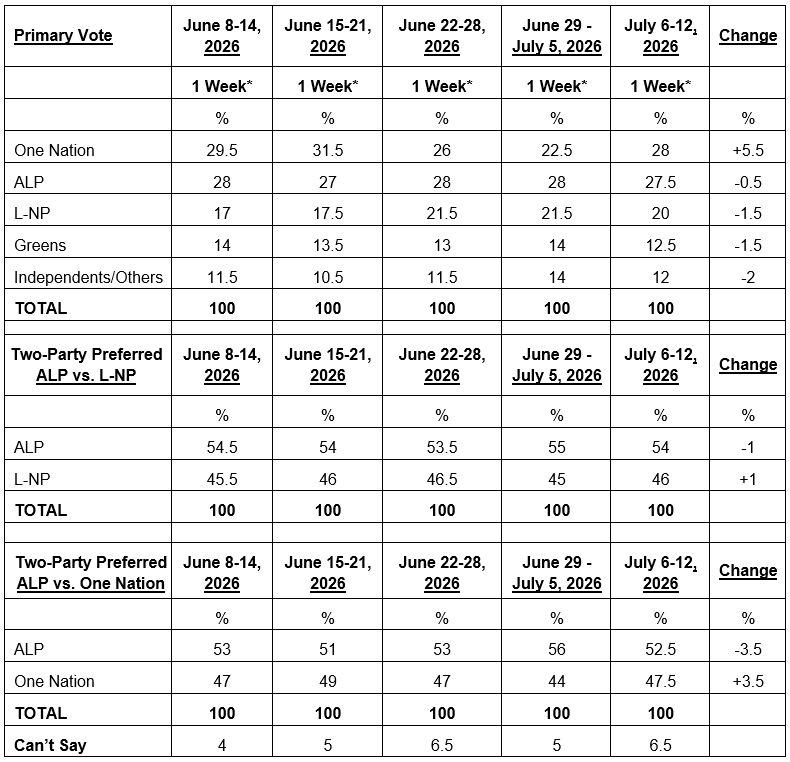
*Interviewing dates of Australian electors aged 18+: June 8-14, 2026 (n=1,583), June 15-21, 2026 (n=1,575), June 22-28, 2026 (n=1,639), June 28 – July 5, 2026 (n=1,584), July 6-12, 2026 (n=1,612). This week 6.5% (up 1.5%) of those surveyed can’t say who they would vote for.
Further details will be released in Roy Morgan’s weekly video update presented by Roy Morgan Chief Executive Officer Michele Levine.
For detailed analysis such as by States, capital cities/country areas, age, gender, occupation, and education contact Julian McCrann on (03) 9224 5365 or email julian.mccrann@roymorgan.com.
About Roy Morgan
Margin of Error
The margin of error to be allowed for in any estimate depends mainly on the number of interviews on which it is based. Margin of error gives indications of the likely range within which estimates would be 95% likely to fall, expressed as the number of percentage points above or below the actual estimate. Allowance for design effects (such as stratification and weighting) should be made as appropriate.
| Sample Size | Percentage Estimate |
| 40% – 60% | 25% or 75% | 10% or 90% | 5% or 95% | |
| 1,000 | ±3.0 | ±2.7 | ±1.9 | ±1.3 |
| 5,000 | ±1.4 | ±1.2 | ±0.8 | ±0.6 |
| 7,500 | ±1.1 | ±1.0 | ±0.7 | ±0.5 |
| 10,000 | ±1.0 | ±0.9 | ±0.6 | ±0.4 |
| 20,000 | ±0.7 | ±0.6 | ±0.4 | ±0.3 |
| 50,000 | ±0.4 | ±0.4 | ±0.3 | ±0.2 |


