


Roy Morgan Business Confidence hits a new record low of 76
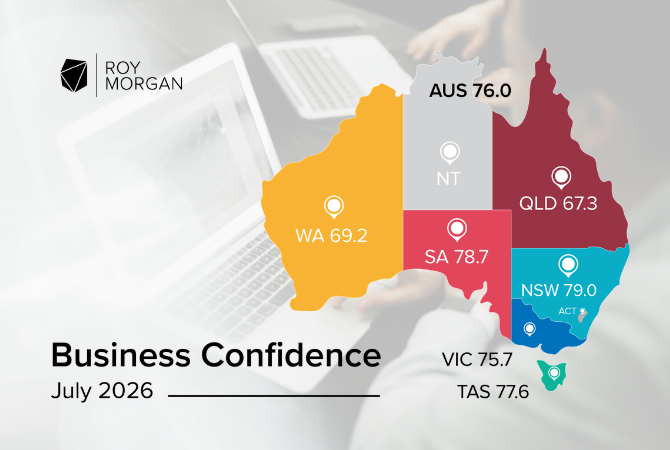
In July 2026 Roy Morgan Business Confidence dropped 1.5 points to a new record low of 76, marginally below the previous record low in May of 76.1.
The decline in Business Confidence in July is despite the Reserve Bank leaving interest rates unchanged at its meeting in mid-June, and official ABS inflation dropping from a recent high of 4.6% in March 2026, to 4.2% in April, 4% in May, and 3.8% in June – down 0.8% points in three months.
However, as July progressed the fragile ‘Memorandum Of Understanding’ (MOU) between Iran and the United States broke down and the two sides returned to a low-level conflict in July.
Driving the small decrease in July were declines in confidence about the financial situation of the business compared to a year ago and looking ahead over the next 12 months.
Now only 18.7% of businesses (down 7.9% points in July) say their business is ‘better off’ financially than this time a year ago (the lowest figure for this indicator for over six years since May 2020), and just 29.1% (down 4.3% points) expect business to be ‘better off’ financially this time next year.
In addition, now a new record low 25.5% (down 3.9% points) say now is a ‘good time to invest’ in growing the business while 48% (up 0.2% points) that say it’s a ‘bad time to invest’.
Roy Morgan Monthly Business Confidence -- Australia
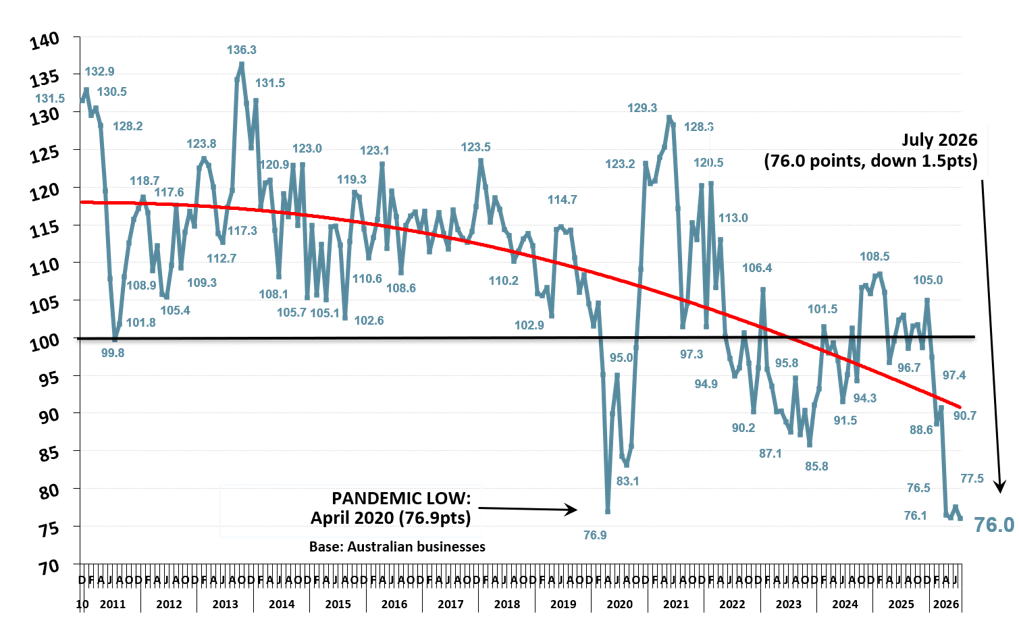
Source: Roy Morgan Business Single Source, Dec 2010-July 2026. Average monthly sample over the last 12 months = 1,167.
In July 2026 Business Confidence is below 80 in all six States for the first time ever
Year-on-year Business Confidence was down significantly (down 27 points from a year ago to 76). All six States now have Business Confidence below the level of 80 for the first time ever, and Business Confidence is down in all States from a year ago by at least 15 points.
New South Wales again has the highest Business Confidence of any State – although still well into negative territory at only 79, down 27pts from a year ago. Business Confidence fell by 19.7pts in South Australia to only 78.7 and fell to 77.6 (down 36.6pts from a year ago) in Tasmania.
Business Confidence in the three other States is below the national average of 76. Business Confidence in Victoria fell by 18.2pts to just 75.7 and fell by over 35 points in the two resource heavy States of Western Australia – down 45.9pts to 69.2, and in Queensland fell by 35.9pts to only 67.3.
Business Confidence by State in July 2025 vs July 2026
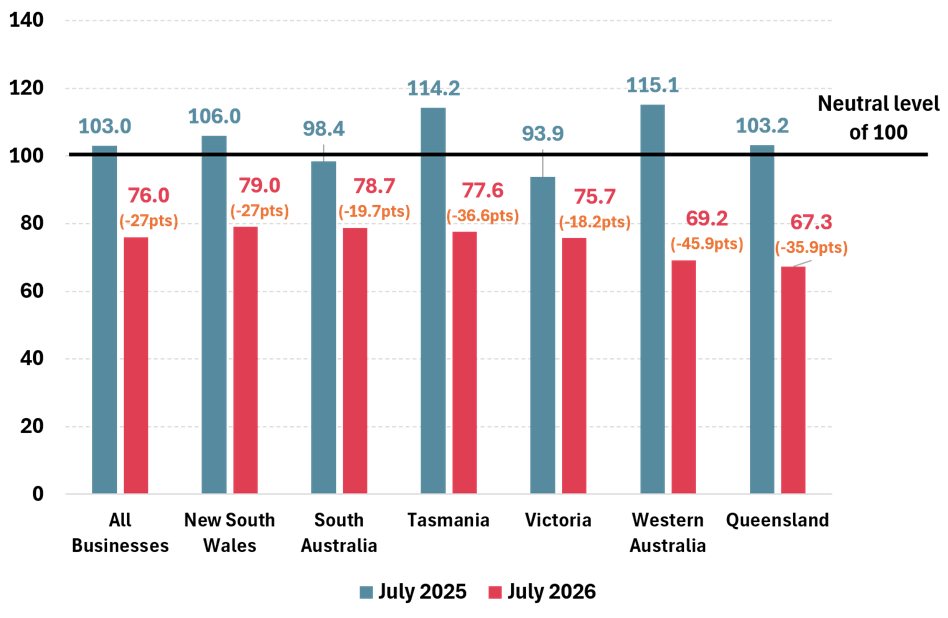
Source: Roy Morgan Business Single Source, July 2025, n=1,246, July 2026, n=1,097. Base: Australian businesses. *Tasmanian Business Confidence is measured over two months: June & July 2025 cf. June & July 2026.
Education & Training, Arts & Recreational Services, Professional, Scientific & Technical Services are the most confident industries during the three months to July 2026
Over the last three months there was only one industry with Business Confidence in positive territory above 100 – Education & Training, and even that industry is down by 5.8pts from a year ago to 100.1.
Other industries with higher-than-average Business Confidence, just below the neutral level of 100, are Arts & Recreational Services on 94.6, down 10.8pts, Professional, Scientific & Technical Services on 89.6, down 14.pts, Information, Media & Telecommunications on 88, down 6.9pts, and Electricity, Gas, Water & Waste Services on 87.4, down 29.2pts.
There were four industries with Business Confidence below 70 including Retail Trade on 69.8, down 39.3pts on a year ago, Agriculture, Forestry & Fishing on 69.6, but up 2.7pts on a year ago, Rental, Hiring & Real Estate Services on only 68.2, down 41.8pts on a year ago, and lowest of all is Accommodation & Food Services on just 65.3, and down a large 58.6pts on a year ago – the largest decline of any industry from a year ago.
Agriculture, Forestry & Fishing has had low Business Confidence for an extended period now with an average of only 79.5 since the beginning of 2023 – clearly the lowest of any industry.
Business Confidence for Top 5 and Bottom 5 Industries in May – July 2026
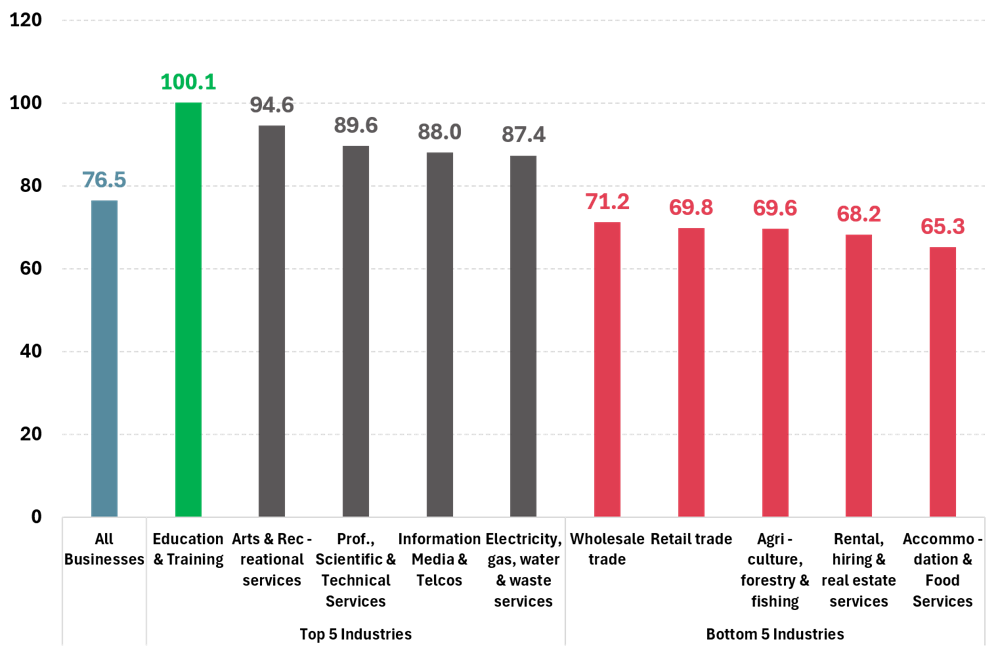
Source: Roy Morgan Business Single Source, May – July 2026, n=3,387. Base: Australian businesses.
Note: In the chart above, green bars represent Business Confidence in positive territory above the national average, red bars represent Business Confidence well below the national average and below the neutral level of 100 while the dark grey bar represents Business Confidence below the neutral level of 100 but still above the national average.
Business Confidence drops to a new all-time record low in July, down 1.5pts to 76 in July as businesses lost confidence about their own finances and investing in growing the business:
- In July, under a fifth of businesses, 18.7% (down 7.4ppts), said their business is ‘better off’ financially than a year ago (the lowest figure for this indicator for over six years since May 2020), while a large plurality, 48.3% (down 3.1ppts), said the business is ‘worse off’;
- Views on businesses’ prospects for the next year deteriorated in July with only 29.1% (down 4.3ppts) expecting the business will be ‘better off’ financially this time next year, while more, 32.8% (up 1.3ppts), expect the business will be ‘worse off’;
- Confidence regarding the performance of the Australian economy over the next year was virtually unchanged in July with 41.5% (down 0.1ppts) expecting ‘good times’,while a majority of 57.8% (up 0.7ppts) expect ‘bad times’;
- Businesses’ views on the long-term future of the Australian economy over the next five years actually improved in July with 22% (up 3.3ppts) expecting ‘good times’ over the next five years compared to a majority of 69.6% (down 4.1ppts) expecting ‘bad times’;
- Views on whether now is a ‘good or bad time to invest in growing the business’ deteriorated in July with a new record low of only 25.5% (down 3.9ppts) of businesses saying the next 12 months will be a ‘good time to invest’ in growing the business while 48% (up 0.2ppts) say the next 12 months will be a ‘bad time to invest’.
Michele Levine, CEO of Roy Morgan, says Business Confidence continued to languish in July, down 1.5pts to 76 – a new record low and the fourth straight month the indicator has been stuck well into negative territory below 80:

“Roy Morgan Business Confidence dropped 1.5 points to a new record low of just 76 in July driven lower by less confidence about businesses’ own prospects as well as fewer businesses saying the next 12 months will be a ‘good time to invest’ in growing the business.
“Now only 18.7% (down 7.4% points) of businesses say they’re ‘better off’ financially than this time last year – the lowest figure for this indicator for over six years since May 2020, while a record low of just 25.5% (down 3.9% points) say now is a ‘good time to invest’ in growing the business.
“For the first time Business Confidence has languished below 80 for four straight months, and in July all six States had Business Confidence under 80. Business Confidence is at just 79 in New South Wales, and even lower in South Australia (78.7), Tasmania (77.6), Victoria (75.7), and below 70 in the two resource heavy States of Western Australia (69.2), and Queensland (67.3).
“The slump in Business Confidence over the last four months (April – July 2026) has been heavily correlated to the conflict in the Middle East. Concerningly, the Memorandum Of Understanding (MOU) between the United States and Iran broke down in early July and the conflict restarted and has continued throughout the rest of the month.
“Until the Iran War is ultimately resolved, the upward pressure on oil prices, and thus inflation, and inflation expectations, will remain ever present. Concerns about higher inflation feed directly into worries about interest rates being increased, and put downward pressure on Business Confidence, as well as Consumer Confidence – which is even lower at only 74.7.
“However, the pause in fighting since the MOU was signed in mid-June did take the pressure off official inflation – at least temporarily. Official ABS Inflation dropped to 3.8% in June 2026, down from 4% (May 2026), 4.2% (April 2026) and a recent high of 4.6% (March 2026).
“At an industry level, there is again only one industry (out of 18) with Business Confidence in positive territory just marginally above the neutral level of 100 – and that is Education & Training on 100.1, although down 5.8pts on a year ago.
“At the other end of the scale are several industries with low Business Confidence below 70 including Retail Trade (69.8), Agriculture, Forestry & Fishing (69.6), Rental, Hiring & Real Estate Services (68.2), and Accommodation & Food Services on only 65.3.
“Confidence in the Agriculture, Forestry & Fishing industry has been at a sustained low level and has averaged only 79.5 since the start of 2023 – clearly the lowest average of any industry over this extended period.”
The latest Roy Morgan Business Confidence results for July are based on 1,097 detailed interviews with a cross-section of Australian businesses from each State and Territory. Detailed findings are available to purchase on a monthly or annual subscription as part of the Roy Morgan Business Confidence Report.
For comments or more information please contact:
Michele Levine
CEO, Roy Morgan
Office: +61 (3) 9224 5215
Mobile: 0411 129 093
To learn more about Roy Morgan’s Business Confidence, Consumer Confidence and Inflation Expectations data call (+61) (3) 9224 5309 or email askroymorgan@roymorgan.com.
About Roy Morgan
Roy Morgan is Australia’s largest independent Australian research company, with offices in each state, as well as in the U.S. and U.K. A full-service research organisation, Roy Morgan has over 80 years’ experience collecting objective, independent information on consumers.
Margin of Error
The margin of error to be allowed for in any estimate depends mainly on the number of interviews on which it is based. Margin of error gives indications of the likely range within which estimates would be 95% likely to fall, expressed as the number of percentage points above or below the actual estimate. Allowance for design effects (such as stratification and weighting) should be made as appropriate.
| Sample Size | Percentage Estimate |
| 40% – 60% | 25% or 75% | 10% or 90% | 5% or 95% | |
| 1,000 | ±3.0 | ±2.7 | ±1.9 | ±1.3 |
| 5,000 | ±1.4 | ±1.2 | ±0.8 | ±0.6 |
| 7,500 | ±1.1 | ±1.0 | ±0.7 | ±0.5 |
| 10,000 | ±1.0 | ±0.9 | ±0.6 | ±0.4 |
| 20,000 | ±0.7 | ±0.6 | ±0.4 | ±0.3 |
| 50,000 | ±0.4 | ±0.4 | ±0.3 | ±0.2 |


