


Extreme mortgage stress increases nationally, driven by people on lower incomes and in lower socio-economic quintiles

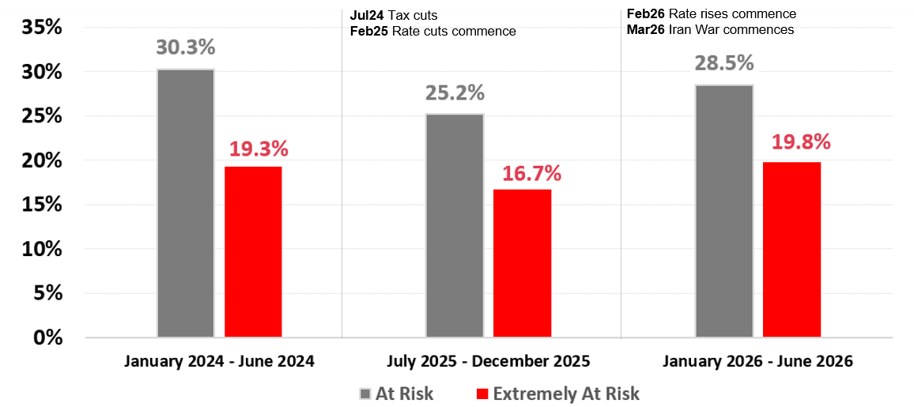
Roy Morgan’s Single Source research reveals that the share of owner-occupier mortgage holders ‘Extremely at Risk [1]’ of mortgage stress rose in the six months to June 2026 vs December 2025 and is now higher than in June 2024 – just before the reworked Stage 3 tax cuts kicked in.
A key cohort driving high levels of extreme mortgage stress are lower income earners with household incomes of less than $100,000, and people in the lower socio-economic quintiles.
An estimated 1.06 million mortgage holders (19.8%) were ‘Extremely at Risk’ of mortgage stress in the six months to June 2026, up from 16.7% in December 2025, and now higher than in June 2024 (19.3%). There was also a rise in the percentage of mortgage holders ‘At Risk [2]’ of mortgage stress (a less strict measure), from 25.2% in December 2025 to 28.5% in June 2026. This equates to 1.53 million mortgage holders.
Mortgage stress eased from June 2024 to December 2025 driven by factors such as real wage growth as inflation declined, income tax cuts, home loan interest rate cuts and a rising share market. However, renewed increases in interest rates and inflation in 2026 are putting renewed pressure on mortgage stress.
Chart 1: Mortgage Stress among Owner Occupier Mortgage Holders
Source: Roy Morgan Single Source (Australia), average interviews per 6-month period, n=6,908
Base: Australians 18+ with owner occupied home loan. * Note: The RBA lifted the cash rate in February 2026 to start the recent rising interest rate cycle, and from when mortgage stress began to increase.
The lower socio-economic quintiles are particularly vulnerable to rising mortgage stress
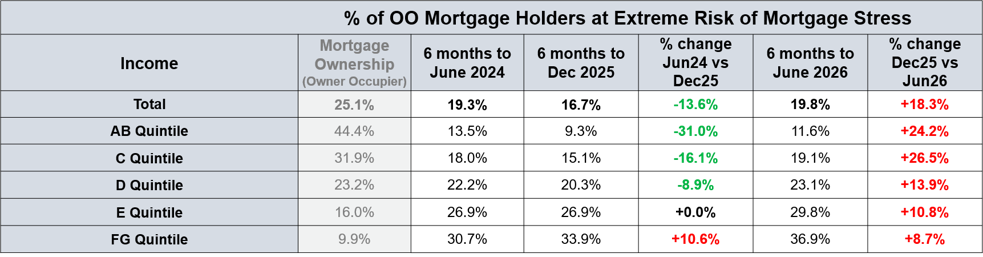
While the proportion of mortgage holders at ‘Extreme Risk’ of mortgage stress increased in the six months to June 2026 (up 18.3%), this is particularly concerning for the two lowest socio-economic quintiles (40% of Australians) as they received no relief from mortgage stress between June 2024 and December 2025 when mortgage stress reduced among the three upper socio-economic quintiles (60% of Australians) [3].
Among those in the lowest two quintiles, the proportion of mortgage holders ‘at extreme risk’ of mortgage stress increased between December 2025 and June 2026 by 10.8% among those in the E Quintile, and by 8.7% among those in the FG quintile. Unlike the upper three quintiles, these two quintiles received no relief between June 2024 and December 2025, when mortgage stress was stable among those in the E quintile (0.0%) and rose among those in the FG quintile (up 10.6%).
Chart 2: ‘Extremely at Risk’ Mortgage Holders by Socio-Economic Quintiles
Source: Roy Morgan Single Source (Australia), average interviews per 6-month period, n=6,908
Base: Australians 18+ with owner occupied home loan. * Note: The RBA lifted the cash rate in February 2026 to start the recent rising interest rate cycle, and from when mortgage stress began to increase.
The rise in mortgage stress among the E and FG quintiles between June 2024 and December 2025 was likely influenced by weaker income growth. Although personal income increased by 6.3% among all mortgage holders during this period, it fell by 4.7% in the E quintile and by 11.1% in the FG quintile.
Rising interest rates and inflation affected all Australians in the first half of 2026 and consequently, mortgage stress has increased among all socio-economic quintiles in the six months to June 2026.
Mortgage stress has risen consistently for lower income earners
Mortgage holders with annual household incomes of under $100,000 are more likely to be ‘Extremely at Risk’ of mortgage stress. They have also experienced consistent increases in mortgage stress since June 2024, rising by 3.1% between June 2024 and December 2025, and by a further 5.0% between December 2025 and June 2026. By contrast, among households with incomes over $100,000, mortgage stress declined between June 2024 and December 2025 (down 26.3%) before rising between December 2025 and June 2026 (up 17.3%).
Chart 3: ‘Extremely at Risk’ Mortgage Holders by Household Income

Source: Roy Morgan Single Source (Australia), average interviews per 6-month period, n=6,908.
Base: Australians 18+ with owner occupied home loan. * Note: The RBA lifted the cash rate in February 2026 to start the recent rising interest rate cycle, and from when mortgage stress began to increase.
Roy Morgan CEO, Michele Levine, commented:

“Mortgage stress is based on those paying more than a certain proportion of their after-tax household income (25% to 45% depending on income and spending) into their home loan, based on the appropriate Standard Variable Rate reported by the RBA and the amount they initially borrowed.
“Extremely at Risk” is based on those paying more than a certain proportion of their after-tax household income into their home loan, based on the Standard Variable Rate set by the RBA and the amount now outstanding on their home loan.
“Those in extreme mortgage stress are unlikely to qualify for a new mortgage – even for a reduced amount outstanding. Even if the amount currently owing on their mortgage was refinanced and payments reduced to spread the mortgage over the maximum number of years, they would struggle to keep up payments.
“The proportion of mortgage holders classified as at ‘Extreme Risk’ of mortgage stress increased from 16.7% in the six months to December 2025, up to 19.8% in the six months to June 2026 and is now higher than a previous peak in June 2024 (19.3%) – just before the reworked Stage 3 income tax cuts increased people’s take-home pay from July 2024.
“The rise in mortgage stress was underpinned by a combination of rising home loan interest rates and rising inflation, and the volatile impact of the Iran War. This renewed spike in mortgage stress follows a period of declining mortgages stress between June 2024, and December 2025 driven by a combination of tax relief, real wage growth, and falling home loan interest rates.
“The rise in mortgage stress in early 2026 is particularly concerning for the two lowest socio-economic quintiles (40% of Australians) as they experienced no relief from mortgage stress when it declined across the mortgage population overall between June 2024 and December 2025.
“During that 18-month period during which the Stage 3 income tax cuts provided taxpayers with extra cash, and the RBA cut interest rates three times during 2025 (from 4.35% to 3.6%), mortgage stress only declined among the three upper socio-economic quintiles (60% of Australians).
“Among those in the lowest two socio-economic quintiles, the proportion of mortgage holders ‘at extreme risk’ of mortgage stress increased between December 2025 and June 2026 by 10.8% among those in the E Quintile, and by 8.7% among those in the FG quintile. These two quintiles had received no relief between June 2024 and December 2025, when mortgage stress had been stable among those in the E quintile and rose among those in the FG quintile (up 10.6%).
“These are important factors for the Reserve Bank to consider when it decides next week whether to increase interest rates again, although the latest official ABS inflation figures show CPI dropping to 3.8% in the 12 months to June 2026, a third consecutive monthly fall.”
These are the latest findings from Roy Morgan’s Single Source Survey, based on in-depth interviews conducted with over 60,000 Australians each year including over 10,000 owner-occupied mortgage-holders.
To learn more about Roy Morgan’s mortgage data, call (+61) (3) 9224 5309 or email askroymorgan@roymorgan.com. Please click on this link to the Roy Morgan Online Store.
About Roy Morgan
Roy Morgan is Australia’s largest independent Australian research company, with offices in each state, as well as in the U.S. and U.K. A full-service research organisation, Roy Morgan has over 80 years’ experience collecting objective, independent information on consumers.
[1] "Extremely at Risk" is based on those paying more than a certain proportion of their after-tax household income into their home loan, based on the Standard Variable Rate set by the RBA and the amount now outstanding on their home loan.
[2] "At Risk" is based on those paying more than a certain proportion of their after-tax household income (25% to 45% depending on income and spending) into their home loan, based on the appropriate Standard Variable Rate reported by the RBA and the amount they initially borrowed.
[3] Respondents are allocated scores for each of their income, education and occupation. The respondent’s scores for each of the three categories are then tallied to give a score out of 180. We then look at the frequency distribution of the scores and divide the population into five even groups of 20%, i.e. quintiles. The AB quintile is the highest level - people in this quintile have the highest scores.
Margin of Error
The margin of error to be allowed for in any estimate depends mainly on the number of interviews on which it is based. Margin of error gives indications of the likely range within which estimates would be 95% likely to fall, expressed as the number of percentage points above or below the actual estimate. Allowance for design effects (such as stratification and weighting) should be made as appropriate.
| Sample Size | Percentage Estimate |
| 40% – 60% | 25% or 75% | 10% or 90% | 5% or 95% | |
| 1,000 | ±3.0 | ±2.7 | ±1.9 | ±1.3 |
| 5,000 | ±1.4 | ±1.2 | ±0.8 | ±0.6 |
| 7,500 | ±1.1 | ±1.0 | ±0.7 | ±0.5 |
| 10,000 | ±1.0 | ±0.9 | ±0.6 | ±0.4 |
| 20,000 | ±0.7 | ±0.6 | ±0.4 | ±0.3 |
| 50,000 | ±0.4 | ±0.4 | ±0.3 | ±0.2 |


