


Victorian State Voting Intention: Liberal-National Coalition set for victory at this week’s Victorian State Election

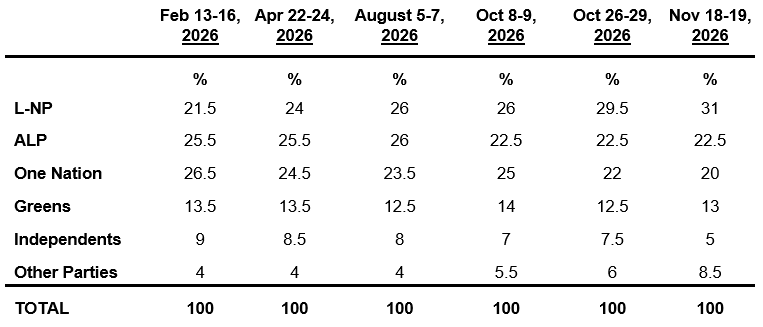
In late November the L-NP Coalition 31% (up 1.5% since October 26-29, 2026) maintains a clear lead over the ALP 22.5% (unchanged) and One Nation 20% (down 2%) with 26.5% (up 0.5%) supporting Other Parties and Independents including the Greens 13% (up 0.5%), Other Parties 8.5% (up 2.5%) and Independents 5% (down 2.5%) according to a special SMS Roy Morgan Poll conducted from November 18-19, 2026, with a representative Victoria-wide cross-section of 1,563 electors.
Importantly, the L-NP Coalition maintains a clear lead over the ALP Government on a two-party preferred basis: L-NP 55% (down 1% from October 26-29, 2026) cf. ALP 45% (up 1%). This result represents a swing of 10% points to the L-NP Coalition since the last Victorian State Election in November 2022 (ALP 55% cf. L-NP 45%).
The L-NP Coalition is set for victory at this week’s Victorian State election although the margin of victory will be determined by the flow of preferences in individual seats around the State. Winning a majority of seats is not certain for the L-NP given the highly contested nature of many seats – especially in rural and regional Victoria, and outer suburban Melbourne.
The recent special Roy Morgan SMS Poll into four key Eastern Victoria electorates – Bass, Hastings, Morwell and Pakenham is a good example of this. One Nation was projected to win three of these seats (Hastings, Morwell and Pakenham), and the L-NP Coalition was projected to win only one – Bass. See more detail on this poll here: Victorian State Voting Intention: One Nation and L-NP Coalition set to win key seats of Bass, Hastings, Morwell and Pakenham. The second, and third, preference decisions of voters will be more important than ever in determining the result of this year’s Victorian State Election.
Two-Party Preferred (ALP vs. L-NP)
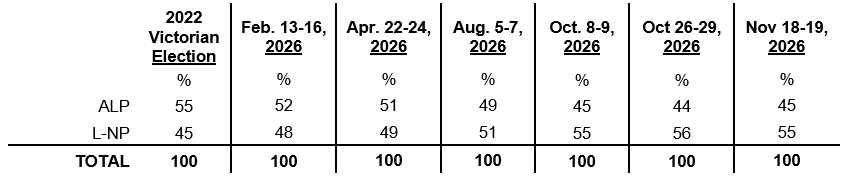
Two-Party Preferred results show L-NP Coalition well ahead of the ALP and One Nation
Roy Morgan has analysed three different two-party preferred results between the ALP and the L-NP Coalition, ALP and One Nation, and the L-NP Coalition and One Nation.
The L-NP Coalition is well ahead of both the ALP and One Nation on a two-party preferred basis: L-NP 55% (down 1% point from October 26-29, 2026) cf. ALP 45% (up 1% point) and against One Nation: L-NP 69% (down 5% points) cf. One Nation 31% (up 5% points). The L-NP’s large lead over One Nation is due to the preferences of ALP voters heavily favouring the L-NP Coalition.
There is little change on a two-party preferred basis between the ALP and One Nation. The ALP 54% (down 0.5% points) holds a clear lead over One Nation 46% (up 0.5% points).
Roy Morgan SMS Polls Victoria (February, April, August, October and November 18-19, 2026)
Three Party Preferred

Three-Party Preferred result still shows the ALP ahead of the L-NP Coalition and One Nation
A three-party preferred result – which includes the major party preferences (ALP, L-NP Coalition or One Nation) from supporters of the Greens, Other parties, and Independents, shows the ALP on 43% (unchanged from October 26-29, 2026), ahead of the L-NP on 35% (up 2% points) and One Nation on 22% (down 2% points).
Importantly, a three-party preferred result shows the ALP is still in a strong position to progress to the final two-party preferred contest in many electorates due to the strong flow of preferences to the ALP from the supporters of the Greens, Other Parties, and Independent, candidates.
Although the ALP performs well on a three-party preferred result, the flow of preferences from One Nation to the L-NP Coalition means the L-NP Coalition clearly overtakes the ALP on a two-party preferred basis.
Primary Voting Intention – By City/Country
Voting: "If a Victorian State Election were held today – which party would receive your first preference?"
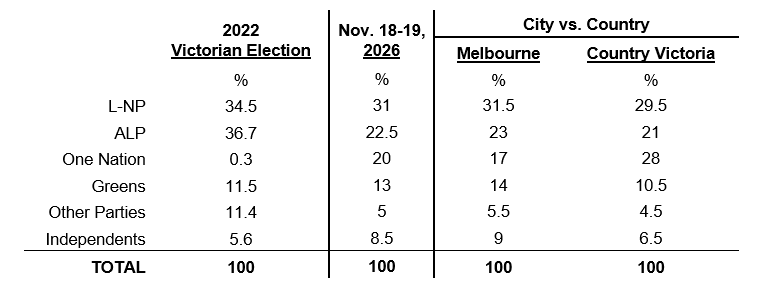
This special SMS Roy Morgan survey was conducted from November 18-20, 2026, with a representative Victoria-wide cross-section of 1,563 electors.
Further details will be released in Roy Morgan’s weekly video update presented by Roy Morgan Chief Executive Officer Michele Levine.
In-depth detailed analysis such as by capital cities/country areas, age, gender, Victoria’s eight Upper House regions, occupation, and education is available to subscribers to the Morgan Poll.
To learn more contact Julian McCrann on (03) 9224 5365 or email julian.mccrann@roymorgan.com.
About Roy Morgan
Roy Morgan is Australia’s largest independent Australian research company, with offices in each state, as well as in the U.S. and U.K. A full-service research organisation, Roy Morgan has over 80 years’ experience collecting objective, independent information on consumers.
Margin of Error
The margin of error to be allowed for in any estimate depends mainly on the number of interviews on which it is based. Margin of error gives indications of the likely range within which estimates would be 95% likely to fall, expressed as the number of percentage points above or below the actual estimate. Allowance for design effects (such as stratification and weighting) should be made as appropriate.
| Sample Size | Percentage Estimate |
| 40% – 60% | 25% or 75% | 10% or 90% | 5% or 95% | |
| 1,000 | ±3.0 | ±2.7 | ±1.9 | ±1.3 |
| 5,000 | ±1.4 | ±1.2 | ±0.8 | ±0.6 |
| 7,500 | ±1.1 | ±1.0 | ±0.7 | ±0.5 |
| 10,000 | ±1.0 | ±0.9 | ±0.6 | ±0.4 |
| 20,000 | ±0.7 | ±0.6 | ±0.4 | ±0.3 |
| 50,000 | ±0.4 | ±0.4 | ±0.3 | ±0.2 |


