


Roy Morgan Business Confidence jumps 5.2pts to 81.7 – before RBA raises interest rates; highest since March
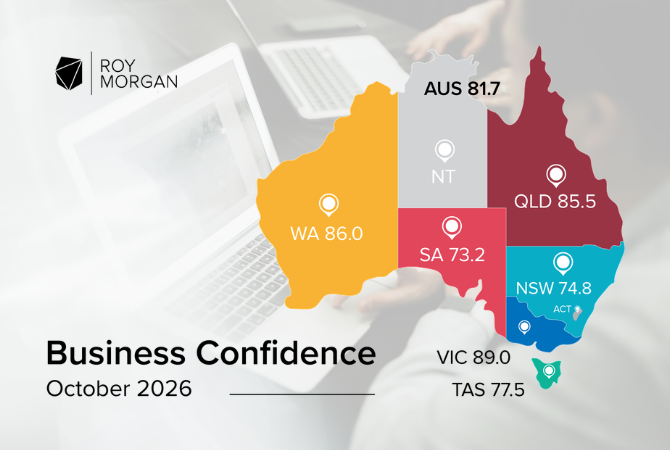
In October 2026 Roy Morgan Business Confidence increased 5.2 points to 81.7, the largest jump this year and is now at its highest for six months since March 2026. However, the increase was before the Reserve Bank raised interest rates to an 18-year high of 4.85% on Melbourne Cup Day.
Driving the increase in October were improvements in confidence about the Australian economy’s performance – now 35% (up 4.7% points in October) of businesses expect ‘good times’ for the economy over the next year and 45.3% (up 3.8% points) expect ‘good times’ over the next five years.
In addition, now 30% (up 3.1% points) say now is a ‘good time to invest’ in growing the business while 48.1% (down 0.9% points) that say it’s a ‘bad time to invest’ – an improvement of 4% points.
Roy Morgan Monthly Business Confidence -- Australia
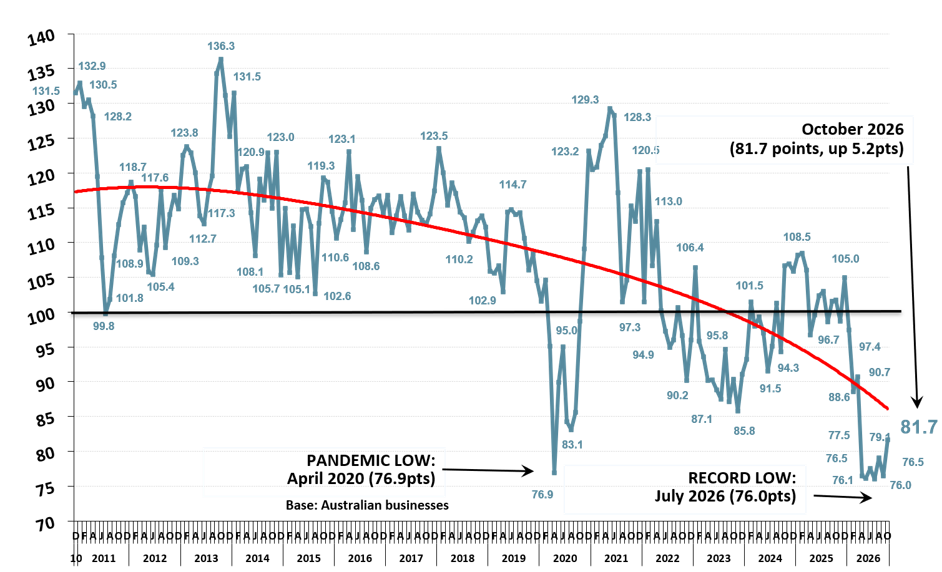
Source: Roy Morgan Business Single Source, Dec 2010-Oct 2026. Average monthly sample over the last 12 months = 1,162.
In October 2026 Business Confidence is highest in Victoria facing a State Election this month
Year-on-year Business Confidence was down significantly (down 20 points from a year ago to only 81.7). Business Confidence was down in all six States, and below 80 in three out of the six States.
Business Confidence is highest in Victoria, but at only 89, and down 13.5 points from a year ago. Victoria faces a State Election in November, and the latest Roy Morgan Poll shows the L-NP Coalition is set to win and return to office after 12 years in Opposition: Victorian State Voting Intention: Liberal-National Coalition opens a significant lead (L-NP 56% cf. ALP 44%) one month before the Victorian State Election.
Business Confidence is above 80 in two other States: Western Australia at 86, but down 26.9 points on a year ago, and in Queensland at 85.5, but down 16.4 points on a year ago.
However, in three States Business Confidence remains significantly lower, and under 80. This includes Tasmania, at only 77.5, down a large 26.1 points on a year ago, and in New South Wales at 74.8, and down 22 points on a year ago.
The State with the lowest Business Confidence in October was South Australia at only 73.2, and down by a large 24.4 points on a year ago.
Business Confidence (Year-over-Year) by State in October 2025 vs. October 2026
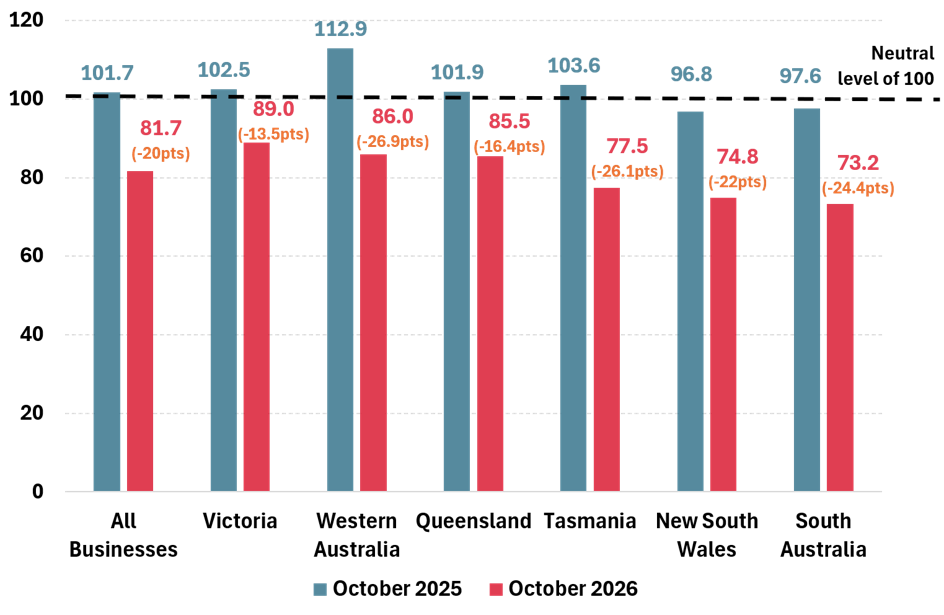
Source: Roy Morgan Business Single Source, October 2025, n=1,411, October 2026, n=1,332. Base: Australian businesses. *Tasmanian Business Confidence is measured over two months: Sep & Oct 2025 cf. Sep & Oct 2026.
Education & Training is the only industry with Business Confidence above 100
Over the three months to October 2026 there was only one industry with Business Confidence in positive territory above 100 – Education & Training on 100.9, but down 5.7 points on a year ago.
Two industries with Business Confidence slightly below neutral are Arts & Recreational Services on 95, and down 5.8 points on a year ago, and Public Administration & Safety on 90.5, but up 3.4 points on a year ago – the only industry with higher Business Confidence than a year ago.
There were three industries with Business Confidence between 60-70 led by Transport, Postal & Warehousing on 69, down 31.3 points on a year ago, Information, Media & Telecommunications on 67.6, and down a large 31.8 points, and Agriculture, Forestry & Fishing on 63.7, and down 16.3 points.
Two industries have very low Business Confidence including Wholesale Trade on only 58.3, down 23.7 points on a year ago, and Mining on only 49.1, down a massive 74.3 points on a year ago, and once again the least confident industry for a third straight month.
Business Confidence for Top 5 and Bottom 5 Industries in August – October 2026
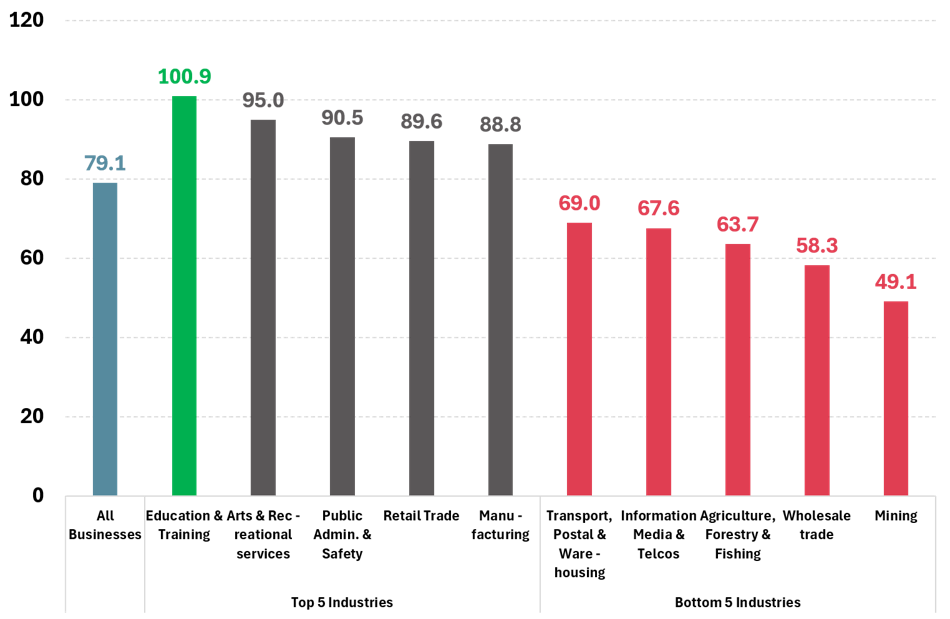
Source: Roy Morgan Business Single Source, August – October 2026, n=3,456. Base: Australian businesses.
Note: In the chart above, green bars represent Business Confidence in positive territory above the national average, red bars represent Business Confidence well below the national average and below the neutral level of 100 while the dark grey bar represents Business Confidence below the neutral level of 100 but still above the national average.
Business Confidence improved in October as businesses grew more confident about the next 12 months both for the performance of the business and the Australian economy’s performance:
- In October, under a quarter of businesses, 23% (down 3ppts in a month), said their business is ‘better off’ financially than a year ago, while a plurality, 44.3% (up 1.6ppts), said the business is ‘worse off’;
- Views on businesses’ prospects for the next year improved significantly in October with 35% (up 4.7ppts) expecting the business will be ‘better off’ financially this time next year, while under a third, 32.1% (down 4ppts), expect the business will be ‘worse off’;
- Confidence regarding the performance of the Australian economy over the next year improved in October with 45.3% (up 3.8ppts) expecting ‘good times’,while 53.3% (down 3.2ppts) expect ‘bad times’;
- Businesses’ views on the long-term future of the Australian economy over the next five years also improved in October with 22.9% (up 4.6ppts) expecting ‘good times’ over the next five years compared to 70.1% (down 6.2ppts) expecting ‘bad times’;
- Views on whether now is a ‘good or bad time to invest in growing the business’ improved with 30% (up 3.1ppts) of businesses saying the next 12 months will be a ‘good time to invest’ in growing the business while 48.1% (down 0.9ppts) say the next 12 months will be a ‘bad time to invest’.
Michele Levine, CEO of Roy Morgan, says Business Confidence jumped in October, up 5.2 points to 81.7 – to its highest mark for seven months since March after the Reserve Bank (RBA) raised interest rates at the end of September, but before the RBA raised rates last week to 4.85%:

“Roy Morgan Business Confidence jumped 5.2 points to 81.7 in October, its biggest monthly increase so far this year, and driving the index to its highest mark for seven months since March.
“Driving the monthly increase was more confidence about businesses’ prospects over the next year, and about the Australian economy’s performance over the next year, and next five years.
“Now 35% (up 4.7% points) of businesses expect to be ‘better off’ financially this time next year compared to 32.1% (down 4% points) that expect to be ‘worse off’ – and the only indicator now in positive territory above the neutral level.
“Looking toward the economy, 45.3% (up 3.8% points) of businesses expect ‘good times’ for the economy over the next year, and 22.9% (up 4.6% points) expect ‘good times’ for the economy over the longer-term of the next five years – both significant improvements on a month ago.
“However, concerningly, nearly half of businesses, 48.1% (down 0.9% points) say the next 12 months is a ‘bad time to invest’ in growing the business compared to only 30% (up 3.1% points) that say the next 12 months is a ‘good time to invest’ in growing the business.
“A look at Business Confidence by State shows the measure is highest in Victoria at 89, and facing a key State Election later this month. The latest Roy Morgan SMS Poll shows the L-NP Coalition is in pole position to defeat the 12-year incumbent Labor Government: L-NP 56% cf. ALP 44%. The prospect of a change in Government appears to be driving an increasing level of confidence amongst Victorian businesses.
“Business Confidence in other States was lower than this in Western Australia (86), Queensland (85.5), and below 80 in Tasmania (77.5), New South Wales (74.8), and again lowest of all in South Australia at only 73.2.
“The ongoing Iran War – now into its ninth month – is continuing to pressure oil prices, and thereby inflation. The latest official ABS Inflation figure of 4.3% for the 12 months to September 2026 is still well above the Reserve Bank’s preferred target range of 2-3% over the course of the economic cycle.
“The high inflation estimates continue to put pressure on the Reserve Bank (RBA) and has led to the RBA raising rates in late September (up 0.25% to a 15-year high of 4.6%) and last week in early November (up 0.2% to an 18-year high of 4.85%). The next meeting of the RBA to decide on the level of interest rates is due to be held in early December.
“At an industry level, there is only a single industry (out of 18) with Business Confidence in positive territory just marginally above the neutral level of 100 – Education & Training on 100.9. Two other industries have relatively high Business Confidence between 90-100 and they are Arts & Recreational Services on 95.0 and Public Administration & Safety on 90.5.
“At the other end of the scale are five industries with low Business Confidence below 70 including Transport, Postal & Warehousing (69), Information, Media & Telecommunications (67.6), Agriculture, Forestry & Fishing (66.7), Wholesale Trade (58.3), and lowest of all is the Mining Industry on 49.1.
“Confidence in the Transport, Postal & Warehousing, Information, Media & Telecommunications, and the Mining industry have plunged by over 30 points from a year ago.”
The latest Roy Morgan Business Confidence results for September are based on 1,332 detailed interviews with a cross-section of Australian businesses from each State and Territory. Detailed findings are available to purchase on a monthly or annual subscription as part of the Roy Morgan Business Confidence Report.
For comments or more information please contact:
Michele Levine
CEO, Roy Morgan
Office: +61 (3) 9224 5215
Mobile: 0411 129 093
To learn more about Roy Morgan’s Business Confidence, Consumer Confidence and Inflation Expectations data call (+61) (3) 9224 5309 or email askroymorgan@roymorgan.com.
About Roy Morgan
Roy Morgan is Australia’s largest independent Australian research company, with offices in each state, as well as in the U.S. and U.K. A full-service research organisation, Roy Morgan has over 80 years’ experience collecting objective, independent information on consumers.
Margin of Error
The margin of error to be allowed for in any estimate depends mainly on the number of interviews on which it is based. Margin of error gives indications of the likely range within which estimates would be 95% likely to fall, expressed as the number of percentage points above or below the actual estimate. Allowance for design effects (such as stratification and weighting) should be made as appropriate.
| Sample Size | Percentage Estimate |
| 40% – 60% | 25% or 75% | 10% or 90% | 5% or 95% | |
| 1,000 | ±3.0 | ±2.7 | ±1.9 | ±1.3 |
| 5,000 | ±1.4 | ±1.2 | ±0.8 | ±0.6 |
| 7,500 | ±1.1 | ±1.0 | ±0.7 | ±0.5 |
| 10,000 | ±1.0 | ±0.9 | ±0.6 | ±0.4 |
| 20,000 | ±0.7 | ±0.6 | ±0.4 | ±0.3 |
| 50,000 | ±0.4 | ±0.4 | ±0.3 | ±0.2 |


