


ANZ-Roy Morgan Inflation Expectations were at 5.7% in late November – down 0.3% points from the month of October
The weekly ANZ-Roy Morgan Inflation Expectations increased from late September for four straight weeks until late October but have now fallen in three out of the last four weeks since then as average retail petrol prices have consistently fallen. Inflation Expectations are now at 5.7% for the week of November 16-22, 2026, down 0.3% points from the month of October.
The latest weekly reading is 0.2% points below the average for Inflation Expectations over the last 25 weeks since early June of 5.9%. A look at monthly Inflation Expectations for October 2026 shows the measure at 6.0% for the month – down 0.1% points from the prior month of September.
Inflation Expectations hit a record monthly high of 7% for April 2026 following the United States and Israel attack on Iran but then dropped rapidly until hitting a monthly low of 5.6% in July 2026. However, Inflation Expectations have increased steadily since early July. In addition, the latest information on weekly Inflation Expectations is available to view each week in the Roy Morgan Weekly Update video on YouTube.
Monthly Inflation Expectations Index long-term trend – Expected Annual Inflation in next 2 years
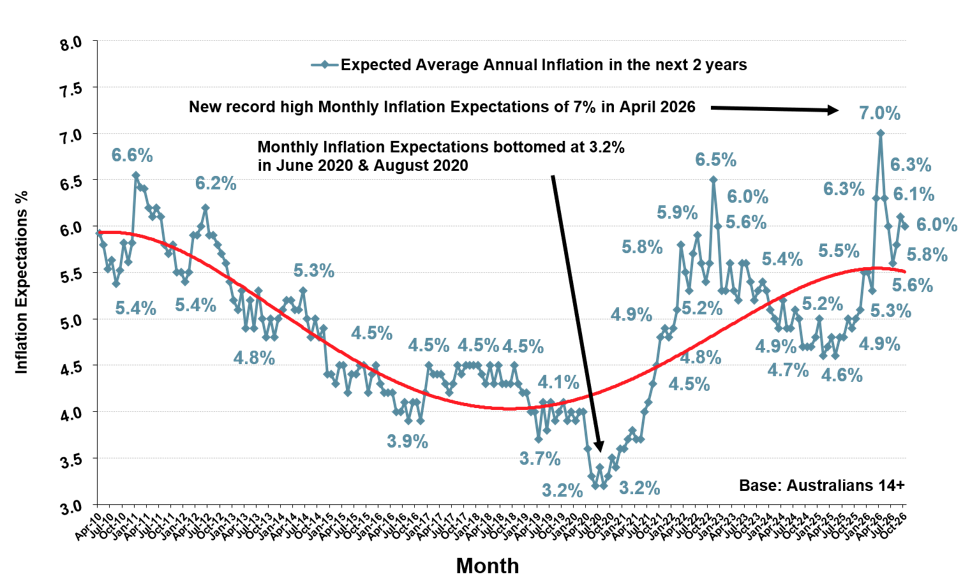
Source: Roy Morgan Single Source: Interviewing an average of 4,900 Australians aged 14+ per month (Nov. 2010 – Oct. 2026).
Average retail petrol prices 20 cents a litre to a new record high of $2.40 per litre in October
Average retail petrol prices increased consistently since hitting a four-and-a-half year low of only $1.597 in late June and hit highs above $2.30 for seven straight weeks from late September until early November.
Average retail petrol prices hit a new record high of $2.20 per litre in September 2026, and this increased another 20 cents per litre to a new record high of $2.40 per litre in October 2026.
However, since the weekly price peaked in mid-October, average retail petrol prices have now declined for five straight weeks since then to settle back at $2.13 per litre in late November – the lowest price for over two months since early September.
Since the fuel excise cut began to be wound back in early July average retail petrol prices are now up by over 50 cents per litre (+33.1%).
Australian average retail petrol prices (cents per litre) weekly: 2021 – 2026
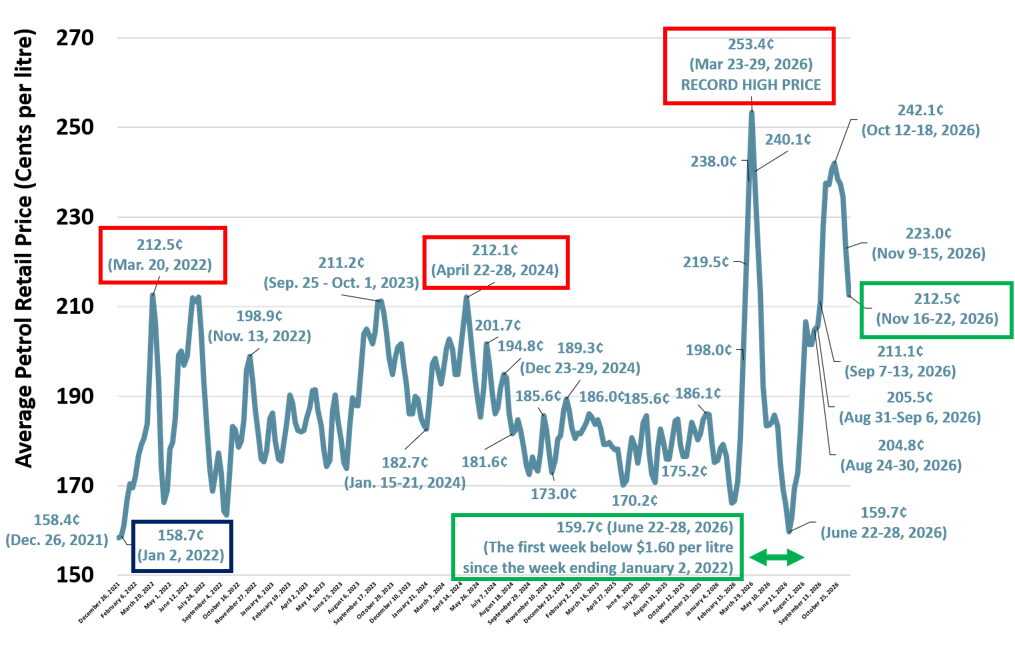
Source: Australian Institute of Petroleum (AIP) weekly reports: https://www.aip.com.au/pricing/weekly-prices-reports.
The latest official ABS monthly annual CPI estimate at 4.3% for the year to September 2026 is above the Reserve Bank’s preferred target range of 2-3% over the course of the economic cycle. ABS estimates of inflation have more than doubled since June 2025 (1.9%).
The next ABS Monthly CPI estimate for October 2026 is due to be released on Wednesday.
Inflation Expectations were highest in Tasmania, Queensland and New South Wales
A look at Monthly Inflation Expectations on a State-based level for October shows a large increase for Tasmania, up 0.9% points to 6.8% - and now clearly the highest for any State, an unchanged result in Queensland at 6.5%, and a small increase in New South Wales, up 0.1% points to 6.1% - all three above the national average of 6%.
Inflation Expectations were down in all other States including Western Australia, down 0.1% points to 6%, Victoria, down 0.3% points to 5.5%, and down most of all in South Australia, down 1.7% points to just 5.3% - and clearly the lowest of any State.
Inflation Expectations in Country Areas were unchanged at 6.4% in October, but in Capital Cities dropped by 0.2% points to 5.8%.
Roy Morgan CEO Michele Levine says Inflation Expectations have decreased since hitting a recent high of 6.3% in late October, now down three out of the last four weeks to 5.7% in late November – down 0.6% points in a month:

“ANZ-Roy Morgan Inflation Expectations in Australia hit a record monthly high of 7% in April before dropping over the next few months to 5.6% in July three months later. However, since then Inflation Expectations began increasing again, up in August (5.8%), and September (6.1%), before moderating in the month of October (6.0%).
“A big part of the reason Inflation Expectations increased from July is the ending of the fuel excise cut. After the fuel excise cut ended progressively in July and August average retail petrol prices soared by over 80 cents per litre to hit levels above $2.30 per litre for seven straight weeks from late September until early November and reached a high of $2.42 per litre in mid-October.
“However, since peaking in mid-October, average retail petrol prices have now dropped for five straight weeks from $2.42 per litre in mid-October to $2.13 per litre in late November – down by almost 30 cents per litre.
“This fall in the average retail petrol price has also mirrored a consistent fall in Inflation Expectations during this period from a weekly high of 6.3% in late October and is now down in three out of the last four weeks by a total of 0.6% points to 5.7% in late November.
“The fall in average retail petrol prices, and Inflation Expectations, over this period is good news as it is taking the pressure off official inflation, and also off the Reserve Bank which has raised interest rates in both September (+0.25% to 4.6%), and November (+0.25% to an 18-year high of 4.85%).
“The Reserve Bank is set to meet again in early December to consider the level of interest rates.”
See below for a comprehensive list of RBA interest rate changes during the time-period charted above.
The data for the Inflation Expectations series is drawn from the Roy Morgan Single Source which has interviewed an average of around 5,300 Australians aged 14+ per month over the last decade from November 2016 – October 2026 and includes interviews with 5,126 Australians aged 14+ in October 2026.
For comments and information about Roy Morgan’s Inflation Expectations data, please contact:
Roy Morgan Enquiries
Office: +61 (3) 9224 5309
askroymorgan@roymorgan.com
About Roy Morgan
Roy Morgan is Australia’s largest independent Australian research company, with offices in each state, as well as in the U.S. and U.K. A full-service research organisation, Roy Morgan has over 80 years’ experience collecting objective, independent information on consumers.
Margin of Error
The margin of error to be allowed for in any estimate depends mainly on the number of interviews on which it is based. Margin of error gives indications of the likely range within which estimates would be 95% likely to fall, expressed as the number of percentage points above or below the actual estimate. Allowance for design effects (such as stratification and weighting) should be made as appropriate.
| Sample Size | Percentage Estimate |
| 40% – 60% | 25% or 75% | 10% or 90% | 5% or 95% | |
| 1,000 | ±3.0 | ±2.7 | ±1.9 | ±1.3 |
| 5,000 | ±1.4 | ±1.2 | ±0.8 | ±0.6 |
| 7,500 | ±1.1 | ±1.0 | ±0.7 | ±0.5 |
| 10,000 | ±1.0 | ±0.9 | ±0.6 | ±0.4 |
| 20,000 | ±0.7 | ±0.6 | ±0.4 | ±0.3 |
| 50,000 | ±0.4 | ±0.4 | ±0.3 | ±0.2 |


