


Victorian Election Webinar: High distrust of Labor to ensure change of Government in Victoria with Liberal leader Jess Wilson set to be the first elected female Premier of the State
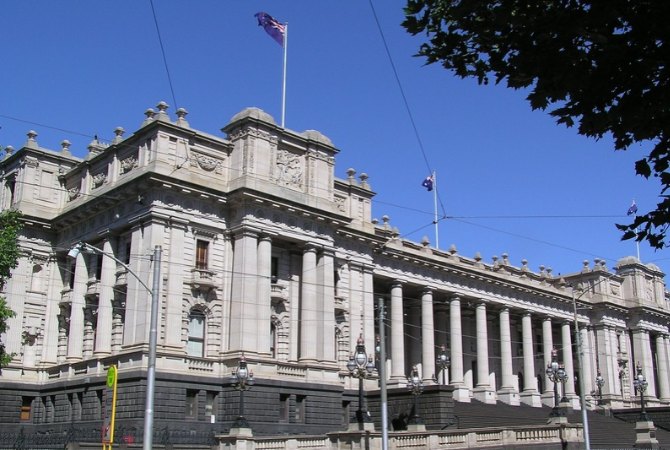
A special Roy Morgan webinar on trust and distrust in the Victorian Election shows high, and rising, distrust of the ALP is the primary factor driving the election result with the Labor Government set to lose office after 12 years in power.
Net distrust in Victorian Labor more than doubles from 2022
DISTRUST in Victorian Labor has soared since 2022 – more than doubling from 15.6% to 38.1% - an increase of 22.5% points. At the same time, trust in Labor has fallen significantly, down 9.1% points to just 12.4%.
These movements mean Labor now has high net distrust of -25.7, down a large 31.6% points from 2022 when Labor had net trust of +5.9.
Be sure to watch the special Roy Morgan Victorian State Election webinar presented by Roy Morgan Chief Executive Officer Michele Levine.
In Victoria distrust in Labor soars from 2022 while distrust in the Liberal-Nationals drops from 2022
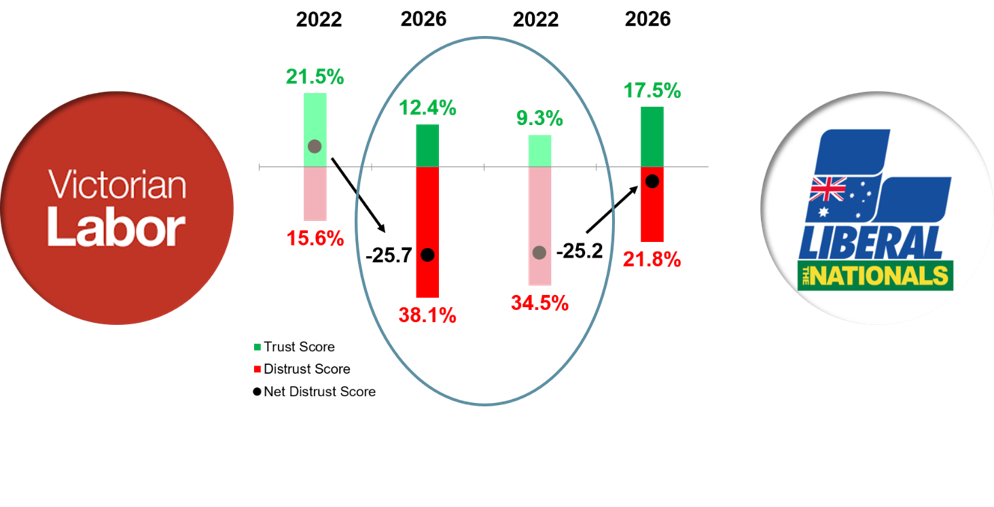
Source: Roy Morgan Snap SMS Survey 2022 and 2026. Base: 2022: Victorians aged 18+, n=1,460. 2026: Victorians aged 18+ n=1,796. Q1. “Thinking about the upcoming Victorian state election, who do you trust?” Q3. “Thinking about the upcoming Victorian state election, who do you distrust?” Weighted results.
L-NP Coalition is still distrusted, but net distrust is down significantly from 2022
The L-NP Coalition has improved its standing in the electorate but is still dealing with a significant level of distrust at 21.8% (down 12.7% points from 2022). Trust in the L-NP Coalition has increased 8.2% points to 17.5%. This means net distrust in the L-NP Coalition is now at -4.3, an improvement of +20.9% points from 2022.
In both cases, the larger movement and by far the most important, is in DISTRUST. Labor now confronts an electorate who doubt its intentions and integrity, and that makes every new promise harder to believe.
The Coalition faces much less hostility than before, but it hasn't gained positive trust on the same scale. That gives the opposition room to win support from vast numbers who want change, without necessarily needing to create the perfect alternative.
Labor’s critics raise lies and dishonesty, corruption, and financial management
Among people who distrust Labor and told us why, 36 per cent mentioned dishonesty, while corruption and financial mismanagement each appeared in 34 per cent of the answers.
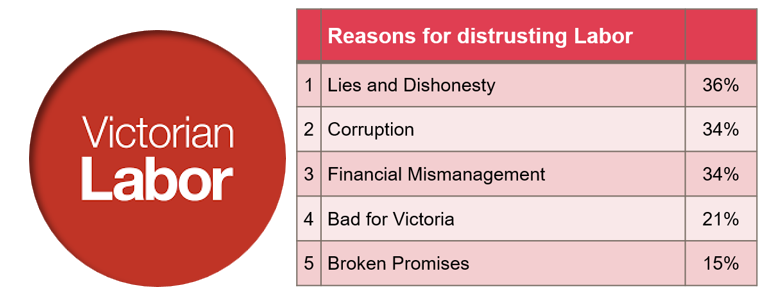
Source: Roy Morgan Snap SMS Survey. 16-17 November 2026. Base: Victorians aged 18+. Total distrust Labor, unprompted and gave a reason for distrust (n=579). Weighted results. Responses may be coded to more than one reason.
Coalition critics question whose interests it would serve and its lack of policies
Among those explaining their distrust of the Coalition, 30 per cent felt it favoured wealthy or elite interests, and 28 per cent pointed to a lack of policies.
Lies, dishonesty and corruption are deeply visceral. Being elitist and having a lack of policies are water-cooler discussion issues.
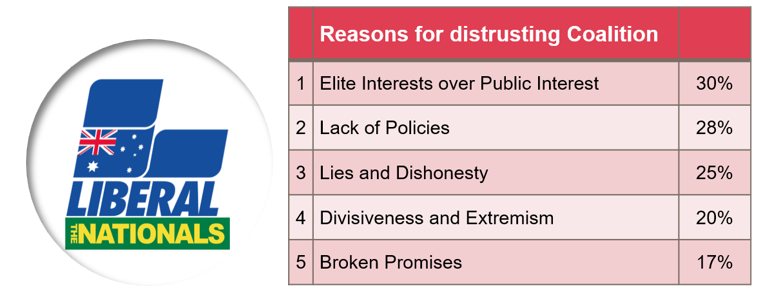
Source: Roy Morgan Snap SMS Survey. 16-17 November 2026. Base: Victorians aged 18+. Total distrust Coalition, unprompted and gave a reason for distrust (n=287). Weighted results. Responses may be coded to more than one reason.
Labor’s trust relates to policy alignment, and working in the public interest
When we ask people why they TRUST the parties, Labor's strongest reason is policy alignment/ good policies (37%), followed by working for ordinary people and in the public interest (26%) and its track record (25%).
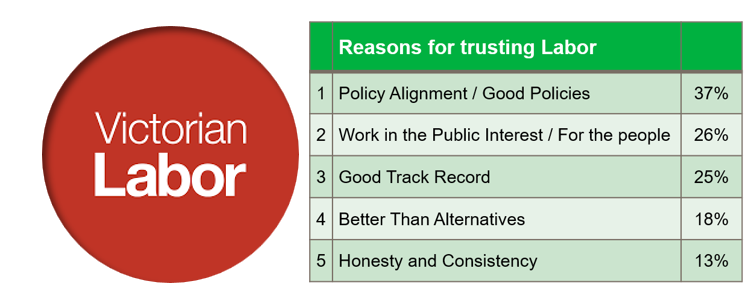
Source: Roy Morgan Snap SMS Survey. 16-17 November 2026. Base: Victorians aged 18+. Total trust Labor, unprompted and gave a reason for trust (n=176). Weighted results. Responses may be coded to more than one reason.
Coalition trust is rooted in rejecting Labor, but trust nominations alone can’t define a mandate
The Coalition's leading reason for TRUST is simply being better than Labor. There are positive comments about economic management (21%), Coalition policies (21%), honesty and consistency (20%), and competence (15%).
But being better than the government leaves open the important question about what voters expect.
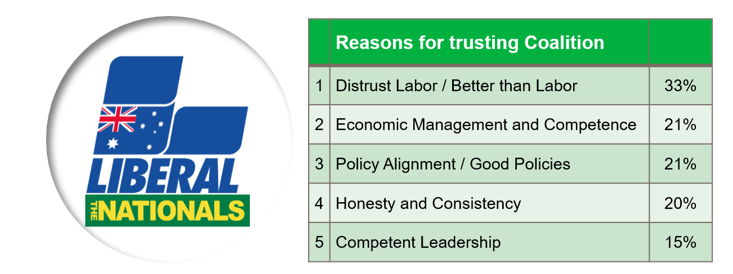
Source: Roy Morgan Snap SMS Survey. 16-17 November 2026. Base: Victorians aged 18+. Total trust Coalition, unprompted and gave a reason for trust (n=262). Weighted results. Responses may be coded to more than one reason.
Distrust of One Nation is more than twice as high as trust
One Nation is a good example of why we always need to look at DISTRUST alongside TRUST. One Nation’s unprompted trust is 14.8 per cent, that’s higher than Labor's 12.4 per cent.
On its own, that could sound like encouraging news for the party. But a far higher 31.3 per cent of respondents say they DISTRUST One Nation, which is more than twice its trust.
These aren't voting figures, but they show very different feelings about the same party. For somebody who's lost patience with the major parties, One Nation may offer a way of being heard. For somebody else, its success may be something they're determined to prevent. So, dissatisfaction with Labor doesn't give us a simple answer about where people will go, or which alternative they'll accept.
One Nation’s appeal confronts doubts about competence and experience, alongside fears of racism and division
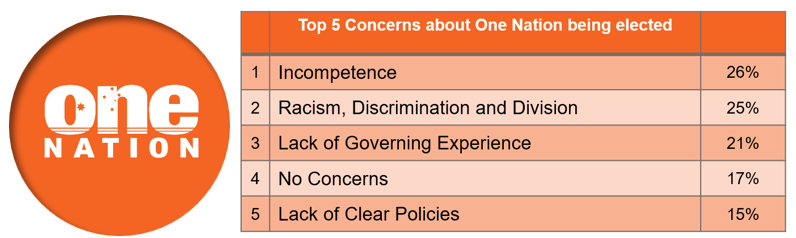
Source: Roy Morgan Snap SMS Survey. 16-17 November 2026. Q7. What, if anything, would worry you if One Nation were elected? Base: Victorians aged 18+ answered question, n=1,013. Weighted results.
What worries people about One Nation isn't confined to whether its policies would work.
Among those answering this question, 26 per cent mentioned incompetence, 25 per cent raised racism, discrimination or division, and 21 per cent mentioned a lack of governing experience. Those are concerns about both doing the job and how people would be treated.
A further seventeen per cent said they had no concerns, so we're certainly not hearing one view across the community. A party can give people a powerful way to express frustration, but asking them to put it in charge in the polling booth brings another decision into play. Someone may want their anger heard and still hesitate when they think about who would make decisions affecting their family, their community and the State.
Victorian Primary Voting Intention (November 2026 vs. Victorian State Election 2022)
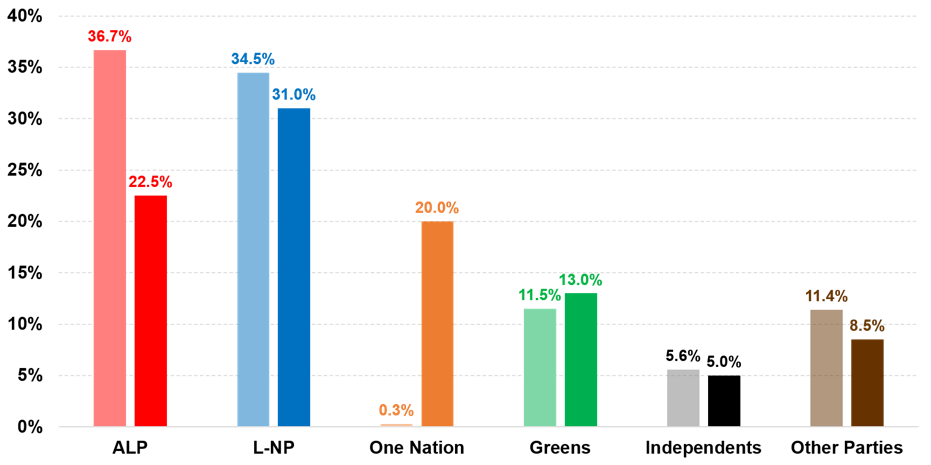
Source: Roy Morgan Snap SMS Voting Survey. 18-19 November 2026. Base: Victorians electors n=1,563. Weighted results.
The Victorian primary voting intention from the latest Roy Morgan Poll (November 18-19, 2026) shows a very different picture to the last Victorian State Election four years ago in November 2022.
Both traditional major parties are showing lower primary support than four years ago, but the Labor Party’s has fallen by much more. The ALP primary vote is down 14% to just 22.5%. To put that into perspective, that equates to more than 500,000 people who voted Labor at the last election changing their vote. Support for the L-NP is down marginally by 3.5% to 31%.
Support for the Greens is up 1.5% to 13%, but support for Other Parties is down 2.9% to 8.5%, while support for Independents is down 0.6% to 5%.
The big mover is One Nation – with support surging to an unprecedented 20% of the vote.
The latest Morgan Poll (Victorian State Voting Intention: Liberal-National Coalition set for victory at this week’s Victorian State Election) shows the L-NP ahead 55-45 – an exact reversal of the 2022 result.
However, in many seats, the two-candidate preferred vote won’t be between the ALP and L-NP at all.
We will see many National/One Nation contests in the bush, and Labor/Greens contests in the inner city, as well as classic ALP/Liberal contests in middle suburbia, and ALP/One Nation contests in the outer suburbs.
This makes this election perhaps the most unpredictable in recent history.
Be sure to watch the special Roy Morgan Victorian State Election webinar presented by Roy Morgan Chief Executive Officer Michele Levine.
In-depth detailed analysis such as by capital cities/country areas, age, gender, Victoria’s eight Upper House regions, occupation, and education is available to subscribers to the Morgan Poll.
To learn more contact Julian McCrann on (03) 9224 5365 or email julian.mccrann@roymorgan.com.
About Roy Morgan
Margin of Error
The margin of error to be allowed for in any estimate depends mainly on the number of interviews on which it is based. Margin of error gives indications of the likely range within which estimates would be 95% likely to fall, expressed as the number of percentage points above or below the actual estimate. Allowance for design effects (such as stratification and weighting) should be made as appropriate.
| Sample Size | Percentage Estimate |
| 40% – 60% | 25% or 75% | 10% or 90% | 5% or 95% | |
| 1,000 | ±3.0 | ±2.7 | ±1.9 | ±1.3 |
| 5,000 | ±1.4 | ±1.2 | ±0.8 | ±0.6 |
| 7,500 | ±1.1 | ±1.0 | ±0.7 | ±0.5 |
| 10,000 | ±1.0 | ±0.9 | ±0.6 | ±0.4 |
| 20,000 | ±0.7 | ±0.6 | ±0.4 | ±0.3 |
| 50,000 | ±0.4 | ±0.4 | ±0.3 | ±0.2 |


