


Cracking a century – ANZ-Roy Morgan New Zealand Consumer Confidence rises into positive territory above 100

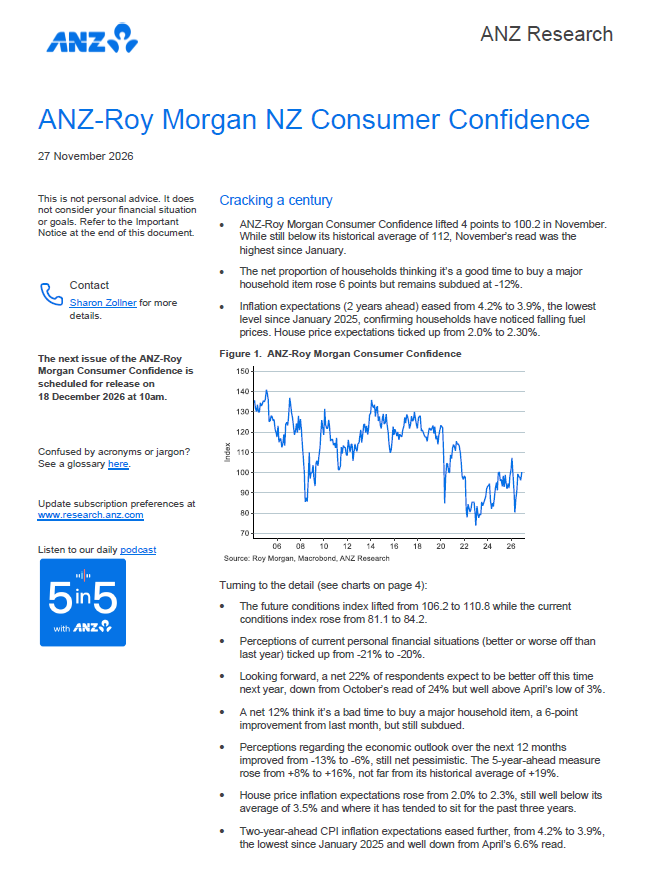
- ANZ-Roy Morgan New Zealand Consumer Confidence lifted 4 points to 100.2 in November. While still below its historical average of 112, November’s read was the highest for nearly a year since January.
- The net proportion of households thinking it’s a good time to buy a major household item rose 6 points but remains subdued at -12%.
- Inflation expectations (2 years ahead) eased from 4.2% to 3.9%, the lowest level since January 2025, confirming households have noticed falling fuel prices. House price expectations ticked up from 2.0% to 2.3%.
Turning to the detail (see charts on page 4 of the linked PDF):
- The future conditions index lifted from 106.2 to 110.8 while the current conditions index rose from 81.1 to 84.2.
- Net perceptions of current personal financial situations (better or worse off than last year) ticked up slightly from -21% to -20% with just under a quarter (24%) of respondents saying they are 'better off' financially than a year ago compared to 44% saying they are 'worse off'.
- Looking forward, a net 22% of respondents expect to be better off this time next year, down from October’s read of 24% but well above April’s low of 3%. This is based upon 42% (down 1%) that expect to be 'better off' financially this time next year compared to 20% (unchanged) that expect to be 'worse off'.
- A net 12% of respondents think it’s a bad time to buy a major household item, a 6-point improvement from last month as the Black Friday sales start and Christmas spending ramps up with 36% (up 2% points) saying now is a 'good time to buy' major household items compared to a plurality of 47% (down 4% points) that say it's a 'bad time to buy', but still a subdued figure.
- Net perceptions regarding the economic outlook over the next 12 months improved from -13% to -6%, still net pessimistic. The 5-year-ahead measure rose from +8% to +16%, not far from its historical average of +19%.
- House price inflation expectations rose from 2.0% to 2.3%, still well below its average of 3.5% and where it has tended to sit for the past three years.
- Two-year-ahead CPI inflation expectations eased further, from 4.2% to 3.9%, the lowest since January 2025 and well down from April’s 6.6% read.
The view on New Zealand
With fuel prices at the pump falling, it is perhaps not surprising to see consumers feeling a little more upbeat in November. However, the overall read on the consumer mood remains sub-par, which is understandable given broader cost-of- living pressures and the still-soft labour market.
Indeed, the details continue to suggest the here and now remains tough going for many, with consumers feeling more chipper about their future prospects than their current circumstances. Still, it was good to see both the current and future conditions indexes rise this month.
Consumers do not get to set prices, meaning their inflation expectations do not tend to carry the same weight for the monetary policy outlook as those of firms, whose inflation expectations could influence their choices about the prices they actually decide on. However, it is noteworthy that consumers’ inflation expectations have fallen a little more over the month than fuel prices have, having tracked them almost one-for-one earlier in the year (figure 2 of the linked PDF).
Margin of Error
The margin of error to be allowed for in any estimate depends mainly on the number of interviews on which it is based. Margin of error gives indications of the likely range within which estimates would be 95% likely to fall, expressed as the number of percentage points above or below the actual estimate. Allowance for design effects (such as stratification and weighting) should be made as appropriate.
| Sample Size | Percentage Estimate |
| 40% – 60% | 25% or 75% | 10% or 90% | 5% or 95% | |
| 1,000 | ±3.0 | ±2.7 | ±1.9 | ±1.3 |
| 5,000 | ±1.4 | ±1.2 | ±0.8 | ±0.6 |
| 7,500 | ±1.1 | ±1.0 | ±0.7 | ±0.5 |
| 10,000 | ±1.0 | ±0.9 | ±0.6 | ±0.4 |
| 20,000 | ±0.7 | ±0.6 | ±0.4 | ±0.3 |
| 50,000 | ±0.4 | ±0.4 | ±0.3 | ±0.2 |


