


Roy Morgan Business Confidence down 3.4 points to 90.2 in April before the RBA hiked interest rates in May
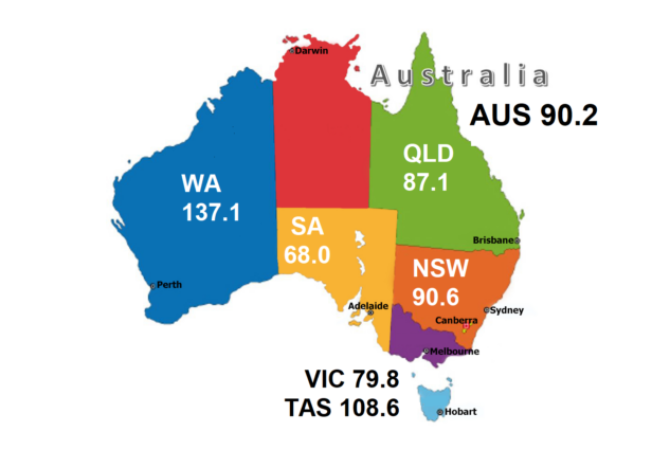
In April 2023 Roy Morgan Business Confidence was 90.2 (down 3.4pts since March) before the RBA raised interest rates last week by +0.25% to 3.85%. Official interest rates are now at their highest for over a decade since May 2012.
Business Confidence has returned to its level of November 2022 (90.2) when official interest rates were at 2.85%. Since then, there have been four interest rate increases in December, February, March and May, up by a total of 1% point during this intervening period.
The RBA’s latest increase last week came after the ABS released March quarter 2023 CPI figures which showed annual inflation in Australia at 7.0% - down from 7.8% in the December quarter 2022.
Now only 38.7% of businesses (down 3.1ppts) expect the business will be ‘better off’ financially this time next year – the lowest figure for this indicator for four years since April 2019 – although this is the only indicator still in positive territory with optimists exceeding pessimists. Just over a quarter of businesses, 27.7%, up 0.6ppts, expect to be ‘worse off’ financially in a year’s time.
In contrast, businesses are most worried about the performance of the Australian economy over the next year with 60.1% expecting ‘bad times’ for the economy over the next year compared to only 37.4% expecting ‘good times’ – a net negative of 22.7% points in April.
Business Confidence is now 22.1pts below the long-term average of 112.3 but still 12.5pts higher than the latest - ANZ-Roy Morgan Consumer Confidence of 77.7 for May 1-7, 2023.
Roy Morgan Monthly Business Confidence -- Australia
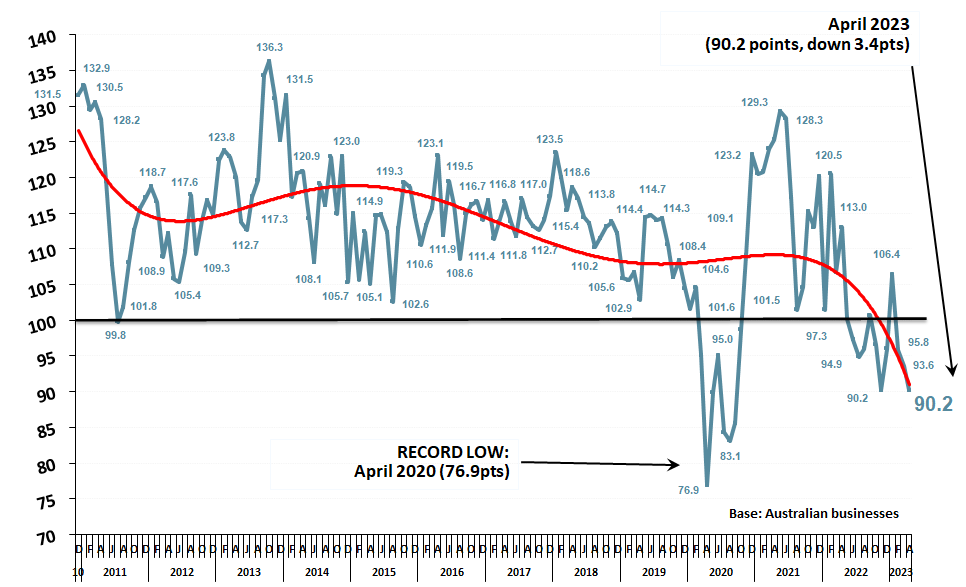
Source: Roy Morgan Business Single Source, Dec 2010-Apr 2023. Average monthly sample over the last 12 months = 1,465.
Business Confidence is highest in Western Australia and Tasmania in early 2023
Business Confidence was down slightly in April despite the RBA deciding to pause their cycle of interest rate increases for the month. Business Confidence is now at 90.2, down 3.4pts (-3.6%) from a month ago, and down a large 22.8pts (-20.2%) from a year ago.
There are two exceptions to this broader down-trend over the last year led by Western Australia, for which Business Confidence was up in April and up by 16.3pts (+13.5%) on a year ago to 137.1, and in Tasmania with Business Confidence at 108.6, up 25.3pts (+30.4%) on a year ago.
The ongoing commodities boom – and especially exports of iron ore and gas which are heavily concentrated in Western Australia – have clearly given the State a large boost over the last year that other States have not enjoyed. Treasurer Jim Chalmers is set to deliver Australia’s first Federal Budget surplus in 15 years due to the commodity export boom.
Tasmania’s heavy reliance on the tourism sector has also proved to be a boon for the State as the ending of COVID-19 restrictions allows Australians, and foreign holidaymakers, to travel extensively and ‘catch up’ on the holidays foregone during the last three years.
In contrast to these two outliers, all other States have far lower Business Confidence than a year ago – down by at least 25 points in New South Wales, Victoria, Queensland and South Australia.
Business Confidence in New South Wales is in line with the national average at 90.6 in April, down 29.4pts (-24.5%) on a year ago – the first full month of the new ALP Government led by Chris Minns.
In the three other States Business Confidence is down on a year ago and now below the national average. In Queensland Business Confidence is down 26.9pts (-23.6%) from a year ago to 87.1 and in Victoria the measure is down a large 29.9pts (-27.3%) from a year ago to 79.8 – below 80 for the first time since September 2020.
Business Confidence is now lowest in the country in South Australia at only 68.0, down 27.2pts (-28.6%) from a year ago. This is the lowest rating for Business Confidence in the State since the election of Premier Peter Malinauskas and the ALP Government just over a year ago in March 2022.
Business Confidence by State in April 2022 vs April 2023
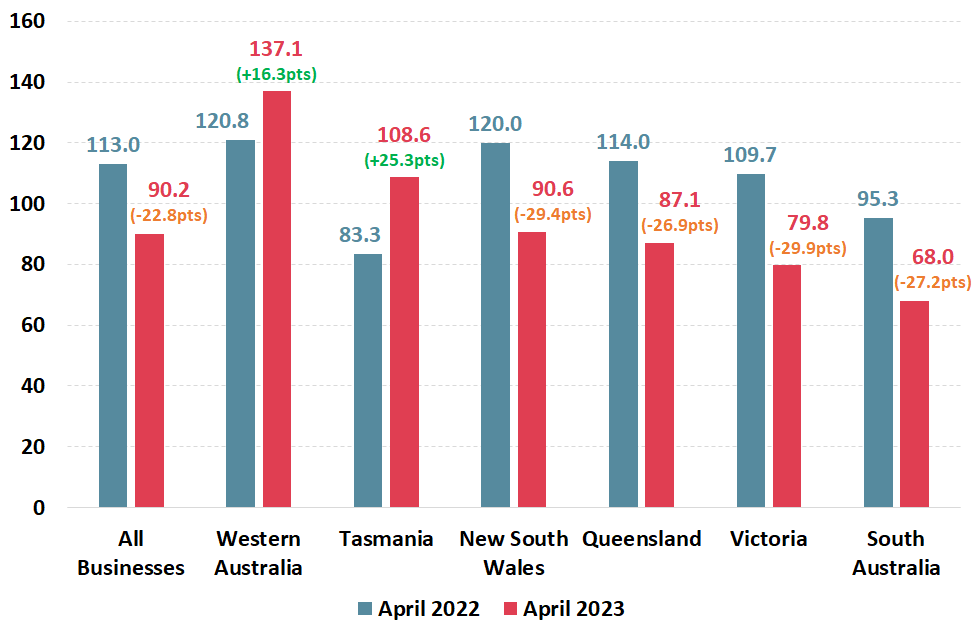
Source: Roy Morgan Business Single Source, April 2022, n=1,353, April 2023, n=1,724. Base: Australian businesses. *Tasmanian Business Confidence is measured over three months: Feb-Apr 2022 cf. Feb-Apr 2023.
Education & Training, Accommodation & Food Services, Information Media & Telecommunications and Recreation & Personal are the most confident industries in April
Over the last two months only four industries, Education & Training, Accommodation & Food Services, Information Media & Telecommunications and Recreation & Personal had Business Confidence over 20% higher than the national average of 91.8.
The most confident industry was again Education & Training with Business Confidence of 128.7, an increase of 21.6pts (+20.1%) on a year ago. This industry has been amongst the most confident throughout the last year as the relaxation of pandemic restrictions led to a re-opening of Australia’s borders and the return of tens of thousands of international students to Australia.
Another industry with high Business Confidence is Accommodation & Food Services on 119.1, although this is down significantly from a year ago by 32.3pts (-21.4%) just after the first big holiday period post re-opening (Easter 2022). Nevertheless, the ending of pandemic related travel restrictions is still providing a boost to this industry as Australians enjoy the freedom to travel once more.
In third place is Information Media & Telecommunications on 114.6, up 5.8pts (+5.3%) on a year ago just ahead of Recreation & Personal on 111.3, up a large 29.6pts (+36.1%) – the largest increase of any industry compared to a year ago.
Other confident industries include Administration & Support Services with Business Confidence of 106.2, down 16.2pts (-13.2%) on a year ago just ahead of Finance & Insurance on 105.8, down 12.6pts (-10.6%) on a year ago and Transport, Postal & Warehousing on 101.0, down 8.7pts (-7.9%) on a year ago.
There’s a familiar industry at the bottom with Business Confidence lowest of all for Electricity, gas & water on 67.8 during March and April 2023 – although this is an increase of 2.9pts (+4.5%) on a year ago.
Other industries with low Business Confidence include Agriculture on 74.9, down 49.3pts (-39.7%) on a year ago – the largest fall over the last year of any industry, Public Administration & Defence on 75.9, down 19.6pts (-20.5%) on a year ago and Manufacturing on 77.3, down 25.7pts (-24.9%) on a year ago.
Business Confidence for Top 5 and Bottom 5 Industries in March – April 2023
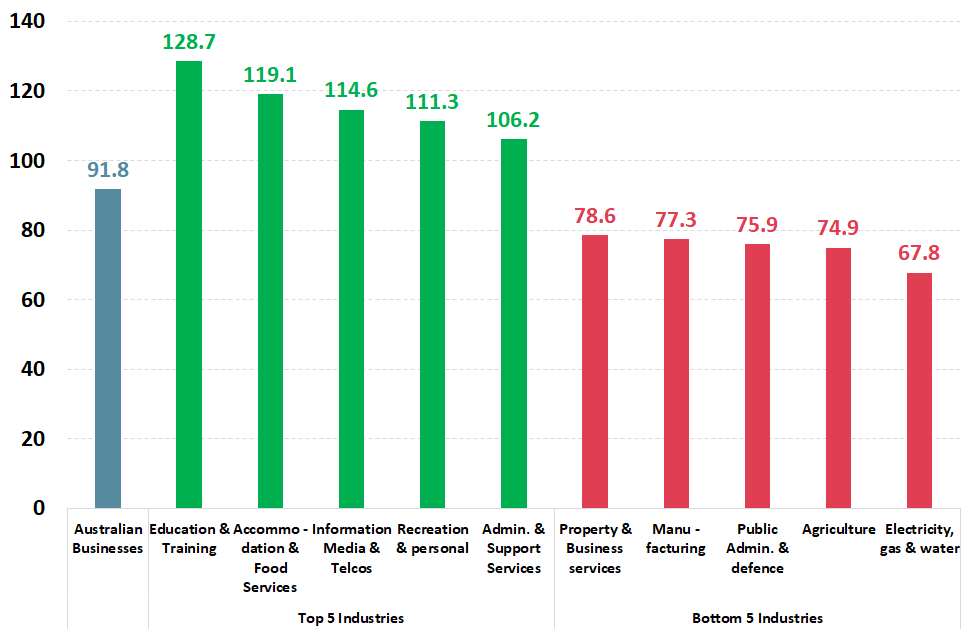
Source: Roy Morgan Business Single Source, March – April 2023, n=3,155. Base: Australian businesses. Note: In the chart, green bars are Business Confidence in positive territory above the national average and red bars represent Business Confidence well below the national average and below the neutral level of 100.
Business Confidence fell to a five-month low in April – led down by a drop in those saying ‘now is a good time to invest’ in growing the business:
- Views on whether now is a ‘good or bad time to invest in growing the business’ deteriorated with 51.7% (up 6.5ppts) saying the next 12 months will be a ‘bad time to invest’ in growing the business (the highest figure for this indicator for over a decade since May 2012) and only 40.5% (down 5.6ppts) who say the next 12 months will be a ‘good time to invest in growing the business;
- In April, just under a third of businesses, 32.4% (down 2.6ppts), said their business is ‘better off’ financially than this time a year ago, the lowest figure for this indicator for over a year since January 2022, while nearly two-fifths, 39.3% (up 5.4ppts), said the business is now ‘worse off’;
- Businesses are still broadly positive about their own prospects for the next year, with 38.7% (down 3.1ppts) expecting the business will be ‘better off’ financially this time next year, while just over a quarter, 27.7% (up 0.6ppts), expect the business will be ‘worse off’;
- In April businesses were on balance slightly more negative about Australia’s economic performance over the next year with a majority of 60.1% (down 0.2ppts) expecting ‘bad times’ while only 37.4% (down 1.1ppts), expect ‘good times’;
- However, businesses were less negative on the longer-term outlook for the Australian economy with a declining majority of 57.1% (down 3.5ppts) expecting ‘bad times’ for the Australian economy over the next five years while 37.7% (up 4.3ppts) expect ‘good times’ over the next five years.
Michele Levine, CEO of Roy Morgan, says Business Confidence dropped for a third straight month in April, down by 3.4pts to 90.2, its lowest since November 2022, even before the RBA raised interest rates in early May to an 11-year high:
“Roy Morgan Business Confidence dropped 3.4pts (-3.6%) to 90.2 in April, sending the index to its lowest for five months since November 2022 (90.2). Business Confidence is now 22.8pts (-20.2%) lower than it was a year ago in April 2022 (113.0) – before the RBA began to raise interest rates.
“A look at the key indicators shows that businesses are still broadly confident about their personal circumstances with 38.7% expecting the business will be ‘better off’ financially this time next year compared to 27.7% who say they will be ‘worse off’ financially.
“The real concern businesses have is about the fortunes for the Australian economy going forward. Over three-fifths of businesses expect ‘bad times’ for the Australian economy over the next year, 60.1%, and almost as many, 57.1% expect ‘bad times’ for the economy over the next five years.
“The uncertainty businesses feel about the economic situation facing Australia highlights the importance of the Albanese Government’s first Federal Budget delivered this week by Treasurer Jim Chalmers. In facing the key challenges of high inflation and rising interest rates Chalmers has already been given a boost with large commodity exports set to deliver Australia’s first Budget Surplus for 15 years.
“On a State-by-State basis Business Confidence is above the neutral level of 100 in only two States – the mining-dependent Western Australia at 137.1 and the tourism-dependent Tasmania at 108. Business Confidence is below the neutral level of 100 in all other States including NSW (90.6), Queensland (87.1), Victoria (79.8) and SA (68.0). This is the lowest Business Confidence in NSW since August 2020 and the lowest for Victoria since September 2020.
“At an industry level there were four industries flying high in March-April 2023 with Business Confidence above 110 – all over 20% higher than the national average. Leading the pack are Education & Training on 128.7, Accommodation & Food Services on 119.1, Information Media & Telecommunications on 114.6 and Recreation & Personal on 111.3.
“In contrast, there continues to be very low Business Confidence for the Electricity, gas & water industry at only 67.8, although this is an improvement of 2.9pts (+4.5%) on a year ago.”
The latest Roy Morgan Business Confidence results for April are based on 1,724 detailed interviews with a cross-section of Australian businesses from each State and Territory. Detailed findings are available to purchase on a monthly or annual subscription as part of the Roy Morgan Business Confidence Report.
For comments or more information please contact:
Michele Levine
CEO, Roy Morgan
Office: +61 (3) 9224 5215
Mobile: 0411 129 093
To learn more about Roy Morgan’s Business Confidence, Consumer Confidence and Inflation Expectations data call (+61) (3) 9224 5309 or email askroymorgan@roymorgan.com.
About Roy Morgan
Roy Morgan is Australia’s largest independent Australian research company, with offices in each state, as well as in the U.S. and U.K. A full-service research organisation, Roy Morgan has over 80 years’ experience collecting objective, independent information on consumers.
Margin of Error
The margin of error to be allowed for in any estimate depends mainly on the number of interviews on which it is based. Margin of error gives indications of the likely range within which estimates would be 95% likely to fall, expressed as the number of percentage points above or below the actual estimate. Allowance for design effects (such as stratification and weighting) should be made as appropriate.
| Sample Size | Percentage Estimate |
| 40% – 60% | 25% or 75% | 10% or 90% | 5% or 95% | |
| 1,000 | ±3.0 | ±2.7 | ±1.9 | ±1.3 |
| 5,000 | ±1.4 | ±1.2 | ±0.8 | ±0.6 |
| 7,500 | ±1.1 | ±1.0 | ±0.7 | ±0.5 |
| 10,000 | ±1.0 | ±0.9 | ±0.6 | ±0.4 |
| 20,000 | ±0.7 | ±0.6 | ±0.4 | ±0.3 |
| 50,000 | ±0.4 | ±0.4 | ±0.3 | ±0.2 |


