


ANZ-Roy Morgan Inflation Expectations were at 6.1% in late May – down 0.9% points from the month of April
The weekly ANZ-Roy Morgan Inflation Expectations increased in the month of April but have since rapidly declined during the subsequent weeks in May and are now at 6.1% for the week of May 17-24, 2026, down 0.9% points from the month of April.
The latest weekly reading is in line with the average for Inflation Expectations over the first 20 weeks of 2026, which is also 6.1%. A look at monthly Inflation Expectations for April 2026 shows the measure at 7% for the month – up 0.7% points from the prior month of March, and up a large 1.7% points over the two months since February, before the conflict in the Middle East began.
Looking back over the last six months weekly Inflation Expectations have averaged 6% since mid-November 2025 and have trended higher in recent months. In addition, the latest information on weekly Inflation Expectations is available to view each week in the Roy Morgan Weekly Update video on YouTube.
Monthly Inflation Expectations Index long-term trend – Expected Annual Inflation in next 2 years
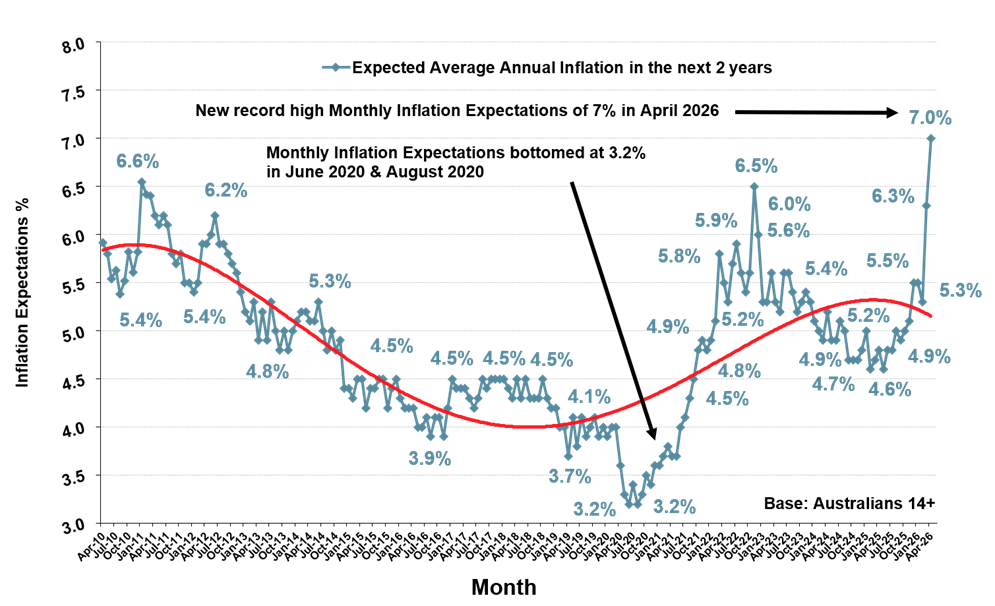
Source: Roy Morgan Single Source: Interviewing an average of 4,900 Australians aged 14+ per month (April 2010 – April 2026).
Average retail petrol prices were at record highs in March, but dropped by over 60 cents in April
Average retail petrol prices hit a record high of $2.53 per litre in late March, but dropped rapidly during April, down by 61 cents per litre (-24.1%) to end the month of April at a price of $1.92 per litre.
The rapid rise in petrol prices during March, and rapid decline during April meant that average retail petrol prices were at a record high of $2.18 in both March and April, more than 10 cents above the previous record monthly high of $2.05 in September 2023.
The Albanese Government’s decision to cut the fuel excise in half, cutting the tax by over 26 cents per litre, at the end of March clearly helped to lower the price of petrol significantly during the month of April.
Since April ended, average retail petrol prices have dropped below $1.90 per litre and averaged $1.84 per litre during the first four weeks of May.
Australian average retail petrol prices (cents per litre) weekly: 2021 – 2026
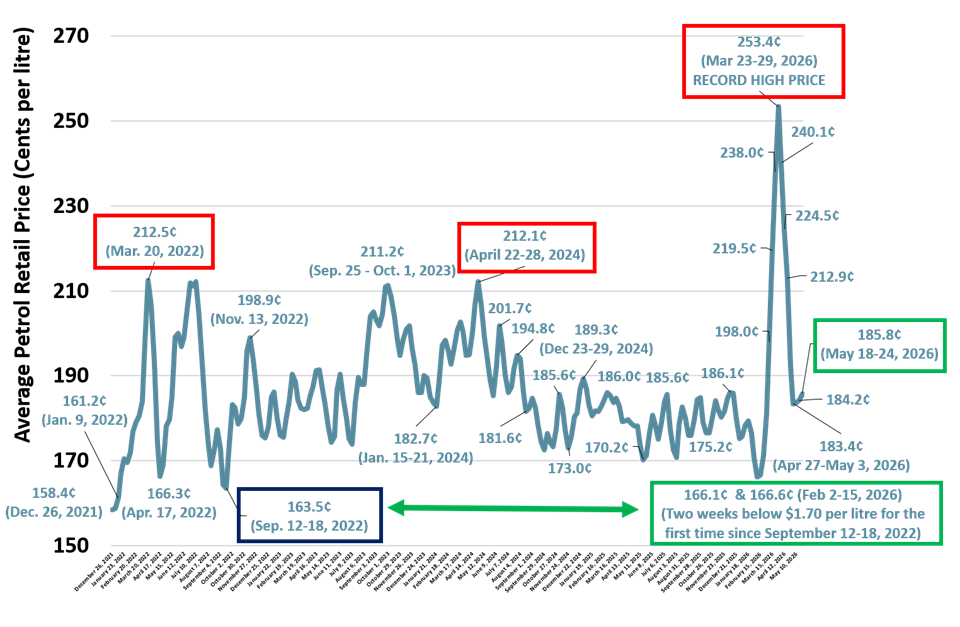
Source: Australian Institute of Petroleum (AIP) weekly reports: https://www.aip.com.au/pricing/weekly-prices-reports.
The latest official ABS quarterly annual CPI estimate at 4.6% for the year to March 2026 is now significantly above the Reserve Bank’s preferred target range of 2-3% over the course of the economic cycle. Official estimates of inflation have more than doubled since June 2025 (1.9%).
The increase in official estimates of inflation led to the Reserve Bank’s decision to commence a cycle of increases by raising interest rates at its first three meetings of 2026 in February (+0.25%), March (+0.25%), and again at its most recent meeting in May (+0.25% to 4.35%).
The next ABS Monthly CPI estimate for April 2026 is due to be released on Wednesday.
Inflation Expectations were again highest in Tasmania and Queensland, at record highs above 7%
A look at Monthly Inflation Expectations on a State-based level for April shows increases in all six States, and significant increases in the three largest States.
Inflation Expectations were highest in Tasmania, up 1% point to 7.8%, just ahead of Queensland at 7.5%, up 0.5% points on a month ago. Inflation Expectations in New South Wales increased 0.7% points to 6.9% and were up 1.1% points to 6.8% in Victoria – the largest increase of any State.
There were marginal increases to Inflation Expectations in Western Australia, up 0.2% points to 6.8%, and were up 0.2% points to 6.6% in South Australia.
Inflation Expectations in Country Areas increased 0.4% points to 7.3% in April, and in Capital Cities jumped 0.8% points for a second straight month to 6.8%.
Roy Morgan CEO Michele Levine says Inflation Expectations rocketed higher in March and remained at a high level throughout April – from 5.3% (February 2026) to 6.3% (March 2026) and 7% (April 2026) – an increase of 1.7% points, but have since fallen to 6.1% in late May:

“ANZ-Roy Morgan Inflation Expectations in Australia increased sharply after the United States and Israel began attacked Iran on the last day of February, increasing 1% point in the month of March to 6.3%, and up a further 0.7% points to a record monthly high of 7% for April.
“In fact, weekly Inflation Expectations hit a record high of 7.3% in late March and were still as high as 7.1% in mid-April. Over the last month since then weekly Inflation Expectations have declined by 1% point to 6.1% in late May. Inflation Expectations dropped after the Albanese Government cut the fuel excise in half – a drop of over 26 cents per litre – in the first week of April.
“Average retail petrol prices hit a record high of $2.53 per litre in late March – an increase of over 87 cents per litre since mid-February. However, since peaking, the cut in the fuel excise has led to a plummeting fuel price – now down around 70 cents a litre since late March (-31.9%).
“Even before the conflict in the Middle East and the recent increase in the average retail petrol price, official estimates of inflation in Australia were rapidly increasing, from a low of 1.9% in June 2025, up to 3.7% in February 2026. During the first month of the Middle Eastern conflict official inflation figures jumped to 4.6% in March 2026 – the highest since October 2023.
“The sharp rise in inflationary pressures in the broader economy over the last nine months – more than doubling and increasing by 2.7% points since June – led to the Reserve Bank’s decision to increase interest rates by +0.25% to 3.85% in early February, by +0.25% to 4.1% in mid-March, and by another +0.25% to 4.35% in early May – wiping out last year’s rate cuts.
“The sharp rise in Inflation Expectations clearly continued during April, and this will likely lead to another rise in the official ABS inflation figures released later this week. A further increase in the official inflation figures is likely to pressure the Reserve Bank to raise interest rates again.
“However, the latest Inflation Expectations data shows concerns about inflation have moderated over the last few weeks with the measure dropping by over 1% point since reaching a high in late March. These results suggest the Reserve Bank should consider leaving interest rates unchanged at their next meeting set for mid-June.”
See below for a comprehensive list of RBA interest rate changes during the time-period charted above.
The data for the Inflation Expectations series is drawn from the Roy Morgan Single Source which has interviewed an average of around 5,300 Australians aged 14+ per month over the last decade from May 2016 – April 2026 and includes interviews with 5,066 Australians aged 14+ in April 2026.
For comments and information about Roy Morgan’s Inflation Expectations data, please contact:
Roy Morgan Enquiries
Office: +61 (3) 9224 5309
askroymorgan@roymorgan.com
About Roy Morgan
Roy Morgan is Australia’s largest independent Australian research company, with offices in each state, as well as in the U.S. and U.K. A full-service research organisation, Roy Morgan has over 80 years’ experience collecting objective, independent information on consumers.
Margin of Error
The margin of error to be allowed for in any estimate depends mainly on the number of interviews on which it is based. Margin of error gives indications of the likely range within which estimates would be 95% likely to fall, expressed as the number of percentage points above or below the actual estimate. Allowance for design effects (such as stratification and weighting) should be made as appropriate.
| Sample Size | Percentage Estimate |
| 40% – 60% | 25% or 75% | 10% or 90% | 5% or 95% | |
| 1,000 | ±3.0 | ±2.7 | ±1.9 | ±1.3 |
| 5,000 | ±1.4 | ±1.2 | ±0.8 | ±0.6 |
| 7,500 | ±1.1 | ±1.0 | ±0.7 | ±0.5 |
| 10,000 | ±1.0 | ±0.9 | ±0.6 | ±0.4 |
| 20,000 | ±0.7 | ±0.6 | ±0.4 | ±0.3 |
| 50,000 | ±0.4 | ±0.4 | ±0.3 | ±0.2 |


