


ANZ-Roy Morgan Inflation Expectations were at 5.2% in mid-February – down 0.3% points from the month of January

The weekly ANZ-Roy Morgan Inflation Expectations have remained high so far in 2026, averaging 5.4% over the first seven weeks and were at 5.2% for the week of February 16-22, 2026, down 0.3% points from the full month of January.
A look at monthly Inflation Expectations for January 2026 shows the measure at 5.5% for the month – unchanged from the prior month of December, the equal highest monthly figure since July 2023.
Interestingly, looking back over the last six months, since late August 2025, weekly Inflation Expectations have moved in a band of 4.7% - 5.6% and averaged 5.2%. In addition, the latest information on weekly Inflation Expectations is available to view each week in the Roy Morgan Weekly Update video on YouTube.
Monthly Inflation Expectations Index long-term trend – Expected Annual Inflation in next 2 years
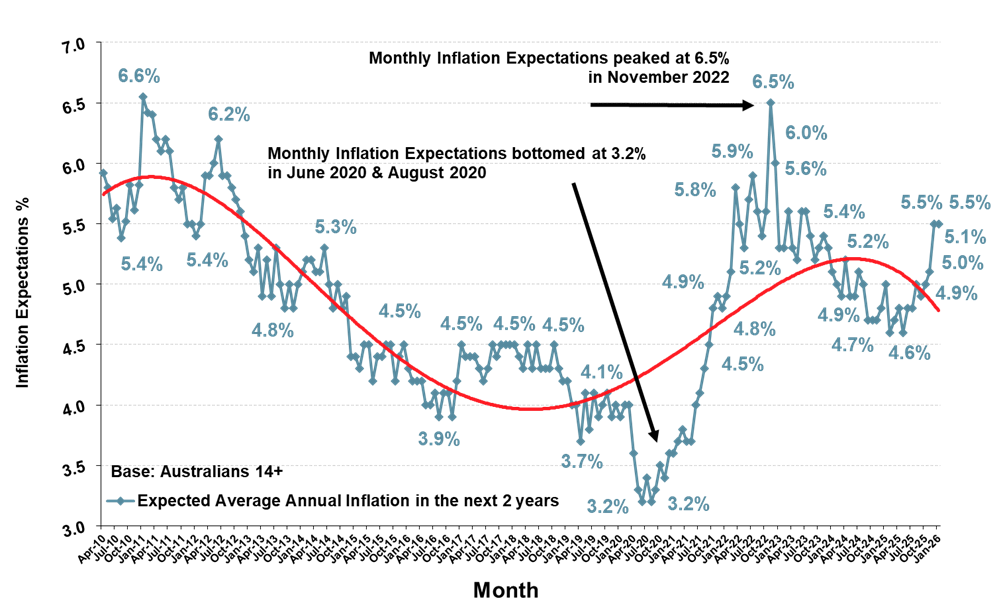
Source: Roy Morgan Single Source: Interviewing an average of 4,900 Australians aged 14+ per month (April 2010 – Jan. 2026).
Average retail petrol prices were at $1.77 per litre in January, the lowest since May 2025
During January, average retail petrol prices were below $1.80 per litre at $1.77 per litre and at their lowest for eight months since May 2025. Average retail petrol prices started the month of January at $1.76 per litre and increased marginally during the next three weeks of the month.
Looking longer-term, average retail petrol prices were at, or above, $1.70 per litre for a record 176 straight weeks, from mid-September 2022 through until the end of January 2026 averaging $1.86 per litre.
The reduction in petrol prices early in 2025 clearly lessened inflation pressures and was no doubt a factor for the Reserve Bank behind its decision to cut interest rates in February, May and August 2025. However, there was renewed strength in petrol prices in the second half of 2025 – peaking at an average price of $1.86 per litre in early December.
This rise undoubtedly contributed to a rise in inflationary pressures in the second half of 2026 which caused the Reserve Bank to leave interest rates unchanged three times in late 2025 and then raised interest rates by +0.25% to 3.85% in its first meeting this year in early February 2026.
Australian average retail petrol prices (cents per litre) weekly: 2021 – 2026
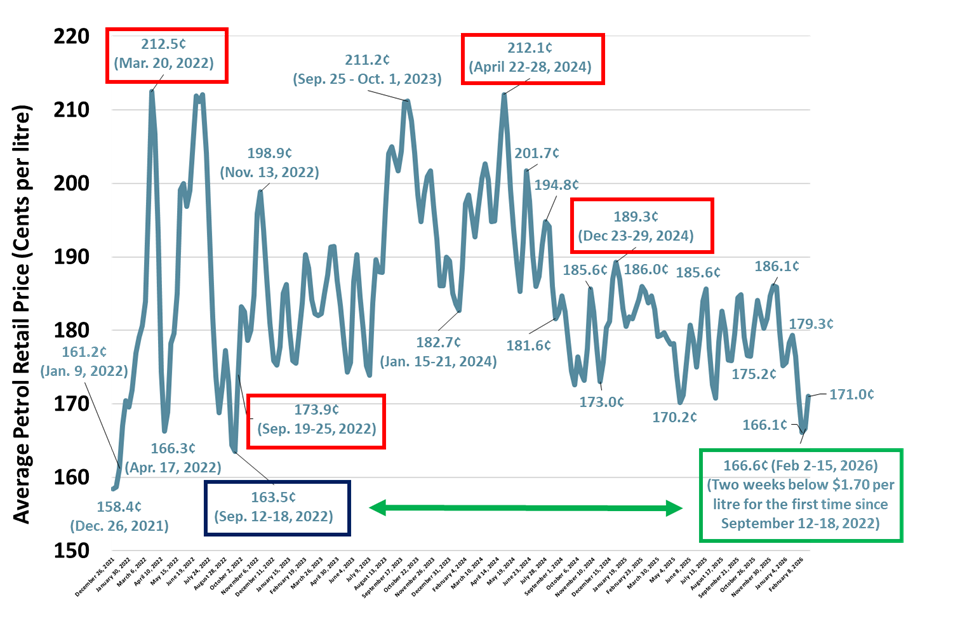
Source: Australian Institute of Petroleum (AIP) weekly reports: https://www.aip.com.au/pricing/weekly-prices-reports.
The latest official ABS quarterly annual CPI estimate at 3.8% for the year to December 2025 is now above the Reserve Bank’s preferred target range of 2-3% over the course of the economic cycle. Office estimates of inflation have doubled in only six months since June 2025 (1.9%).
The increase in official estimates of inflation led to the Reserve Bank’s decision to leave interest rates unchanged for its last three meetings in October, November and December 2025, and eventually commence a cycle of increases by raising interest rates at its first meeting of 2026 early in February.
The next ABS Monthly CPI estimate for January 2026 is due to be released next week on Wednesday.
Inflation Expectations were highest in Tasmania and Western Australia, well above 5.5%
A look at Monthly Inflation Expectations on a State-based level for January shows increases in four States – Tasmania, Western Australia, New South Wales, and Victoria, but sharp declines in both Queensland and South Australia cancelling out the overall movement.
Inflation Expectations in Tasmania increased sharply by 0.8% to 5.9% - and now the highest of any State, and up 0.1% to 5.8% in Western Australia. Inflation Expectations increased by 0.2% to 5.5% in New South Wales, and in line with the national average, and in Victoria, up 0.1% to 5.4%.
However, the large declines in Queensland, down 0.8% to 5.4%, and in South Australia, down 0.7% to 5.3% - and now the lowest of any State meant the overall figure was unchanged at 5.5%.
Inflation Expectations in Country Areas increased 0.2% points to 5.9% in January – the highest Inflation Expectations since July 2023, and in Capital Cities was down by 0.2% points to 5.3%
Roy Morgan CEO Michele Levine says weekly Inflation Expectations dropped to 5.2% in mid-February, down 0.3% from the monthly figure of 5.5% for January:

“ANZ-Roy Morgan Inflation Expectations in Australia have experienced a volatile few weeks – moving in a band of 0.6% between 5%-5.6% over the seven weeks since the start of the year. Inflation Expectations were at 5.2% in mid-February, down 0.3% points from the month of January (5.6%), and now below average so far this year of 5.4%.
“These results show that Inflation Expectations appear to have peaked over the summer months in December (5.5%) and January (5.5%) after a sharp run-up in the second half of 2025.
“The increase in Inflation Expectations in the second half of 2025 is no surprise with inflationary pressures driven by energy prices a key factor. The average retail petrol price hit an 11-month high of $1.86 per litre in early December, although dropped by 20 cents per litre by early February.
“The rise in Inflation Expectations, and average retail petrol prices, has been matched by a rapid increase of the official ABS Inflation from a low of 1.9% in June 2025, up to 2.8% in July 2025, and now 3.8% in December 2025.
“The sharp rise in inflationary pressures in the broader economy during the last few months of 2025 – increasing by 1.9% points since June – led to the Reserve Bank’s decision to leave interest rates unchanged in late 2025 and now increase interest rates by +0.25% to 3.85% at its first meeting of 2026 held in early February.
“Looking forward, the moderating of Inflation Expectations in recent weeks suggests inflation pressures in the economy may be reducing, however, the elevated level of inflation currently measured could lead to an additional RBA interest rate increase in a few weeks in mid-March.”
See below for a comprehensive list of RBA interest rate changes during the time-period charted above.
The data for the Inflation Expectations series is drawn from the Roy Morgan Single Source which has interviewed an average of around 5,300 Australians aged 14+ per month over the last decade from February 2016 – January 2026 and includes interviews with 3,023 Australians aged 14+ in January 2026.
For comments and information about Roy Morgan’s Inflation Expectations data, please contact:
Roy Morgan Enquiries
Office: +61 (3) 9224 5309
askroymorgan@roymorgan.com
About Roy Morgan
Roy Morgan is Australia’s largest independent Australian research company, with offices in each state, as well as in the U.S. and U.K. A full-service research organisation, Roy Morgan has over 80 years’ experience collecting objective, independent information on consumers.
Margin of Error
The margin of error to be allowed for in any estimate depends mainly on the number of interviews on which it is based. Margin of error gives indications of the likely range within which estimates would be 95% likely to fall, expressed as the number of percentage points above or below the actual estimate. Allowance for design effects (such as stratification and weighting) should be made as appropriate.
| Sample Size | Percentage Estimate |
| 40% – 60% | 25% or 75% | 10% or 90% | 5% or 95% | |
| 1,000 | ±3.0 | ±2.7 | ±1.9 | ±1.3 |
| 5,000 | ±1.4 | ±1.2 | ±0.8 | ±0.6 |
| 7,500 | ±1.1 | ±1.0 | ±0.7 | ±0.5 |
| 10,000 | ±1.0 | ±0.9 | ±0.6 | ±0.4 |
| 20,000 | ±0.7 | ±0.6 | ±0.4 | ±0.3 |
| 50,000 | ±0.4 | ±0.4 | ±0.3 | ±0.2 |


