


Australians turn to Kmart, Big W and Bunnings for value, but Amazon is closing the gap
As we head into peak retail season in the second half of the year, new Roy Morgan research reveals that Kmart and Big W continue to lead not only in ‘low price’ perception but also in value. However, over the last 5 years, Amazon has experienced a significant rise in these associations, prompting further conversation about how Australians define products that are value for money and its relationship with low prices.
Who owns ‘low price’ perception?
Kmart and Big W continue to lead on low-price perception, with 58% and 46% of Australians respectively associating these brands with the statement “has low prices”. However, as identified in previous Roy Morgan retail research, most traditional discount retailers have seen declines in this measure over the last five years.
- The Reject Shop: down 13% points since 2021 to 41%.
- Big W: down 9% points to 46%.
- Kmart: down 5% points to 58%.
- Bunnings: down 5% points to 27%.
% of Australians 14+ who associate each store with ‘Has low prices’
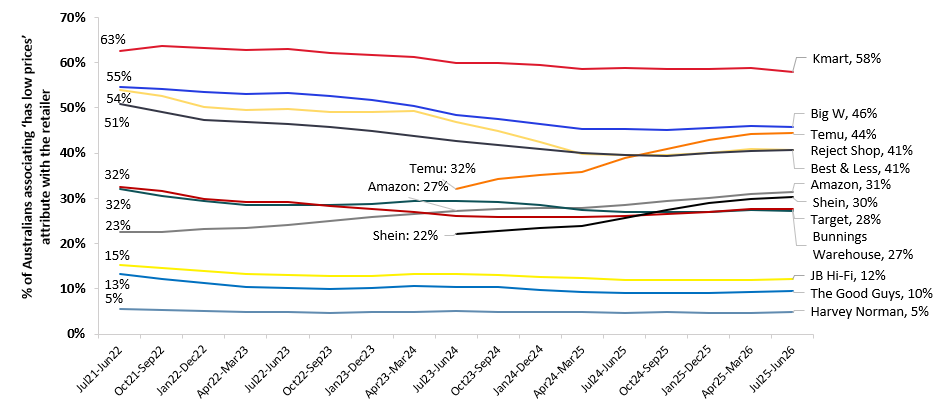
Source: Roy Morgan Single Source (Australia), July 2021 – June 2026. Average number of interviews for each 12-month period, n=65,070. Base: Australians 14+. Question: Which, if any, of the following statements do you associate with each store – “Has low prices.”
Meanwhile, online marketplaces Amazon, Temu and Shein have seen steep increase in low-price perceptions, especially Temu over the last two years. Since the 12 months to June 2024:
- Temu’s “low prices” association has risen from 32% to 44% (+12% points), overtaking The Reject Shop and Best & Less, with its sights now on Big W.
- Association of Amazon to “low prices” went up +4% points to 31% over the same period.
- Shein’s “low prices" association increased from 22% to 30% (+8% points) over the last two years and is now ahead of both Target (28%) and Bunnings Warehouse (27%) and closing the gap with Amazon.
Amazon, Temu and Shein have now firmly reshaped Australians’ perception of ‘low prices’.
Who owns perceived value in Australia?
Low-price perception may increasingly be claimed by global online marketplaces, but established Australian retailers still maintain a stronghold of value-for-money perception. Kmart, Big W and Bunnings Warehouse continue to lead on perceived value, with 54%, 50% and 48% of Australians respectively, associating these brands with the statement “has products that are good value for money”.
While Amazon, Temu and Shein continue to improve their image of value-for-money, only Amazon gained considerable ground with an 11%-point increase over the past five years. Amazon notably surpassed Target, Best & Less and The Reject Shop in the 12 months to June 2025 and appears to be steadily closing the gap on Bunnings Warehouse in the 12 months to June 2026.
The latest Roy Morgan data shows 40% of Australians associate Amazon with having products that are “good value for money”. Similarly to low-price perception, many traditional discount retailers have seen declines in this measure over the last five years.
- The Reject Shop: down 7% points to 29% since 2021.
- Target: down 5% points to 35%.
- Best & Less: down 5% points to 33%.
It should be noted that despite longer-term declines, both Target and Best & Less have shown signs of stabilisation, each recording modest year-on-year improvements.
Temu and Shein have also improved their value-for-money credentials, although they remain associated with value by less than 25% of Australians aged 14+. Since the 12 months to June 2024:
- Temu's value-for-money association has increased from 17% to 23% (+6% points), narrowing the gap on The Good Guys.
- Shein's value-for-money association has increased from 12% to 16% (+4% points), bringing it almost level with Harvey Norman.
% of Australians 14+ who associate each store with ‘Has products that are good value for money’
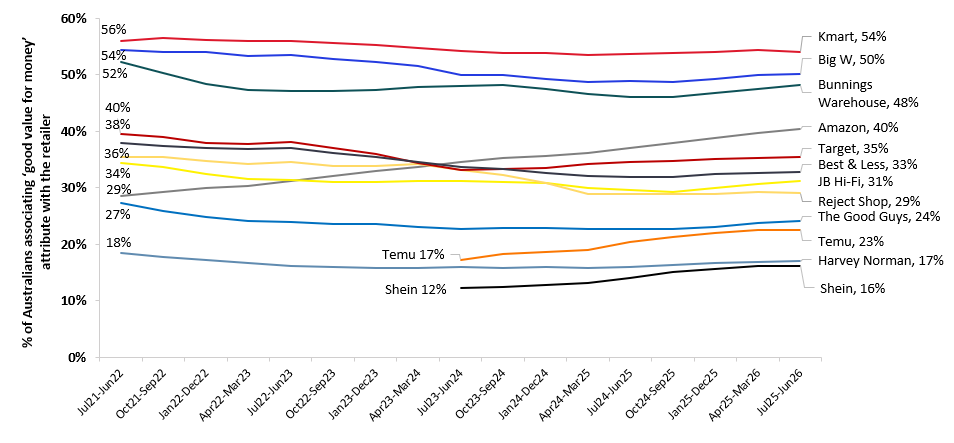
Source: Roy Morgan Single Source (Australia), July 2021 – June 2026. Average number of interviews for each 12-month period, n=65,070. Base: Australians 14+. Question: Which, if any, of the following statements do you associate with each store – “Has products that are good value for money.”
The findings highlight that low prices and value for money are related but distinct concepts in the minds of Australian consumers. While Temu and Shein have rapidly built strong low-price perceptions, retailers such as Bunnings Warehouse continue to score more strongly on value for money, suggesting Australians consider quality, trust and overall shopping experience alongside price when judging value.
One retailer who has steadily improved in both measures over time is Amazon. This suggests Australians increasingly perceive Amazon as offering a balance of competitive pricing, convenience and reliability, rather than simply being a low-cost shopping destination.
Michele Levine, Roy Morgan’s CEO, says:

“The results reflect a retail market where value has become increasingly important, but consumers are defining value more broadly than merely finding the lowest price. Ongoing cost-of-living pressures may continue to drive demand for affordability, but this recent Roy Morgan data shows consumers still see the distinction between low price and overall value. This demonstrates the need for retailers to continue positioning themselves around delivering better overall value rather than simply being the cheapest option.
“BIG W managed to keep its value perception stable in the last couple of years as it continues to lean into affordability and family value through its recent “How Good’s That?” campaign — reinforcing its position as a retailer that helps Australians stretch household budgets without compromising on everyday needs. Similarly, Best & Less showed stabilisation in value perception as it evolved its messaging beyond discount retailing, repositioning itself around “quality value” rather than competing solely on price.
“Bunnings Warehouse continues to outperform on value relative to low-price perceptions. Acknowledging that “lowest prices are just the beginning” appears to be hitting the mark as Australians continue to nominate Bunnings Warehouse as the most trusted brand in Australia. This could be Australians’ way of saying product quality, reliability, assortment and trust alongside price determine whether a retailer offers genuine value.
“Amazon’s growth is particularly noteworthy because it has strengthened both low-price and value-for-money perceptions over time. Our data suggests Amazon’s retail proposition is resonating beyond price and that it has earned its place among major retailers such as Kmart and Big W.
“As competition intensifies heading into major shopping events such as Black Friday and Christmas, the findings suggest retailers face a growing challenge: winning on price may attract attention, but winning on value is increasingly what drives long-term brand strength. Those retailers able to combine affordability with quality, convenience and trust appear best positioned to resonate with Australian shoppers.”
For comments or more information about Roy Morgan’s Retail data and insights please contact:
Roy Morgan Enquiries
Office: +61 (3) 9224 5309
askroymorgan@roymorgan.com
About Roy Morgan
Roy Morgan is Australia’s largest independent Australian research company, with offices in each state, as well as in the U.S. and U.K. A full-service research organisation, Roy Morgan has over 80 years’ experience collecting objective, independent information on consumers.
Margin of Error
The margin of error to be allowed for in any estimate depends mainly on the number of interviews on which it is based. Margin of error gives indications of the likely range within which estimates would be 95% likely to fall, expressed as the number of percentage points above or below the actual estimate. Allowance for design effects (such as stratification and weighting) should be made as appropriate.
| Sample Size | Percentage Estimate |
| 40% – 60% | 25% or 75% | 10% or 90% | 5% or 95% | |
| 1,000 | ±3.0 | ±2.7 | ±1.9 | ±1.3 |
| 5,000 | ±1.4 | ±1.2 | ±0.8 | ±0.6 |
| 7,500 | ±1.1 | ±1.0 | ±0.7 | ±0.5 |
| 10,000 | ±1.0 | ±0.9 | ±0.6 | ±0.4 |
| 20,000 | ±0.7 | ±0.6 | ±0.4 | ±0.3 |
| 50,000 | ±0.4 | ±0.4 | ±0.3 | ±0.2 |


