


Bunnings is Australia’s most trusted brand; but distrust grows for key supermarkets and technology brands

Bunnings is the most trusted brand in the 12 months to September 2026 – a twelfth consecutive quarterly victory for the leading hardware retailer stretching back three years to late 2023.
Optus is the most distrusted brand for a third straight quarter ahead of Facebook/Meta, and there’s growing distrust for supermarket giants Woolworths and Coles, with both deteriorating in the latest rankings.
For the eleventh straight quarter (starting in the 12 months to March 2024) the top three places are unchanged, with discount supermarket Aldi in second place, and discount department store Kmart in third.
The next two spots are unchanged for a fourth straight quarter with the Commonwealth Bank in fourth place just ahead of technology giant Apple, filling out the top five.
In fact, in the top ten there was only one mover, consumer electronics brand Samsung which improved one spot to tenth. Other brands to improve in the most recent quarter include Bendigo Bank, up two places to 16th, and media brand the ABC, re-entering the top 20 in 18th place, up three ranking positions.
There were downward movements for Australia Post, by one place to 11th, and office and stationery retailer Officeworks, down four spots to 20th.
Although not in the top 20 most trusted brands, the biggest improvements were media brand SBS, improving 38 spots to 79th, popular quick service restaurant KFC, up 25 spots to 76th, and consumer energy retailer Red Energy, up 24 places to 72nd.
View the latest Roy Morgan Trust & Distrust September 2026 Quarterly Update Webinar.
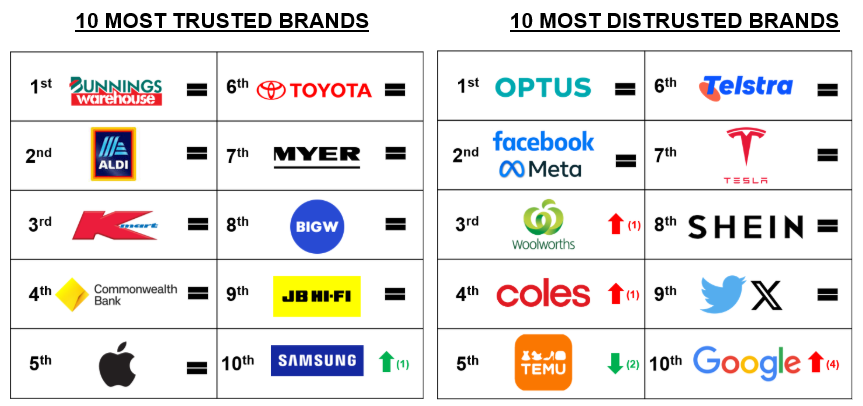
Figure 1: Australia’s 10 most trusted and 10 most distrusted brands in September 2026. Source: Roy Morgan Single Source (Australia). Risk Monitor, 12-month average to September 2026. Base: Australians 14+, n=17,975. Arrows with numbers show ranking change since June 2026.
Distrusted Brands: Woolworths, Coles, Google, OpenAI, and Microsoft deteriorate in the rankings
Optus has maintained the unwanted position as the most distrusted brand in Australia for the third straight quarter in the 12 months to September 2026, ahead of social media company Facebook/Meta.
Supermarket giants Woolworths and Coles deteriorated one place each to third and fourth most distrusted brands respectively amid renewed scrutiny of pricing and discount claims.
The beneficiary of their misfortune was discount online retailer Temu which improved its lowly standing by two positions to be the fifth most distrusted brand.
There were significant declines for three high tech companies including online search leader Google, which deteriorated four places to be the tenth most distrusted, artificial intelligence leader OpenAI (including ChatGPT) which deteriorated four spots to 12th most distrusted due to concerns about data use and privacy, and software giant Microsoft, which plunged 11 positions to be the 16th most distrusted brand.
Distrusted brands to improve their rankings included national carrier Qantas, improving four places to 14th, online retailer Amazon, which improved three places to 15th, social media company TikTok which improved two places to 17th, quick service hamburger restaurant McDonalds improving one place to 18th, and energy and petroleum company BP which improved one place to be 19th most distrusted.
Supermarket giants Woolworths and Coles both experience reversals in their recoveries with trust falling and distrust edging higher as scrutiny grows over pricing and discounting
Supermarkets bring questions of trust into the weekly shopping trip. People must keep buying food while deciding whether the businesses selling food are treating them fairly. That makes the relationship unusually exposed. A price rise can become a judgment about the company’s intentions, and a profit announcement can reopen a grievance the business thought it had addressed.
Both Woolworths and Coles had been recovering some ground, so what we now need to understand is why that recovery has become harder to sustain.
Woolworths trust and distrust trend chart (12-month average)
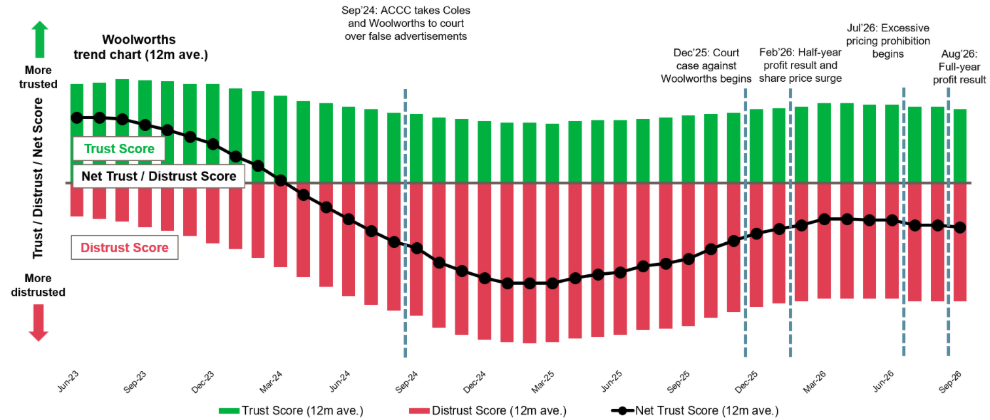
Source: Roy Morgan Single Source (Australia). Risk Monitor, 12-month average to September 2026.
Base: Australians 14+, latest 12-month average n=17,975. Latest 12-month average for Woolworths, n = 2,859.
Firstly to Woolworths (now the third most distrusted brand in Australia), which shows just how fragile a recovery can be. The improvement for Woolworths earlier in the year has stalled. Since June, trust in Woolworths has fallen and distrust has edged higher, leaving the net score sinking further below zero.
The larger part of that recent deterioration is the loss of positive trust.
Woolworths has reported stronger underlying earnings, but good financial results can carry a different meaning for a household struggling with its grocery bill. People may hear that the business is recovering and ask when their own position will improve. The excessive pricing rules that took effect on July 1, 2026, add scrutiny to that relationship.
The business problem is that a customer who already suspects unfairness can interpret the next corporate success as further evidence against the company.
Recovery then depends on changing what everyday encounters mean to that customer.
Coles trust and distrust trend chart (12-month average)
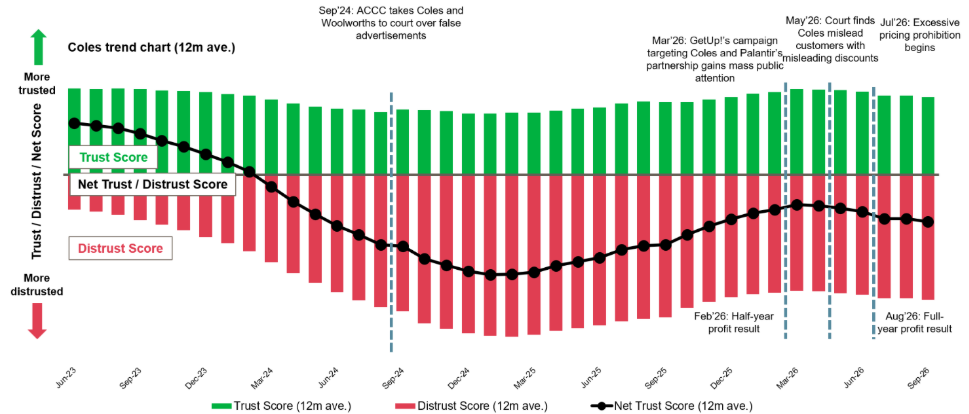
Source: Roy Morgan Single Source (Australia). Risk Monitor, 12-month average to September 2026.
Base: Australians 14+, latest 12-month average n=17,975. Latest 12-month average for Coles, n = 2,774.
Coles (now the fourth most distrusted brand in Australia) shows a similar reversal, with trust falling and distrust rising after an earlier period of improvement.
There’s also a concrete finding here about how customers were treated.
In May, the Federal Court found misleading representations by Coles in 13 of the 14 ‘Down Down’ tickets considered in the liability hearing. That matters because a discount is a promise that the customer is receiving genuine value.
When that promise fails, the damage can extend to the next offer and the next explanation. People begin to question whether they can rely on what the business tells them.
The excessive pricing rules that began on July 1, 2026, add another layer of scrutiny. We can’t assign a share of the score movement to any one event, but we can see the problem facing Coles: rebuilding confidence in its intentions as well as its prices. Continuing to shop there doesn’t tell us whether that confidence has returned.
Google moves into top ten most distrusted brands for the first time as distrust rises
Google brings the technology pattern into focus. Trust in Google has continued to decline, while distrust in the online search giant has risen again in the latest quarter.
Australians that distrust Google are citing privacy, poor quality AI and concerns about reliability or safety. Those reasons reach into the core of the relationship.
People depend on Google to help them find and judge information. If they become less confident in its answers or in how it handles their information, the usefulness of the service may no longer be enough to reassure them.
There’s a larger issue here about the limits of familiarity. We can know a brand, use it many times a day, and at the same time become less willing to accept its judgment.
An organisation can remain part of daily life while confidence in its intentions and competence drains away. That takes us beyond the score of any one brand and towards the social consequences of distrust.
Google trust and distrust trend chart (12-month average)
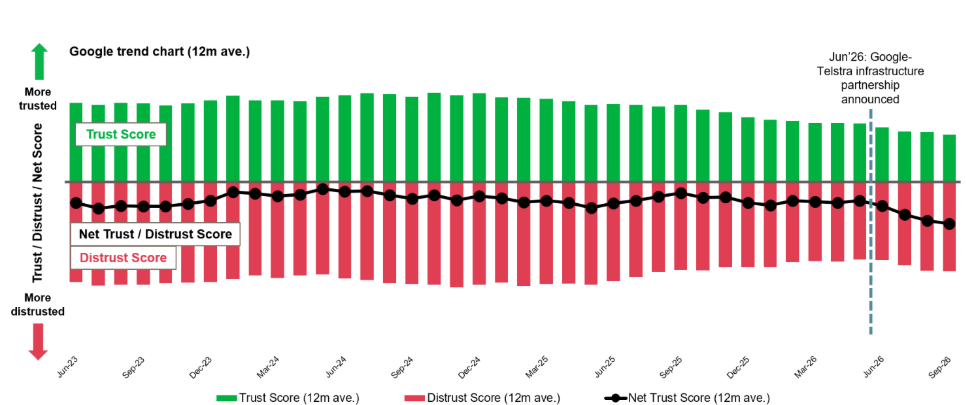
Source: Roy Morgan Single Source (Australia). Risk Monitor, 12-month average to September 2026.
Base: Australians 14+, latest 12-month average n=17,975. Latest 12-month average for Google, n = 566.
Roy Morgan CEO Michele Levine says Bunnings has notched up a twelfth consecutive quarter as Australia’s most trusted brand, but previous high-flyers including the supermarket giants, and several large technology companies are experiencing a significant rise in distrust:

“Bunnings has topped the rankings as Australia’s most trusted brand for an unprecedented twelfth consecutive quarter, and there’s some familiar faces at the top with Aldi and Kmart filling places second and third – as they have for eleven straight quarters since early 2024.
“Notable improvers in the most recent quarter are consumer products brand Samsung, up one spot to be the tenth most trusted, banking company the Bendigo Bank, up two places to 16th, and public broadcaster and media brand the ABC, re-entering the top 20 most trusted brands in 18th place.
“At the other end of the scale it is telecommunications company Optus which is again the most distrusted brand for a third straight quarter ahead of social media company Facebook/Meta.
“The most notable movers downward in the most recent quarter were the supermarket giants Woolworths and Coles – now the third and fourth most distrusted brands in the country respectively, indicating their recent recoveries have begun to stall as scrutiny increases on their pricing and discounting practices.
“There has been a continued rise in distrust in leading technology brands – a trend now seen over several quarters. Google is in the top ten most distrusted brands for the first time – deteriorating four places to tenth. AI category leader OpenAI (ChatGPT) has deteriorated again, by four places to 12th, and software giant Microsoft has plunged into the top 20 most distrusted brands in 16th.
“Distrust surrounding these tech giants is increasing driven by similar complaints from Australians with concerns about data use and respect for privacy all prevalent in relation to Google, OpenAI (ChatGPT) and Microsoft.
“In addition, Australians say Google’s Gemini AI is ‘poor quality’ and is ‘unreliable and unsafe’, assert that Microsoft is ‘not customer focused’ and is ‘too motivated by profit’, and note that the hack of the Medicare statistics portal by OpenAI’s ChatGPT bought questions about AI oversight into focus.
“To learn more about how trust, and distrust, are shaping perceptions of leading Australian brands, view the special ‘Trust and Distrust Quarterly Rankings Webinar”
Subscribe to Roy Morgan’s YouTube channel to ensure you don’t miss our next webinar on trust and distrust: https://www.youtube.com/c/roymorganaus.
Comprehensive Trust and Distrust Insights Reports are available in Roy Morgan’s online store here.
The Roy Morgan Risk Monitor surveys approximately 1,500-2,000 Australians every month (around 18,000 per year) to measure levels of trust and distrust of around 1,000 brands across 27 industries. Respondents are asked which brands they trust, and why, and which brands they distrust, and why. The survey is designed to be open-ended, context-free, and unprompted. Roy Morgan Risk Monitor data is available in a variety of formats, from snapshot overviews to detailed tracking of individual brands and competitors. Industry Trust and Brand Health Surveys are also conducted (e.g. Private Health Insurance, Agribusiness, Banking, Media, Telco, Utilities, Insurance, etc.) for deep insights into brand health, perceptions of brands, and customer experience (CX) with brands.
To learn more call (+61) (3) 9224 5309 or email askroymorgan@roymorgan.com.
About Roy Morgan
Roy Morgan is the source of the most comprehensive data on Australians’ behaviour and attitudes, surveying over 1,000 people weekly in a continuous cycle that has been running for two decades. The company has more than 80 years’ experience collecting objective, independent information.
Margin of Error
The margin of error to be allowed for in any estimate depends mainly on the number of interviews on which it is based. Margin of error gives indications of the likely range within which estimates would be 95% likely to fall, expressed as the number of percentage points above or below the actual estimate. Allowance for design effects (such as stratification and weighting) should be made as appropriate.
| Sample Size | Percentage Estimate |
| 40% – 60% | 25% or 75% | 10% or 90% | 5% or 95% | |
| 1,000 | ±3.0 | ±2.7 | ±1.9 | ±1.3 |
| 5,000 | ±1.4 | ±1.2 | ±0.8 | ±0.6 |
| 7,500 | ±1.1 | ±1.0 | ±0.7 | ±0.5 |
| 10,000 | ±1.0 | ±0.9 | ±0.6 | ±0.4 |
| 20,000 | ±0.7 | ±0.6 | ±0.4 | ±0.3 |
| 50,000 | ±0.4 | ±0.4 | ±0.3 | ±0.2 |


