


Bunnings is Australia’s most trusted brand; but distrust continues to grow in AI brands like OpenAI and Palantir

Bunnings is the most trusted brand in the 12 months to June 2026 – an eleventh consecutive quarterly victory for the leading hardware retailer stretching back almost three years to late 2023.
Although Optus is the most distrusted brand for a second straight quarter, the growing distrust for AI means two key AI brands are among the top 30 most distrusted brands in the country – Open AI (including ChatGPT) and AI defence and intelligence company Palantir – more on that development below.
For the tenth straight quarter (starting in the 12 months to March 2024) the top three places are unchanged, with discount supermarket Aldi in second, and discount department store Kmart in third.
The next two spots are unchanged for a third straight quarter with the Commonwealth Bank in fourth just ahead of technology giant Apple, filling out the top five.
Brands to move up in the most recent quarter include car manufacturer Toyota, up two places to sixth, insurance company NRMA, improving two spots to 12th, banking giant ING, up four positions to 15th, and office and stationery retailer Officeworks, up two places to 16th.
There were downward movements for discount department stores Big W, down two spots to eighth, and Target, down two places to 14th, banking brands NAB, down one position to 17th, and Bendigo Bank, down three spots to 18th, and supermarket IGA, falling two positions to 19th.
Although not in the top 20 most trusted brands, the biggest improvements were health insurer Bupa, up 43 spots to 61st place, insurer GIO, up 25 spots to 50th, and food manufacturer Bega, up 22 places to enter the top 100 in 79th place. Driving this improvement is mostly not trust rising, but distrust falling.
View the latest Roy Morgan Trust & Distrust June 2026 Quarterly Update Webinar.
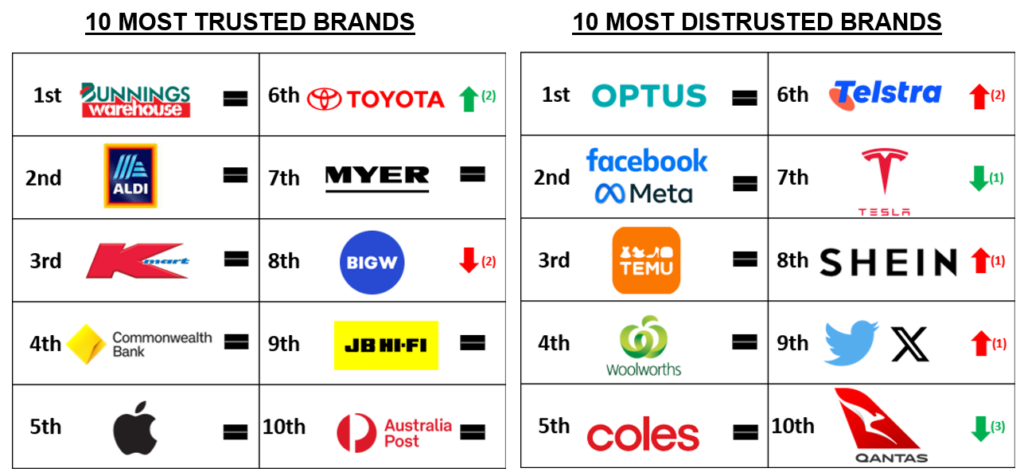
Figure 1: Australia’s 10 most trusted and 10 most distrusted brands in June 2026. Source: Roy Morgan Single Source (Australia). Risk Monitor, 12-month average to June 2026. Base: Australians 14+, n=17,704. Arrows with numbers show ranking change since March 2026.
Distrusted Brands: OpenAI, Palantir, Google, X, Telstra, BP, Shein and Shell deteriorate in rankings
Optus has maintained the unwanted position as the most distrusted brand in Australia for the second straight quarter in the 12 months to June 2026.
The remainder of the top five most distrusted are also unchanged with social media company Facebook/Meta the second most distrusted brand, discount online retailer Temu in third place, ahead of supermarket giants Woolworths and Coles in fourth and fifth positions.
The most consequential declines were experienced by Open AI (including ChatGPT) which deteriorated three places to 16th most distrusted due to privacy concerns and the risk to people’s personal data and is now down 10 positions in the last two quarters, and Palantir, declining 15 places to be the 30th most distrusted brand in the country. That’s instructive as most Australians had never heard of Palantir a year ago. The insight is that distrust doesn’t require familiarity. It travels digitally and virally.
In addition to these two brands tied directly to AI, online search leader Google continued its long decline, deteriorating one spot to 14th most distrusted, and social media and news company X / (formerly Twitter) dropped one place to 9th. Google (with Gemini) and X (with Grok) are both focused heavily on developing and integrating these AI tools into their product offering.
Australia’s largest private mining company Hancock Prospecting has entered the top 20 most distrusted brands for the first time amid rising negative sentiment toward both the company and its proprietor, Gina Rinehart, deteriorating by four places to 20th.
Shell and BP faced rising distrust on fuel-price scepticism as people watched the same litre of petrol change price by suburb amidst the conflict in the Middle East. BP – deteriorating two places to 18th most distrusted, and Shell, declining three spots to 19th. Outside the top 20 most distrusted, Caltex / Ampol, faced the same problem and worsened nine places to be the 56th most distrusted brand.
Other brands declining are telecommunications giant Telstra, deteriorating two spots to become the sixth most distrusted brand – even before the recent widespread outage in early July, online retailer Shein, worsening one place to eighth, and telecommunications company Vodafone, declining 11 places to 38th after customers suffered a major service outage during the month of June.
Distrusted brands to improve their rankings included electric vehicle company Tesla, improving one place to 7th, national carrier Qantas, improving three places to 10th, and social media company TikTok which improved one place to 15th most distrusted.
OpenAI / ChatGPT trust and distrust trend chart (12-month average)
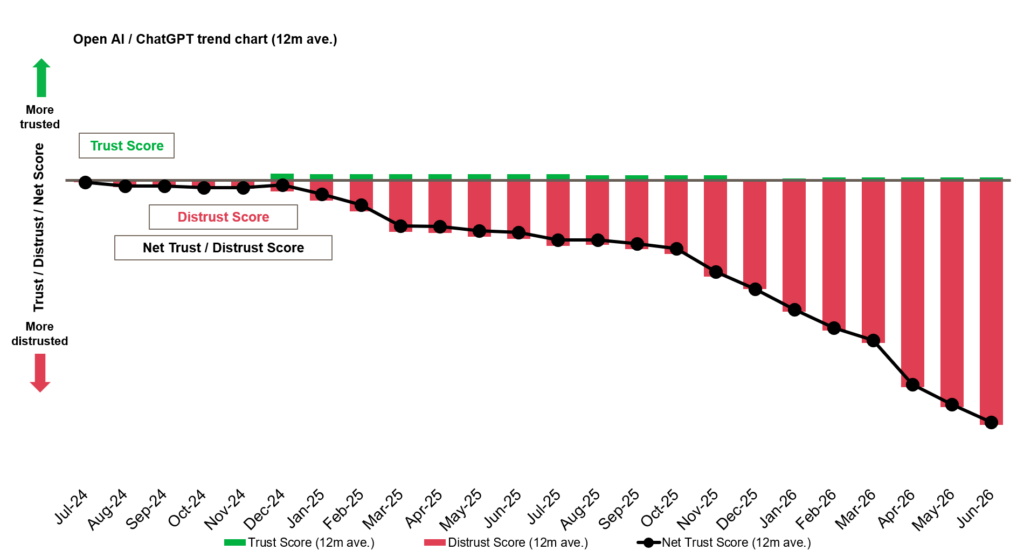
Source: Roy Morgan Single Source (Australia). Risk Monitor, 12-month average to June 2026.
Base: Australians 14+, latest 12-month average n=17,704. Latest 12-month average for OpenAI / ChatGPT n = 2,856.
OpenAI: trust never built, and distrust is compounding
OpenAI’s chart reveals that trust is almost flat and negligible while distrust has been soaring since late 2025 as adoption of the platform has grown. The latest Roy Morgan data shows 13.6 million people, equivalent to 58% of Australians aged 14+, use ‘Artificial Intelligence’ (AI) platforms, including 10.5 million using OpenAI’s ChatGPT.
OpenAI has built up a userbase of millions of Australians without first building a comparable level of trust. So, if an AI brand has its Optus moment – and one will – there may well be very little goodwill available to absorb the shock.
In people’s own words: OpenAI and its ChatGPT customer interface don’t protect privacy, are unethical, and are dishonest – all three are rising as AI reimagines the zeitgeist. Other factors driving distrust include concerns that the AI platforms are environmentally irresponsible, and the companies like OpenAI are too motivated by profit and are greedy.
Reasons Australians Distrust OpenAI / ChatGPT (2025-26)
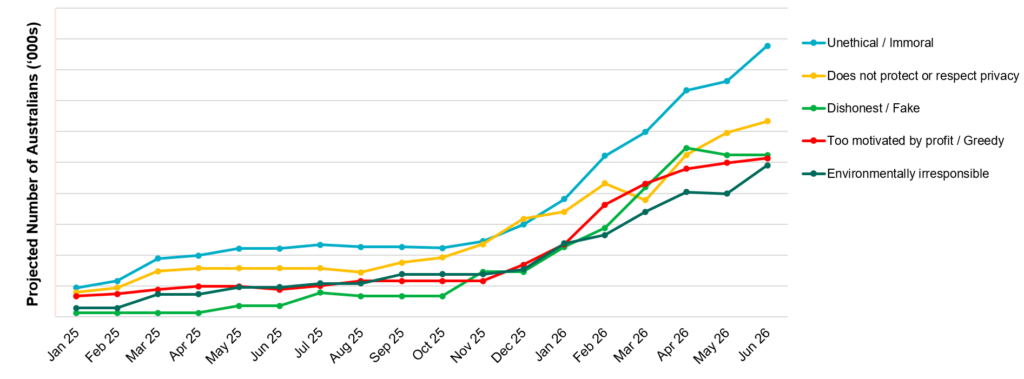
Source: Roy Morgan Single Source (Australia). Risk Monitor, 12-month average to Jun 2026.
Base: Australians 14+, Latest 12-month average n=17,704. Latest 12-month average for OpenAI / ChatGPT n=2,856.
Roy Morgan CEO Michele Levine says Bunnings, Aldi and Kmart are Australia’s most trusted brands in the 12 months to June 2026 for a tenth consecutive quarter while Optus, Facebook/Meta and Temu are the most distrusted for a second consecutive quarter:

“Bunnings has topped the rankings as Australia’s most trusted brand for an eleventh consecutive quarter, and there’s some familiar faces at the top with Aldi and Kmart filling places second and third – as they have for ten straight quarters since early 2024.
“Also improving in the most recent quarter are car manufacturer Toyota, up two spots to sixth most trusted, insurer NRMA, up two places to 12th, banking giant ING, up four spots to 15th, and office and stationery retailer Officeworks, up two places to 16th.
“At the other end of the scale it is telecommunications company Optus which is again the most distrusted brand for a second straight quarter, with the top five most distrusted unchanged and comprising of social media company Facebook/Meta, discount online retailer Temu, and supermarket giants Woolworths and Coles filling places second to fifth respectively.
“There have been several significant movements in terms of distrust in the most recent quarter highlighted by OpenAI (ChatGPT) which has deteriorated further by three spots to 16th most distrusted, and Palantir, declining 15 places to be the 30th most distrusted brand in the country.
“Both OpenAI and Palantir are two companies at the forefront of the AI revolution although OpenAI has a heavy focus on consumers via its ChatGPT AI platform, and Palantir is more focused on developing software for extensive contracts with government and businesses – including a working partnership with one of Australia’s most distrusted brands – Coles.
“The latest results from the ongoing trust survey show distrust in both brands has grown quickly – despite neither facing a definable and definitive scandal such as alleged price gouging and profiteering by the large supermarkets, or significant service outages experienced by several of the distrusted telecommunications companies.
“Despite a lack of scandals, Australians are increasingly citing concerns about AI companies such that the customer interfaces don’t protect users’ privacy, the companies are unethical and dishonest, they’re too motivated by profit and greed, and also that the large electricity requirements to run the data centres these companies rely on are environmentally irresponsible.
“Some of the reasons given by Australians who distrust OpenAI/ChatGPT are:
‘They are rolling out AI tools with no consideration for ethics, society and people who aren’t obscenely rich.’
‘Their AI has ripped off authentic creators and is a solution in search of a problem. The environmental and societal cost of their product is not being considered in the relentless pursuit of profit.’
‘They knowingly take resources like water and electricity from locals where their data centres are. CEO believes AI could end the world but runs the company anyway.’
“There are many questions about how much trust we can place in AI companies as this technology develops at an unprecedented ‘machine speed’.
“To learn more about how trust, and distrust, are already shaping views on AI companies and brands, view the special ‘Future of Trust and Distrust in an AI World Webinar’”
Subscribe to Roy Morgan’s YouTube channel to ensure you don’t miss our next webinar on trust and distrust: https://www.youtube.com/c/roymorganaus.
Comprehensive Trust and Distrust Insights Reports are available in Roy Morgan’s online store here.
The Roy Morgan Risk Monitor surveys approximately 1,500-2,000 Australians every month (around 18,000 per year) to measure levels of trust and distrust of around 1,000 brands across 27 industries. Respondents are asked which brands they trust, and why, and which brands they distrust, and why. The survey is designed to be open-ended, context-free, and unprompted. Roy Morgan Risk Monitor data is available in a variety of formats, from snapshot overviews to detailed tracking of individual brands and competitors. Industry Trust and Brand Health Surveys are also conducted (e.g. Private Health Insurance, Agribusiness, Banking, Travel and Tourism, Telco, Utilities, Insurance, etc.) for deep insights into brand health, perceptions of, and customer experience (CX) with brands.
To learn more call (+61) (3) 9224 5309 or email askroymorgan@roymorgan.com.
About Roy Morgan
Roy Morgan is the source of the most comprehensive data on Australians’ behaviour and attitudes, surveying over 1,000 people weekly in a continuous cycle that has been running for two decades. The company has more than 80 years’ experience collecting objective, independent information.
Margin of Error
The margin of error to be allowed for in any estimate depends mainly on the number of interviews on which it is based. Margin of error gives indications of the likely range within which estimates would be 95% likely to fall, expressed as the number of percentage points above or below the actual estimate. Allowance for design effects (such as stratification and weighting) should be made as appropriate.
| Sample Size | Percentage Estimate |
| 40% – 60% | 25% or 75% | 10% or 90% | 5% or 95% | |
| 1,000 | ±3.0 | ±2.7 | ±1.9 | ±1.3 |
| 5,000 | ±1.4 | ±1.2 | ±0.8 | ±0.6 |
| 7,500 | ±1.1 | ±1.0 | ±0.7 | ±0.5 |
| 10,000 | ±1.0 | ±0.9 | ±0.6 | ±0.4 |
| 20,000 | ±0.7 | ±0.6 | ±0.4 | ±0.3 |
| 50,000 | ±0.4 | ±0.4 | ±0.3 | ±0.2 |


