


Bunnings is Australia’s most trusted brand; OpenAI enters the top 20 most distrusted brands for the first time

Bunnings is the most trusted brand in the 12 months to March 2026 – a tenth consecutive quarterly victory for the leading hardware retailer stretching back well over two years to late 2023.
Importantly, leading ‘Artificial Intelligence’ (AI) company OpenAI (including ChatGPT) has entered the top 20 most distrusted brands in Australia for the first time – more on that development below.
For the ninth straight quarter (starting in the 12 months to March 2024) the top three places are unchanged, with discount supermarket Aldi in second, and discount department store Kmart in third.
The next three spots are unchanged for a second straight quarter with the Commonwealth Bank in fourth, consumer products giant Apple filling out the top five, and discount department store Big W again in sixth.
The other brands to move up in the most recent quarter include leading department store Myer, up one place to seventh, consumer products company Samsung, up three places to 11th, big four bank NAB up one position to 16th, office and stationery retailer Officeworks up two places to 18th and entering the top 20 most trusted brands in 20th place is leading pharmacy Chemist Warehouse, up two places.
There were downward movements for car manufacturer Toyota, slipping one spot to eighth, insurance company NRMA, down three places to 14th, and supermarket brand IGA, down one place to 17th.
Although not in the top 20 most trusted brands, the biggest improvements in the Net Trust rankings were insurer Allianz, up 35 places to enter the top 100 in 81st place, consumer products company LG, up 27 spots to 50th, and liquor retailer Dan Murphy’s, up 27 ranking positions to 72nd most trusted brand overall.
View the latest Roy Morgan Trust & Distrust December 2025 Quarterly Update Webinar.
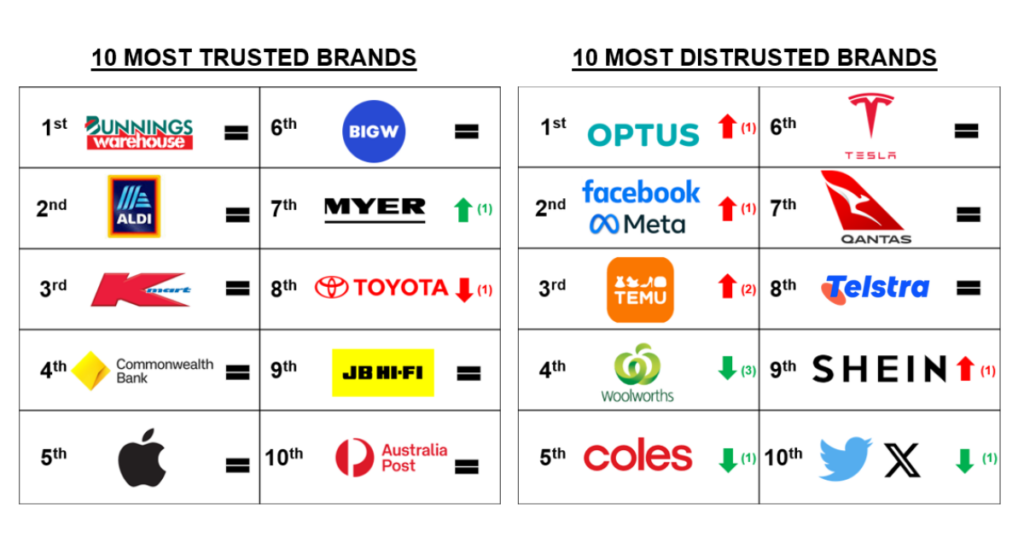
Figure 1: Australia’s 10 most trusted and 10 most distrusted brands in March 2026. Source: Roy Morgan Single Source (Australia). Risk Monitor, 12-month average to March 2026. Base: Australians 14+, n=17,310. Arrows with numbers show ranking change since Dec. 2025.
Distrusted Brands: Optus, Facebook, Temu, Shein, Google, and OpenAI deteriorate in rankings
Optus has replaced Woolworths as the most distrusted brand in Australia in the 12 months to March 2026. This is the first time the telecommunications company has occupied this unwanted position for a year-and-a-half since September 2024. That follows the fatal Triple Zero outage in September 2025 and shows how quickly a service failure can become a national distrust event that lingers.
Facebook and Temu deteriorated and are now the second and third most distrusted. Supermarket giants Woolworths and Coles are fourth and fifth most distrusted, with both improving in the latest quarter. (which was prior to the Federal Court’s findings that Coles had misled consumers with its ‘Down Down’ promotion).
OpenAI (including ChatGPT), experienced one of the biggest declines this quarter, down seven spots to enter the top 20 most distrusted brands in 19th place driven by suspicions around profit motives and ethics.
Google continued its long decline, deteriorating two places to 15th most distrusted. So, there’s an important technology story here, alongside the continuing supermarket, retail marketplace, and telco stories.
Other brands to decline in the latest quarter included online retailer Shein, deteriorating one place to ninth most distrusted, media company News Corp, declining one spot to be 11th most distrusted, and oil major BP, re-entering the top 20 most distrusted brands in 20th place, down two places.
Just outside the top 20, Uber deteriorated by 10 ranking spots to land in 34th spot, while Nvidia worsened by 11 places to be 51st most distrusted, and just behind was Fortescue, declining seven spots to 56th.
There were several distrusted companies that improved their rankings including social media company X / (formerly Twitter), improving one place to 10th, online retailer Amazon, improving for a second straight quarter by one spot and now in 12th, Harvey Norman, improving one spot to 16th, and fast-food outlet McDonalds, which improved one position to 17th.
Mining giant Rio Tinto and oil major Shell both improved their positions again and are out of the top 20 most distrusted brands in the latest quarterly results for the 12 months to March 2026.
Google’s distrust is consistently larger than trust leading to a Net Distrust Score
If we look only at Google’s trust, we see a very comfortable story. The brand is widely trusted by Australians. But as with reputation, NPS®, and satisfaction, that’s only half the picture.
When we add distrust, the story changes dramatically. Since our Risk Lab research began, Google has consistently been more distrusted than trusted.
Google’s principal reason for distrust centres around privacy: for example, people worry that Google does not respect or protect their privacy. Others describe the company as unethical or overly profit-driven. That doesn’t mean everyone stops using Google tomorrow. It means the brand has lower forgiveness and greater vulnerability as alternatives – like AI – become available and more useful.
Google Net Trust / Distrust Score – 12-month average
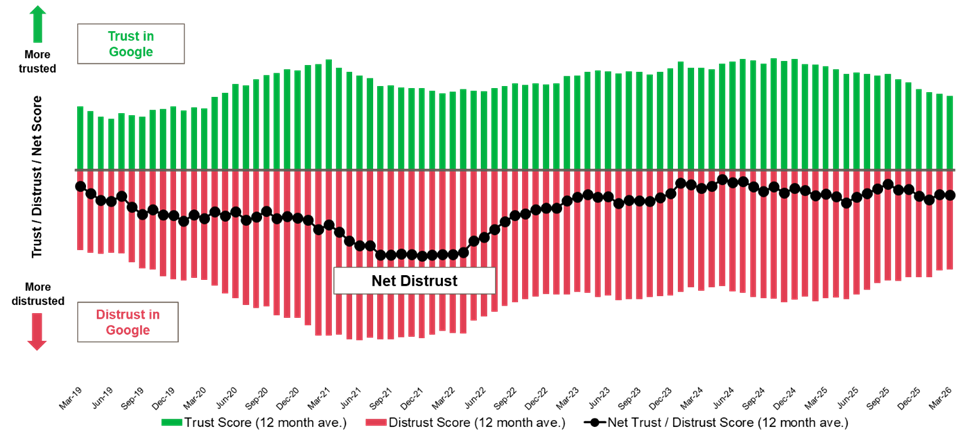
Source: Roy Morgan Single Source (Australia). Risk Monitor, 12-month average to March 2026.
Base: Australians 14+, Latest 12-month average n=17,310. Latest 12-month average for Google n = 557
Roy Morgan CEO Michele Levine says Bunnings, Aldi and Kmart are Australia’s most trusted brands in the 12 months to March 2026 for a ninth consecutive quarter while Optus is the most distrusted, and there is increasing distrust in AI and tech companies Google, Nvidia and OpenAI:

“Bunnings has topped the rankings as Australia’s most trusted brand for a tenth consecutive quarter, and there’s some familiar faces at the top with Aldi and Kmart filling places second and third – as they have for nine straight quarters since early 2024.
“Also improving in the most recent quarter are leading department store Myer, up one place to seventh, consumer products giant Samsung, up one spot to 11th, big four bank NAB, up one position to 16th, stationery retailer Officeworks, up two places to 18th, and leading pharmacy Chemist Warehouse, entering the top 20 most trusted brands in 20th place.
“The broader overall industry rankings show the Retail industry as the most trusted industry ahead of the Consumer Products industry as the top two ranked industries for a third straight quarter.
“The Banking industry is up one place to third in the most recent quarter – and up a significant 15 places from nine months ago. Also rising strongly is the Supermarket & Convenience Stores industry – up nine places in the most recent quarter, and up a total of 16 places over the last nine months to 11th overall – and back in Net Trust territory.
“At the other end of the scale, the Telecommunications industry is the most distrusted for a second straight quarter in the 12 months to March 2026 – driven by Optus returning to a position it has held before as the most distrusted brand in Australia for the first time since September 2024.
“The second most distrusted industry is again Video Sharing Services/Social Media industry driven by the high distrust for brands like Facebook/Meta (second most distrusted brand overall), X/Twitter (10th most distrusted brand), and TikTok (14th most distrusted brand). Sliding into the bottom three industries is the Mining & Petroleum industry with oil major BP now one of the Top 20 most distrusted brands in the country in 20th place overall.
“Three companies with rising distrust worth highlighting in the recent March quarter are at the forefront of the Artificial Intelligence (AI) computing revolution. Google, with its widely used Gemini AI product (now used by an estimated 5 million Australians) and OpenAI with the market leading ChatGPT product (now used by an estimated 10.5 million Australians) both experienced rising distrust which drove both companies up the Net Distrust rankings. Tech giant and computing chip producer Nvidia also experienced a surge in distrust, driven by concerns around ethics, and anti-competitive behaviour.
“Significantly, Open AI deteriorated seven places to enter the top 20 most distrusted brands for the first time in 19th position driven by suspicions around the profit motives and ethics of the firm headed by controversial CEO Sam Altman. Google’s net distrust worsened two places to be the 15th most distrusted brand in Australia.”
Subscribe to Roy Morgan’s YouTube channel to ensure you don’t miss our next webinar on trust and distrust: https://www.youtube.com/c/roymorganaus.
Comprehensive Trust and Distrust Insights Reports are available in Roy Morgan’s online store here.
The Roy Morgan Risk Monitor surveys approximately 1,500-2,000 Australians every month (over 20,000 per year) to measure levels of trust and distrust of around 1,000 brands across 27 industries. Respondents are asked which brands they trust, and why, and which brands they distrust, and why. The survey is designed to be open-ended, context-free, and unprompted. Roy Morgan Risk Monitor data is available in a variety of formats, from snapshot overviews to detailed tracking of individual brands and competitors. Industry Trust and Brand Health Surveys are also conducted (e.g. Private Health Insurance, Agribusiness, Banking, Travel and Tourism, Telco, Utilities, Insurance, etc.) for deep insights into brand health, perceptions of, and customer experience (CX) with brands.
To learn more call (+61) (3) 9224 5309 or email askroymorgan@roymorgan.com.
About Roy Morgan
Roy Morgan is the source of the most comprehensive data on Australians’ behaviour and attitudes, surveying over 1,000 people weekly in a continuous cycle that has been running for two decades. The company has more than 80 years’ experience collecting objective, independent information.
Margin of Error
The margin of error to be allowed for in any estimate depends mainly on the number of interviews on which it is based. Margin of error gives indications of the likely range within which estimates would be 95% likely to fall, expressed as the number of percentage points above or below the actual estimate. Allowance for design effects (such as stratification and weighting) should be made as appropriate.
| Sample Size | Percentage Estimate |
| 40% – 60% | 25% or 75% | 10% or 90% | 5% or 95% | |
| 1,000 | ±3.0 | ±2.7 | ±1.9 | ±1.3 |
| 5,000 | ±1.4 | ±1.2 | ±0.8 | ±0.6 |
| 7,500 | ±1.1 | ±1.0 | ±0.7 | ±0.5 |
| 10,000 | ±1.0 | ±0.9 | ±0.6 | ±0.4 |
| 20,000 | ±0.7 | ±0.6 | ±0.4 | ±0.3 |
| 50,000 | ±0.4 | ±0.4 | ±0.3 | ±0.2 |


