


ANZ-Roy Morgan Consumer Confidence drops 1.6pts to 85.5, despite ‘net buying sentiment’ reaching its highest level since March 2022 amid the growing Black Friday sales weekend
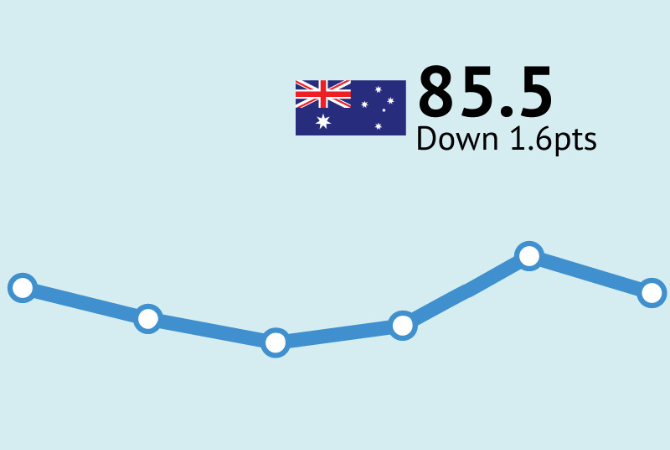
ANZ-Roy Morgan Consumer Confidence dropped 1.6pts to 85.5 and is now 2.9pts lower than a year ago, November 25 – December 1, 2024 (88.4), and 0.9pts above the 2025 weekly average of 86.4. An analysis by State shows a split result with Consumer Confidence down in New South Wales and Victoria, but up in Queensland, Western Australia and South Australia.
Although net buying sentiment improved to its highest for over three-and-a-half years since March 2022, the negative movement in other sub-indices related to personal financial situations and the prospects for the Australian economy going into the future led to the overall result being down.
Now just over a fifth of Australians, 21% (up 1ppt), say their families are ‘better off’ financially than this time last year compared to a plurality of 45% (up 2ppts) that say their families are ‘worse off’.
Views on personal finances over the next year deteriorated this week with 27% (down 1ppt) of respondents expecting their family will be ‘better off’ financially this time next year, while 34% (up 2ppts) expect to be ‘worse off’.
Net sentiment regarding the economy over the next year dropped slightly this week with 9% (down 1ppt) of Australians, expecting ‘good times’ for the Australian economy over the next twelve months compared to almost a third, 30% (up 1ppt), that expect ‘bad times’.
Net views regarding the Australian economy in the longer-term also dropped this week with only 9% (down 2ppts) of Australians expecting ‘good times’ for the economy over the next five years compared to over a quarter, 27% (up 4ppts), expecting ‘bad times’.
Net buying intentions improved for a third straight week with 29% (up 2ppts) of respondents saying now is a ‘good time to buy’ major household items compared to 31% (down 2ppts) that say now is a ‘bad time to buy major household items’ – this is the highest net result for this index for over three-and-a-half years since March 2022, and ‘bad time to buy’ has dropped to its lowest since December 2021.
ANZ Economist, Madeline Dunk, commented:

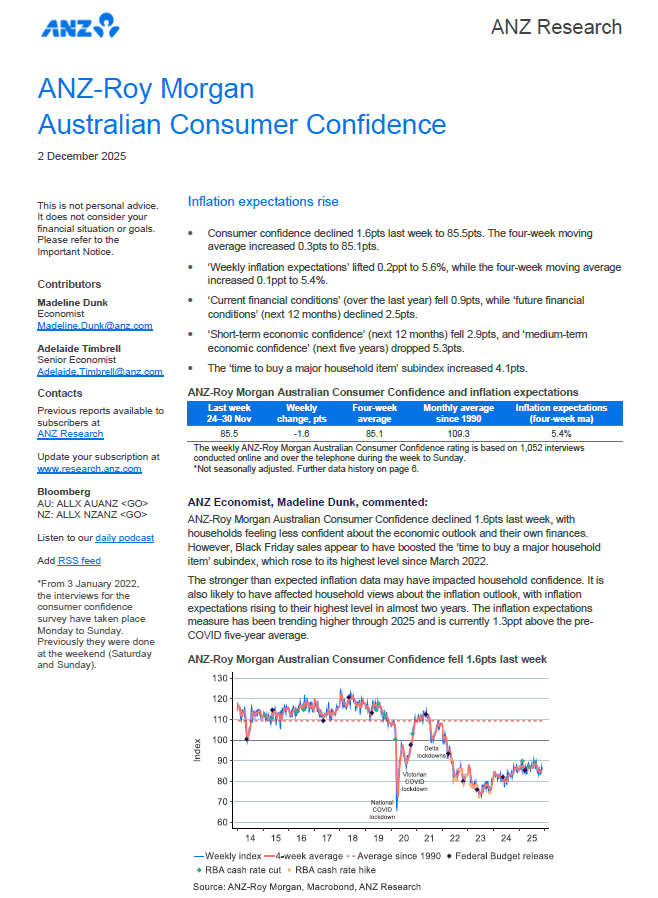
ANZ-Roy Morgan Australian Consumer Confidence declined 1.6pts last week, with households feeling less confident about the economic outlook and their own finances. However, Black Friday sales appear to have boosted the ‘time to buy a major household item’ subindex, which rose to its highest level since March 2022.
The stronger than expected inflation data may have impacted household confidence. It is also likely to have affected household views about the inflation outlook, with inflation expectations rising to their highest level in almost two years. The inflation expectations measure has been trending higher through 2025 and is currently 1.3ppt above the pre-COVID five-year average.
Check out the latest results for our weekly surveys on Business Confidence, Consumer Confidence, and Voting Intention as follows:
Roy Morgan Business Confidence Statistics
ANZ – Roy Morgan Consumer Confidence Statistics
Federal Voting – Government Confidence Rating
Related Research Reports
The latest Roy Morgan Consumer Confidence Monthly Report is available on the Roy Morgan Online Store. It provides demographic breakdowns for Age, Sex, State, Region (Capital Cities/ Country), Generations, Lifecycle, Socio-Economic Scale, Work Status, Occupation, Home Ownership, Voting Intention, Roy Morgan Value Segments and more
Consumer Confidence – Monthly Detailed Report in Australia.
Business Confidence – Monthly Detailed Report in Australia.
Consumer Banking Satisfaction - Monthly Report in Australia.
For comments or more information please contact:
Roy Morgan - Enquiries
Office: +61 (03) 9224 5309
askroymorgan@roymorgan.com
Margin of Error
The margin of error to be allowed for in any estimate depends mainly on the number of interviews on which it is based. Margin of error gives indications of the likely range within which estimates would be 95% likely to fall, expressed as the number of percentage points above or below the actual estimate. Allowance for design effects (such as stratification and weighting) should be made as appropriate.
| Sample Size | Percentage Estimate |
| 40% – 60% | 25% or 75% | 10% or 90% | 5% or 95% | |
| 1,000 | ±3.0 | ±2.7 | ±1.9 | ±1.3 |
| 5,000 | ±1.4 | ±1.2 | ±0.8 | ±0.6 |
| 7,500 | ±1.1 | ±1.0 | ±0.7 | ±0.5 |
| 10,000 | ±1.0 | ±0.9 | ±0.6 | ±0.4 |
| 20,000 | ±0.7 | ±0.6 | ±0.4 | ±0.3 |
| 50,000 | ±0.4 | ±0.4 | ±0.3 | ±0.2 |


