


Bunnings is Australia’s most trusted brand. Telecommunications, led by Optus, is the most distrusted industry

Bunnings is the most trusted brand in the 12 months to December 2025 – a ninth consecutive quarterly victory for the leading hardware retailer stretching back over two years to late 2023.
For the eighth straight quarter (starting in the 12 months to March 2024) the top three places are unchanged, with discount supermarket Aldi in second, and discount department store Kmart in third.
The Commonwealth Bank has achieved a record high, up one place to fourth overall, and now ahead of consumer products giant Apple, down one spot to fifth.
There were several other banks performing well including Westpac, up one spot to 13th, Bendigo Bank, retaining its high ranking in 15thplace, NAB, up two places to 17th, and ING, improving one place to 19th.
The other brands to move up in the most recent quarter include leading retailers such as discount department store Big W, up one spot to sixth, discount department store Target, up one place to 12th, and office supplies and stationary giant Officeworks, entering the top 20 in 20th place.
There were small downward movements throughout the rest of the top 20 most trusted brands with Toyota slipping one spot to seventh, Samsung, dropping one place to 14th, and Nike, down one position to 18th.
Although not in the top 20 most trusted brands, the biggest improvements in the Net Trust rankings were gaming platform Steam, up 28 spots to 43rd, Youi, up 25 places to enter the top 100 in 95thplace, and UniSuper, up 18 places to 66th.
View the latest Roy Morgan Trust & Distrust December 2025 Quarterly Update Webinar.
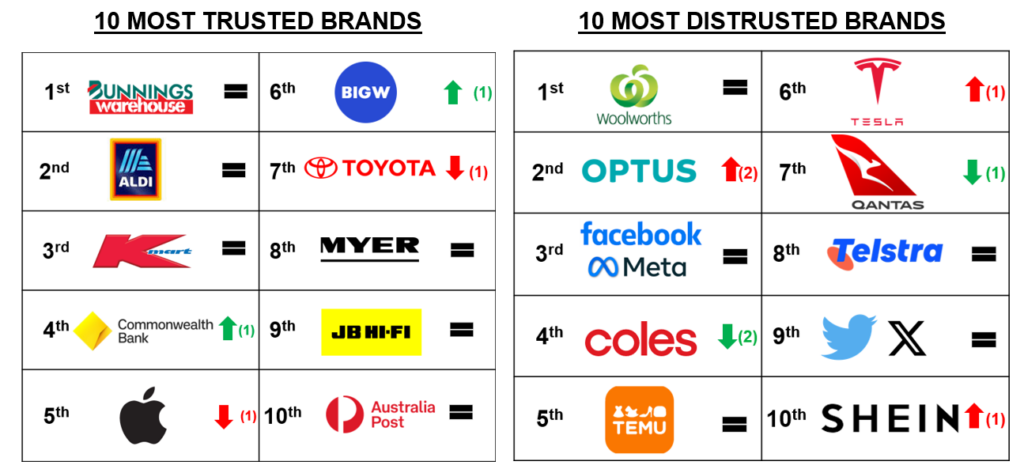
Figure 1: Australia’s 10 most trusted and 10 most distrusted brands in Dec. 2025. Source: Roy Morgan Single Source (Australia). Risk Monitor, 12-month average to Dec. 2025. Base: Australians 14+, n=18,204. Arrows with numbers show ranking change since Sep. 2025.
Distrusted Brands – Optus, Tesla, Shein, Nestle and Google deteriorate in the rankings
The big mover – in the wrong direction – was telecommunications company Optus, which deteriorated two places to be the second most distrusted brand in the 12 months to December 2025. In fact, for the sole month of December, Optus was the single most distrusted brand in Australia following its fatal triple-zero outage during September 2025 that received widespread media coverage.
Despite the poor result for Optus, supermarket giant Woolworths remains Australia’s most distrusted brand, although rival Coles has improved two places to 4th as its distrust eases. The perennially distrusted Facebook remains entrenched as the third most distrusted brand in the country.
Other leading brands to deteriorate in the rankings in December include electric car company Tesla, deteriorating one spot to 6th, discount online retailer Shein, dropping one place to 10th, and food conglomerate Nestle, declining two spots to the 13th most distrusted brand.
Another big slider was technology giant Google, which entered the top 20 most distrusted brands in 17th, deteriorating by five spots.
Just outside the top 20, Microsoft deteriorated by 37 ranking spots to land in 21st spot, and OpenAI worsened by 17 places to be just behind in 26th. Budget Direct, deteriorated by 14 places to be the 55th most distrusted brand in Australia.
There were several distrusted companies that improved their rankings including airline Qantas, which improved one spot to 7th, online retailer Amazon, improving one place to 11th, social media company TikTok, improving one spot to 14th, Harvey Norman, improving one spot to 15th, mining giant Rio Tinto, improving two spot to 19th and oil major Shell, improving one spot to 20th.
Regulation Trust & Distrust by Industry and regulation level
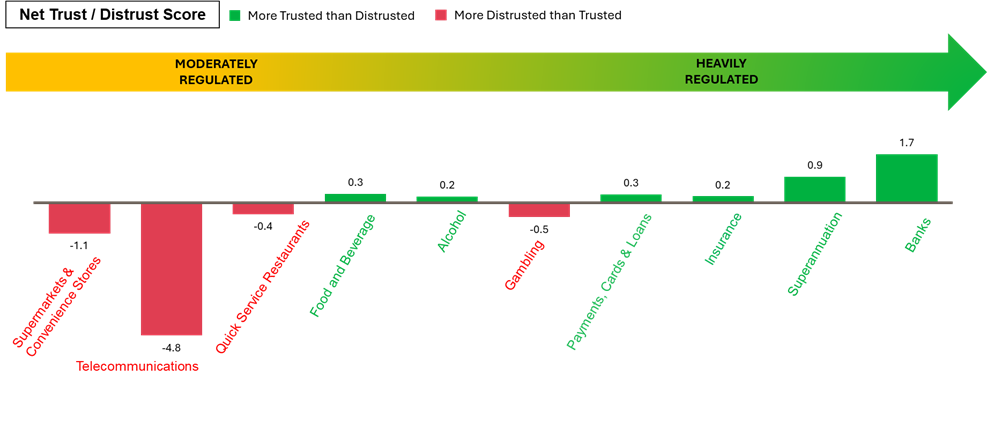
Source: Roy Morgan Single Source (Australia). Risk Monitor, 12-month average to Dec. 2025.
Base: Australians 14+, n=18,204.
Heavier regulation drives higher rates of trust in key industries
Roy Morgan’s latest data on trust and distrust reveals a remarkable relationship between highly regulated industries and trust. The finance sectors encompassing Banks, Superannuation, Insurance, and Payments, Cards & Loans, provide clear evidence that greater regulation and stricter rules have helped shape public perception for the better. Across financial services, many of the current regulations emerged from the Royal Commission into Misconduct in the Banking, Superannuation & Financial Services Industry.
On the flipside, sectors like Telecommunications and Supermarkets have relatively low regulation and suffer deep distrust. They currently face severe regulatory headwinds as the public demands better accountability and a fair go.
Prior to, and following the Royal Commission, the banking industry faced significant scrutiny, with a majority of respondents nominating banks as being profit-driven and unethical. In December 2020, the Royal Commission legislation was passed by parliament, and several new regulations took effect, including granting ASIC stronger powers to ensure compliance with industry codes.
In September 2023, the final introduction of regulatory reforms had a profound impact on the whole finance sector, especially the banking industry. The consequence? Distrust declined, and trust improved so significantly that within two years the entire banking sector had moved back into net trust territory.
Banks Net Trust / Distrust Score – 12-month average
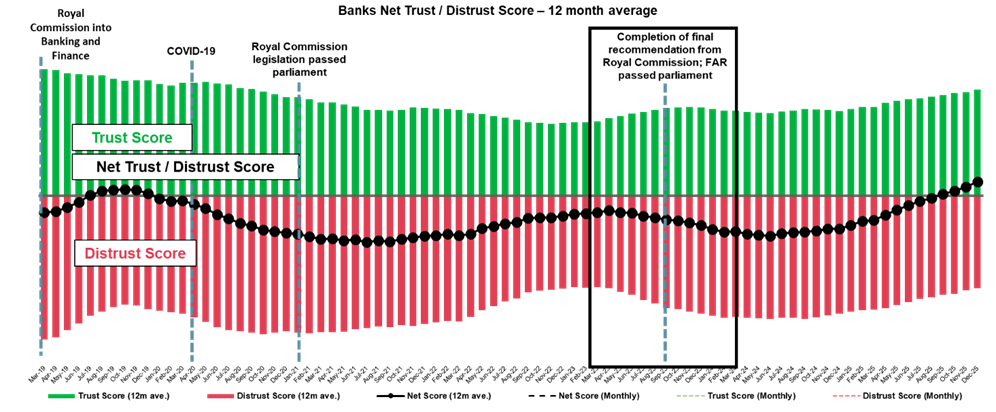
Source: Roy Morgan Single Source (Australia). Risk Monitor, 12-month average to Dec 2025.
Base: Australians 14+, latest 12-month average n=18,204. Latest 12-month average for banks n=4,071.
Following the final recommendations in September 2023, more Australians began to perceive the Banking industry, predominantly the big four Banks, to be customer-centric, reliable and accountable for their actions, while fewer Australians cited the Banking industry to be profit-driven and unethical. It is interesting to note that opinions are divided on service as a reason for trust or distrust in the Banking industry, suggesting room for further improvement.
Roy Morgan CEO Michele Levine says Bunnings, Aldi and Kmart are once again Australia’s most trusted brands in the 12 months to December 2025 – for an eighth consecutive quarter – while there is increasing distrust in leading AI and tech companies such as Google, Microsoft and OpenAI:

“Bunnings has topped the rankings as Australia’s most trusted brand for a ninth consecutive quarter, and there’s some familiar faces at the top with Aldi and Kmart filling places second and third – as they have for eight straight quarters over the last two years.
“Once again, the banking industry has improved its position in the most recent quarter. Commonwealth Bank rises one place to a record high fourth overall, Westpac improves another spot to 13th, just in front of Bendigo Bank in 15th, NAB is up another two places to 17th, and international banking giant ING improves one spot to re-enter the top 20 in 19th overall.
“The broader overall industry rankings show the Banking industry rising another four places to fourth overall in the most recent quarter – and now up a stunning 14 places from six months ago. This is by far the biggest increase of any industry, with the second-best performance over the last six months by the closely related Insurance Industry, up six ranking spots to 10th overall.
“These results highlight an interesting relationship revealed by a Roy Morgan deep dive into the trust and distrust of various industries. As regulation increases in industries, trust rises – and this is especially striking in the key industries of Banking, Insurance, and Superannuation.
“For companies in the financial services industries, many of the current regulations emerged from the Royal Commission into Misconduct in the Banking, Superannuation & Financial Services Industry which was established in December 2017 and provided a comprehensive report in February 2019.
“Since the final recommendations from the Royal Commission were legislated and implemented in September 2023, there is growing confidence among Australians that the Banking industry, which is centred on the big four Banks, is becoming more customer-centric, reliable and accountable for their actions, while fewer Australians cited the banking industry to be profit-driven and unethical.
“There are similar trends driving improvements in trust for the Insurance, Superannuation & Wealth Management and Payments, Cards and Loans industries. All four are now ranked amongst the top ten most trusted industries – Banks (fourth), Superannuation & Wealth Management (sixth), Payments, Cards & Loans (ninth), and Insurance (tenth).
“At the other end of the scale, comparatively moderately regulated industries such as Telecommunications, Supermarkets & Convenience Stores, and Quick Service Restaurants, continue to experience elevated levels of distrust. In fact, in the latest results for the 12 months to December 2025 the Telecommunications industry is now the most distrusted industry of all.
“The default reputational home for the Telecommunications industry is deep in distrust territory, and the September 2022 Optus cyberattack affecting 9.8 million Australians just made it worse. The regulators quickly took matters into their own hands, amending the Telecommunications regulations to better protect privacy, and launching an investigation following the November 2023 outage.
“However, as we saw with the triple zero outages in late 2025, the hits just keep on coming for telecommunications companies, and distrust continues to rise.”
Subscribe to Roy Morgan’s YouTube channel to ensure you don’t miss our next webinar on trust and distrust: https://www.youtube.com/c/roymorganaus.
Comprehensive Trust and Distrust Insights Reports are available in Roy Morgan’s online store, including the Bank Trust and Distrust Insights Report here, Superannuation and Wealth Management Trust and Distrust Insights Report here, Payments, Cards and Loans Trust and Distrust Insights Report here, Insurance Trust and Distrust Insights Report here, Telco Provider Trust and Distrust Insights Report here, Supermarkets Trust and Distrust Insights Report here, Gambling Provider Trust and Distrust Insights Report here.
The Roy Morgan Most Trusted Brand Awards Report 2025 with rankings of over 230 brands and analysis by industry is now available for purchase here. The latest Trust and Distrust Webinar Report with insights into trust and distrust across various industries is available here.
The Roy Morgan Risk Monitor surveys approximately 1,500-2,000 Australians every month (over 20,000 per year) to measure levels of trust and distrust of around 1,000 brands across 27 industries. Respondents are asked which brands they trust, and why, and which brands they distrust, and why. The survey is designed to be open-ended, context-free, and unprompted. Roy Morgan Risk Monitor data is available in a variety of formats, from snapshot overviews to detailed tracking of individual brands and competitors. Industry Trust and Brand Health Surveys are also conducted (e.g. Private Health Insurance, Agribusiness, Banking, Travel and Tourism, Telco, Utilities, Insurance, etc.) for deep insights into brand health, perceptions of, and customer experience (CX) with brands.
To learn more call (+61) (3) 9224 5309 or email askroymorgan@roymorgan.com.
About Roy Morgan
Roy Morgan is the source of the most comprehensive data on Australians’ behaviour and attitudes, surveying over 1,000 people weekly in a continuous cycle that has been running for two decades. The company has more than 80 years’ experience collecting objective, independent information.
Margin of Error
The margin of error to be allowed for in any estimate depends mainly on the number of interviews on which it is based. Margin of error gives indications of the likely range within which estimates would be 95% likely to fall, expressed as the number of percentage points above or below the actual estimate. Allowance for design effects (such as stratification and weighting) should be made as appropriate.
| Sample Size | Percentage Estimate |
| 40% – 60% | 25% or 75% | 10% or 90% | 5% or 95% | |
| 1,000 | ±3.0 | ±2.7 | ±1.9 | ±1.3 |
| 5,000 | ±1.4 | ±1.2 | ±0.8 | ±0.6 |
| 7,500 | ±1.1 | ±1.0 | ±0.7 | ±0.5 |
| 10,000 | ±1.0 | ±0.9 | ±0.6 | ±0.4 |
| 20,000 | ±0.7 | ±0.6 | ±0.4 | ±0.3 |
| 50,000 | ±0.4 | ±0.4 | ±0.3 | ±0.2 |


