


ANZ-Roy Morgan New Zealand Consumer Confidence jumps 8 points to 99.3 in July

Is New Zealand back in business?
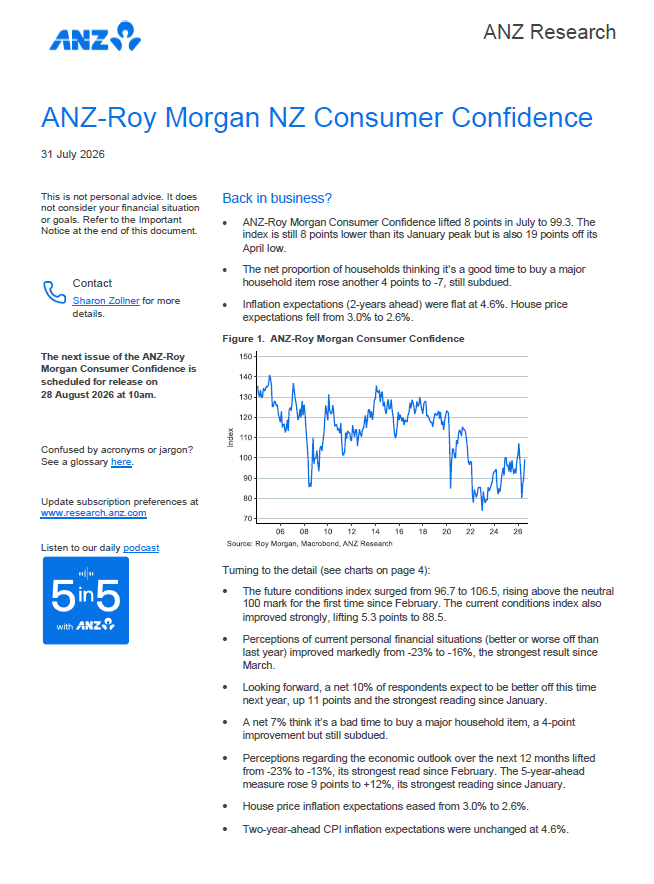
- ANZ-Roy Morgan New Zealand Consumer Confidence lifted 8 points in July to 99.3. The index is still 8 points lower than its January peak but is also 19 points off its April low.
- The net proportion of households thinking it’s a good time to buy a major household item rose another 4 points to -7 but is still subdued.
- Inflation expectations (2-years ahead) were flat at 4.6%. House price expectations fell from 3.0% to 2.6%.
Turning to the detail (see charts on page 4 of linked PDF):
- The future conditions index surged from 96.7 to 106.5, rising above the neutral 100 mark for the first time since February. The current conditions index also improved strongly, lifting 5.3 points to 88.5.
- Net perceptions of current personal financial situations (better or worse off than last year) improved markedly from -23% to -16%, with 26% (up 3% points) of New Zealanders say they are 'better off' financially than this time a year ago compared to 42% (down4% points) who say they are 'worse off' financially. This is the strongest result since March for this indicator.
- Looking forward, a net 10% of respondents expect to be better off this time next year, up 11 points from a month ago with 44% (up 8% points) of New Zealanders saying they expect to be 'better off' financially this time next year compared to just 23% (down 3% points) that expect to be 'worse off' financially, and the strongest reading for this indicator for six months since January.
- A net 7% think it’s a 'bad time to buy' a major household item with 43% (down 3% points) saying it's a 'bad time to buy' major household items compared to 36% (up 1% point) that say its a 'good time to buy' major household items, this is a net a 4-point improvement on a month ago but still subdued.
- Net perceptions regarding the economic outlook over the next 12 months lifted from -23% to -13%, its strongest read since February. The 5-year-ahead measure rose 9 points to +12%, its strongest reading since January.
- House price inflation expectations eased from 3.0% to 2.6%.
- Two-year-ahead Consumer Price Index (CPI) inflation expectations were unchanged at 4.6%.
In July, oil prices moved substantially, initially continuing to fall before turning sharply higher mid-month. The other big development this month was the Reserve Bank of New Zealand (RBNZ) kicking off a new tightening cycle with a 25 basis points lift in the Official Cash Rate (OCR) on 8 July. It had only a very muted impact on wholesale interest rates but did generate a fair amount of media coverage.
Given it was a busy month on the news front, it’s worth taking a look at how the data evolved as the month went on (figure 2 in the linked PDF). It needs to be borne in mind that weekly reads use a smaller sample and so are a rougher estimate of the “truth”. But overall the story is pretty clear: household inflation expectations followed oil price dynamics (figure 2 in the linked PDF) and confidence did too, but inversely (figure 3 in the linked PDF).
Margin of Error
The margin of error to be allowed for in any estimate depends mainly on the number of interviews on which it is based. Margin of error gives indications of the likely range within which estimates would be 95% likely to fall, expressed as the number of percentage points above or below the actual estimate. Allowance for design effects (such as stratification and weighting) should be made as appropriate.
| Sample Size | Percentage Estimate |
| 40% – 60% | 25% or 75% | 10% or 90% | 5% or 95% | |
| 1,000 | ±3.0 | ±2.7 | ±1.9 | ±1.3 |
| 5,000 | ±1.4 | ±1.2 | ±0.8 | ±0.6 |
| 7,500 | ±1.1 | ±1.0 | ±0.7 | ±0.5 |
| 10,000 | ±1.0 | ±0.9 | ±0.6 | ±0.4 |
| 20,000 | ±0.7 | ±0.6 | ±0.4 | ±0.3 |
| 50,000 | ±0.4 | ±0.4 | ±0.3 | ±0.2 |


