


ANZ-Roy Morgan New Zealand Consumer Confidence is Stressed – dropping 11 points to 80.3 in April
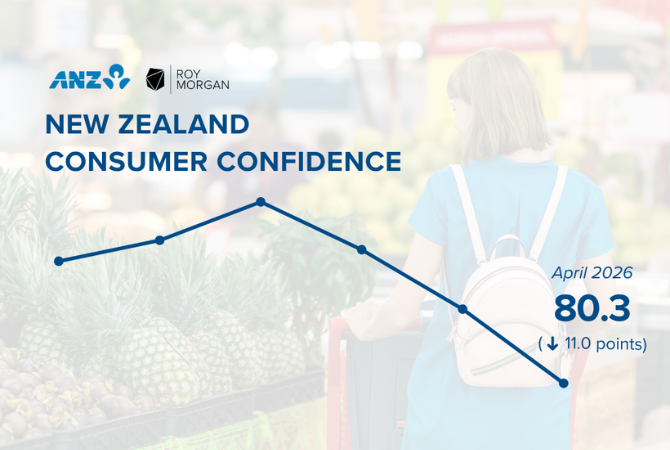
- ANZ-Roy Morgan New Zealand Consumer Confidence fell another 11 points from 91.3 in March to 80.3 in April, the lowest read in about three years. The index has fallen 20 points in the past two months since the Middle East conflict began.
- The net proportion of households thinking it’s a 'good time to buy' a major household item (the best retail indicator) fell 11 points to -25, the lowest since September 2024.
- Inflation expectations (2-years ahead) jumped nearly another full percentage point to 6.6%.
Turning to the detail (see charts on page 4 of the linked PDF):
- The future conditions index made up of forward-looking questions fell from 96.7 to 85.9, the lowest in two years. The current conditions index fell from 83.1 to 71.9, the lowest since October 2023.
- Net perceptions of current personal financial situations (better or worse off than last year) fell 11 points from -20% to -31%, with only 20% (down 4% points) saying they are 'better off' financially than this time last year compared to a majority of 51% (up 7% points) who say they are 'worse off', the weakest figure for this indicator since mid-2008.
- Looking forward, a net 3% of respondents expect to be better off this time next year, down 7 points from a month ago with 35% (down 3% points) saying they expect to be 'better off' financially this time next year compared to 32% (up 4% points) who expect to be 'worse off'.
- A net 25% think it’s a bad time to buy a major household item, with only 27% (down 4% points) saying it is a 'good time to buy' a major household item, while a rising majority of 52% (up 7% points) say it is a 'bad time to buy', the weakest read for this indicator since September 2024.
- Net perceptions regarding the economic outlook over the next 12 months fell another 23 points to -48%, the lowest in three years. The 5-year-ahead measure fell 2 points to +3%.
- House price inflation expectations fell from 3.8% to 3.2%.
- Two-year-ahead CPI inflation expectations jumped 0.9ppt to 6.6%. For context, petrol prices are up about 30% y/y, and food price inflation has been running at 4-5% y/y for some time.
Figure 2 in the linked PDF shows ANZ-Roy Morgan New Zealand Consumer Confidence and petrol prices. The two don’t always move together, but there’s no question that the oil price shock is the driver currently – not just the impact of petrol prices on household budgets, but also the broader concern about what it might mean for the broader economy, which impacts job security. That’s clear from the sharp drop in the answers to the questions about the outlook for the economy (see charts page 4 of the linked PDF).
Margin of Error
The margin of error to be allowed for in any estimate depends mainly on the number of interviews on which it is based. Margin of error gives indications of the likely range within which estimates would be 95% likely to fall, expressed as the number of percentage points above or below the actual estimate. Allowance for design effects (such as stratification and weighting) should be made as appropriate.
| Sample Size | Percentage Estimate |
| 40% – 60% | 25% or 75% | 10% or 90% | 5% or 95% | |
| 1,000 | ±3.0 | ±2.7 | ±1.9 | ±1.3 |
| 5,000 | ±1.4 | ±1.2 | ±0.8 | ±0.6 |
| 7,500 | ±1.1 | ±1.0 | ±0.7 | ±0.5 |
| 10,000 | ±1.0 | ±0.9 | ±0.6 | ±0.4 |
| 20,000 | ±0.7 | ±0.6 | ±0.4 | ±0.3 |
| 50,000 | ±0.4 | ±0.4 | ±0.3 | ±0.2 |


