


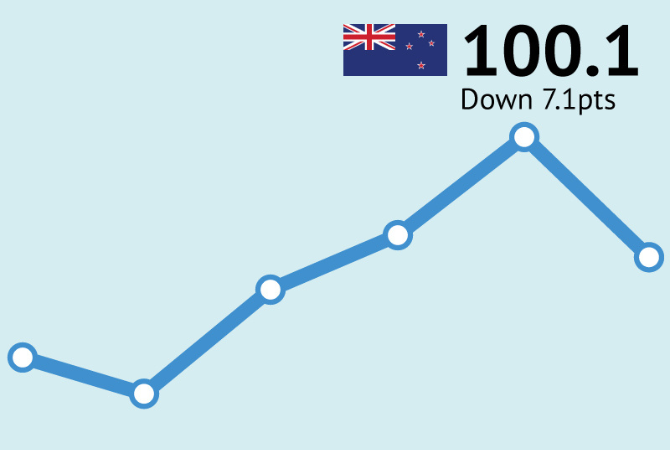
ANZ-Roy Morgan New Zealand Consumer Confidence down 7.1 points to 100.1 in February
A bump in the road
• ANZ-Roy Morgan New Zealand Consumer Confidence fell from 107.2 to 100.1 in February, more than unwinding January’s sharp rise.
• The proportion of households thinking it’s a good time to buy a major household item (the best retail indicator) fell back into negative territory, down 5 points to -4, but it remains well up on year-ago levels.
• Inflation Expectations were relatively steady, up 0.1 ppt to 4.7%.
Turning to the detail (see charts on page 4 of the attached PDF):
• The future conditions index made up of forward-looking questions fell from 113.5 to 106.9, close to its November 2025 level. The current conditions index fell from 97.7 to 90.0, just below where it sat at the end of last year.
• Net perceptions of current personal financial situations (better or worse off than last year) fell 10 points from -6% to -16% with just 27% (down 4% points) of respondents saying they are 'better off' financially than this time a year ago compared to 43% (up 7% points) that say they are 'worse off' financially. It remains slightly above its December 2025 level of -18%.
• Looking forward, a net 20% of respondents expect to be better off this time next year, down 9 points with 42% (down 5% points) of respondents expecting to be 'better off' financially this time next year compared to 22% (up 4% points) who expect to be 'worse off' financially.
• A net 4% of respondents think it’s a bad time to buy a major household item, with 38% (down 3% points) saying now is a 'good time to buy' major household items compared to 42% (up 2% points) saying it's a 'bad time to buy', back in the red after recording its first positive read in 4 years last month. This indicator is still well above year-ago levels.
• Net perceptions regarding the economic outlook over the next 12 months dropped 7 points to -8%. The 5-year-ahead measure fell 4 points to +8%.
• House price inflation expectations eased from 3.7% to 3.6%. Bucking the trend, expectations in Wellington lifted from 2.5% to 3.6%.
• Two-year-ahead CPI inflation expectations were little changed, up 0.1 ppt to 4.7%. That’s very close to the pace of current annual food price inflation.
Figure 2 in the attached PDF shows the net percentage of consumers saying it’s a good time to buy a major item split by whether the respondent has a mortgage or not (the latter group being a mix of renters and those who have paid a mortgage off). Mortgage-holders felt the pain as the Reserve Bank of New Zealand (RBNZ) raised rates to head off inflation, but the two groups have now converged as households with fixed mortgages have gradually rolled onto lower rates, a process that still has some way to run despite the turnaround in interest rates late last year
Margin of Error
The margin of error to be allowed for in any estimate depends mainly on the number of interviews on which it is based. Margin of error gives indications of the likely range within which estimates would be 95% likely to fall, expressed as the number of percentage points above or below the actual estimate. Allowance for design effects (such as stratification and weighting) should be made as appropriate.
| Sample Size | Percentage Estimate |
| 40% – 60% | 25% or 75% | 10% or 90% | 5% or 95% | |
| 1,000 | ±3.0 | ±2.7 | ±1.9 | ±1.3 |
| 5,000 | ±1.4 | ±1.2 | ±0.8 | ±0.6 |
| 7,500 | ±1.1 | ±1.0 | ±0.7 | ±0.5 |
| 10,000 | ±1.0 | ±0.9 | ±0.6 | ±0.4 |
| 20,000 | ±0.7 | ±0.6 | ±0.4 | ±0.3 |
| 50,000 | ±0.4 | ±0.4 | ±0.3 | ±0.2 |


