


In September 2026 risk of mortgage stress was 31.8%; up a large 7.9% points since January

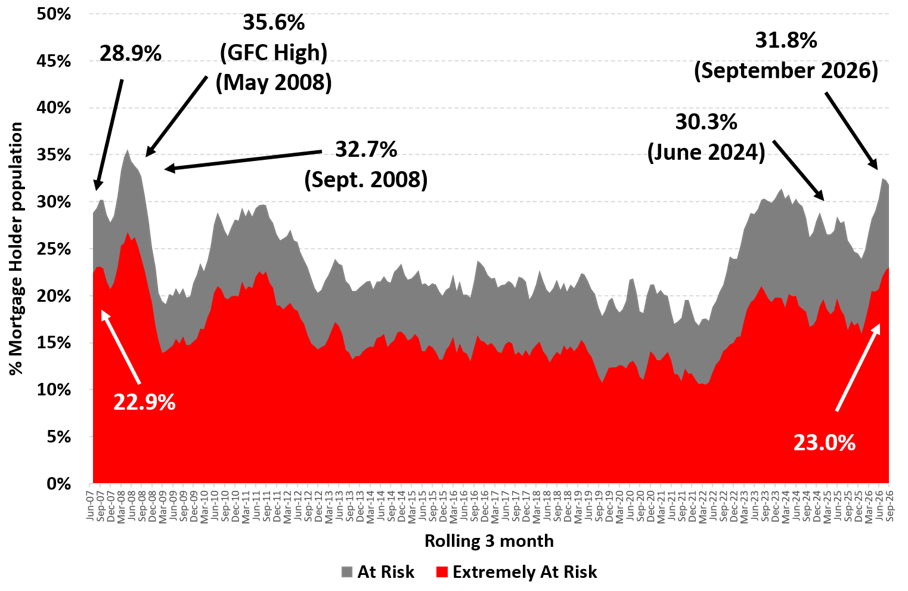
New research from Roy Morgan shows 31.8% of mortgage holders ‘At Risk’ of ‘mortgage stress’ in the three months to September 2026, down 0.5% points from August 2026, but up a large 7.9% points since January after four interest rate increases from the Reserve Bank (RBA) this year.
After raising interest rates in February (+0.25%), March (+0.25%), May (+0.25%), the RBA elected to leave interest rates unchanged in June and August, before raising interest rates again in late September (+0.25%) to a 15-year high of 4.6%.
A share of 31.8% of mortgage holders ‘At Risk’ of mortgage stress is equivalent to 1,750,000 people – up a large 566,000 so far this year.
The record high of 35.6% of mortgage holders ‘At Risk’ of mortgage stress was reached in mid-2008 when official interest rates hit a 30 year high of 7.25% (March – September 2008).
The number of Australians ‘At Risk’ of mortgage stress is up 389,000 on a year ago
The number of Australians ‘At Risk’ of mortgage stress is up 389,000 on a year ago after the RBA raised interest rates four times over the last 12 months. As a result of these changes, interest rates were at 4.6% in September 2026, 1% higher than a year earlier in September 2025
The number of Australians considered ‘Extremely At Risk’, is now numbered at a record high 1,262,000 (23% of mortgage holders) significantly above the long-term average over the last two decades of 16.5%.
Mortgage Stress – % of Owner-Occupied Mortgage-Holders
Source: Roy Morgan Single Source (Australia), average interviews per 3-month period April 2007 – September 2026, n=2,906. Base: Australians 14+ with owner occupied home loan.
Mortgages ‘At Risk’ set to rise as the Reserve Bank increases interest rates again
The Reserve Bank (RBA) has raised interest rates four times so far this year. These increases were due to the official ABS annual inflation rate being above the RBA’s preferred target range of 2-3%. Official estimates of inflation were at 4% in the year to August 2026; well above the RBA’s preferred target range.
Because of this, Roy Morgan has modelled the impact of potential RBA interest rate increases at their meetings next week in early November (+0.25% to 4.85%) and in early December (+0.25% to 5.1%).
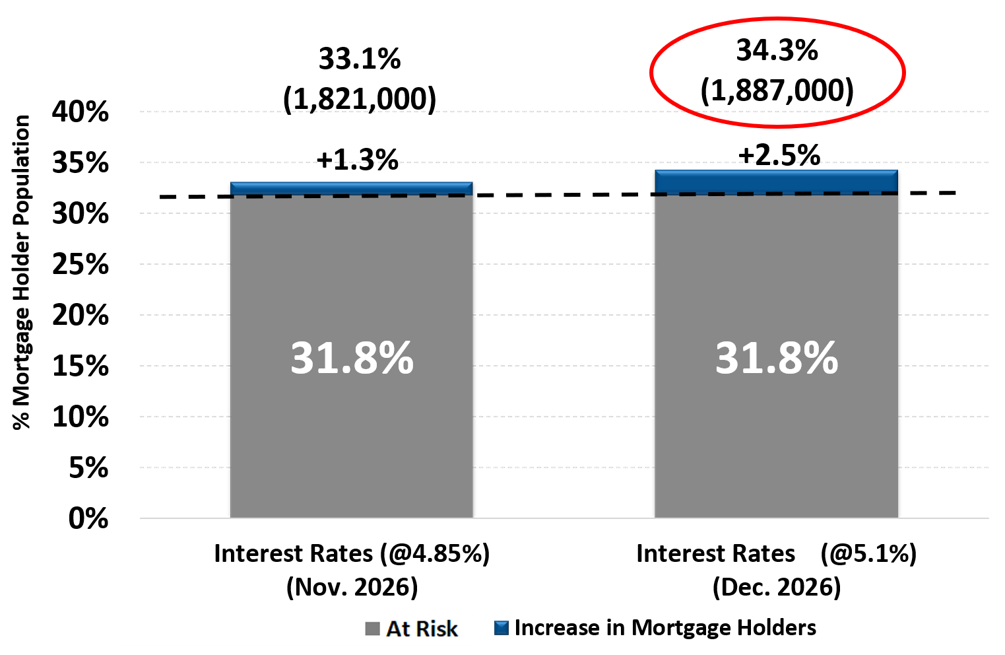
If the RBA increases interest rates by +0.25% to a 19-year high of 4.85% next week, the share of mortgage holders considered ‘At Risk’ would increase to 33.1% (up 1.3% points from now), and equivalent to a new record high 1,821,000 mortgage holders, up 71,000 from now.
Looking forward into December, and another potential RBA interest rate increase of +0.25% to 5.1%, the share of mortgage holders considered ‘At Risk’ would then increase to 34.3% (up 2.5% points from now), and equivalent to a new record high 1,887,000 mortgage holders, up 137,000 from now.
Mortgage Risk projections based on an interest rate increases in November & December 2026
Source: Roy Morgan Single Source (Australia), July 2026 – September 2026, n=3,638.
Base: Australians 14+ with owner occupied home loan.
How are mortgage holders considered ‘At Risk’ or ‘Extremely At Risk’ determined?
Roy Morgan considers the risk of ‘mortgage stress’ among mortgage holders in two ways:
Mortgage holders are considered ‘At Risk’[1] if their mortgage repayments are greater than a certain percentage of household income – depending on income and spending.
Mortgage holders are considered ‘Extremely at Risk’[2] if even the ‘interest only’ is over a certain proportion of household income.
Unemployment is the key factor which has the largest impact on income and mortgage stress
It is worth understanding that Roy Morgan uses a conservative forecasting model, essentially assuming all other factors apart from interest rates remain the same.
The latest figures on mortgage stress show weakness in employment markets negatively impacting levels of household income. This impact is supported by the latest Roy Morgan unemployment estimates which show over 3 million Australian workers are either unemployed or under-employed – 3,041,000 (19.4% of the workforce); (In September, Australian ‘real unemployment’ drops 1.1% to 10.6%, driven by an increase in employment and a decline in the workforce).
Although the Reserve Bank’s decision to cut interest rates three times last year had a positive impact and helped lower mortgage stress, since the turn of the year the Reserve Bank has reversed course and has now increased interest rates on four occasions this year in February, March, May, and at the end of September.
Despite the actions of the Reserve Bank, the fact remains the greatest impact on an individual, or household’s, ability to pay the mortgage is not interest rates, it’s if they lose their job or main source of income.
Michele Levine, CEO Roy Morgan, says mortgage stress has been consistently above 30% for the last few months, and the interest rate increase at the end of September is set to increase mortgage stress even further in the months ahead:

“Mortgage stress is just one indicator of the pressure Australians are under. The good news is that mortgage stress moderated slightly in September before the Reserve Bank (RBA) increased interest rates at the end of the month by +0.25% to a 15-year high of 4.6%. The key driver of the moderation of mortgage stress in September was rising household incomes amongst mortgage holders.
“So far this year the RBA has increased interest rates four times which has significantly increased mortgage repayments, and along with other factors such as declining house prices in key markets, and a contracting Australian workforce compared to earlier this year, has steadily increased the pressure on average Australians.
“The latest Roy Morgan data shows 31.8% of mortgage holders (equivalent to 1,750,000) ‘At Risk’ of mortgage stress in September, up 7.9% points this year. The latest figures for mortgage stress are just below the record highs reached during 2008, when official Australian interest rates hit a 30-year high of 7.25% in mid-2008. This led to record high levels of mortgage stress during this period, peaking at 35.6% in the three months to May 2008.
“Concerningly, inflation pressures in the Australian economy persist with the latest ABS official inflation figures for the 12 months to August 2026 showing CPI at an annual rate of 4% – well above the RBA’s preferred target range of 2-3%.
“Because of the continuing high level of inflation, Roy Morgan has modelled interest rate increases next week (+0.25% to 4.85%) and in December (+0.25% to 5.1%). If the RBA increases rates in November and December, mortgage holders ‘At Risk’ is set to increase to 34.3% of mortgage holders (up 2.5% from now), and equivalent to 1,887,000 mortgage holders (up 137,000 from now).
“If this were to happen, the level of mortgage stress would be at its highest rate since June 2008 over 18 years ago.”
These are the latest findings from Roy Morgan’s Single Source Survey, based on in-depth interviews conducted with over 60,000 Australians each year including over 10,000 owner-occupied mortgage-holders.
To learn more about Roy Morgan’s mortgage data, call (+61) (3) 9224 5309 or email askroymorgan@roymorgan.com. Please click on this link to the Roy Morgan Online Store.
About Roy Morgan
Roy Morgan is Australia’s largest independent Australian research company, with offices in each state, as well as in the U.S. and U.K. A full-service research organisation, Roy Morgan has over 80 years’ experience collecting objective, independent information on consumers.
[1] "At Risk" is based on those paying more than a certain proportion of their after-tax household income (25% to 45% depending on income and spending) into their home loan, based on the appropriate Standard Variable Rate reported by the RBA and the amount they initially borrowed.
[2] "Extremely at Risk" is also based on those paying more than a certain proportion of their after-tax household income (25% to 45% depending on income and spending) into their home loan, based on the Standard Variable Rate set by the RBA and the amount now outstanding on their home loan.
Margin of Error
The margin of error to be allowed for in any estimate depends mainly on the number of interviews on which it is based. Margin of error gives indications of the likely range within which estimates would be 95% likely to fall, expressed as the number of percentage points above or below the actual estimate. Allowance for design effects (such as stratification and weighting) should be made as appropriate.
| Sample Size | Percentage Estimate |
| 40% – 60% | 25% or 75% | 10% or 90% | 5% or 95% | |
| 1,000 | ±3.0 | ±2.7 | ±1.9 | ±1.3 |
| 5,000 | ±1.4 | ±1.2 | ±0.8 | ±0.6 |
| 7,500 | ±1.1 | ±1.0 | ±0.7 | ±0.5 |
| 10,000 | ±1.0 | ±0.9 | ±0.6 | ±0.4 |
| 20,000 | ±0.7 | ±0.6 | ±0.4 | ±0.3 |
| 50,000 | ±0.4 | ±0.4 | ±0.3 | ±0.2 |


