


ANZ-Roy Morgan Consumer Confidence drops 3.6pts to 76.9 – down over 7pts in two weeks to lowest since December 2023
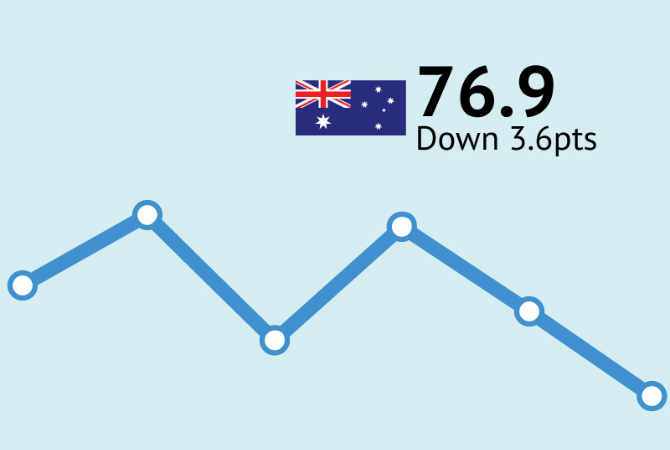
ANZ-Roy Morgan Consumer Confidence dropped 3.6pts to 76.9 in the week the Reserve Bank raised interest rates by +0.25% to 3.85% - its first interest rate increase for over two years since November 2023. This is the lowest Consumer Confidence rating since December 2023.
Consumer Confidence is now a large 9.8pts lower than a year ago, February 3-9, 2025 (86.7), and 4.1pts below the 2026 weekly average of 81.0.
An analysis by State shows the Reserve Bank’s decision to raise interest rates hit confidence everywhere with a uniform fall in confidence across all States this week.
Driving the weekly increase was a rising proportion of Australians expecting ‘bad times’ for the economy over both the next year, and the next five years.
Under one-in-six Australians, 16% (down 2ppts), say their families are ‘better off’ financially than this time last year compared to a rising 47% (up 2ppts) that say their families are ‘worse off’.
Views on personal finances over the next year dipped for a second straight week with only 22% (down 2ppts) of respondents expecting their family will be ‘better off’ financially this time next year (the lowest figure for this indicator for over 36 years since July 1989), while over a third, 35% (down 1ppt), expect to be ‘worse off’ (this is a net rating of -13% - the lowest net rating for this indicator for over two years since November 2023 – the last time the Reserve Bank increased interest rates).
Net sentiment regarding the economy over the next year deteriorated sharply this week with 8% (unchanged) of Australians, expecting ‘good times’ for the Australian economy over the next twelve months compared to well over a third, 38% (up 5ppts), that expect ‘bad times’.
Net views regarding the Australian economy in the longer-term also dipped sharply this week with just 8% (down 2ppts) of Australians expecting ‘good times’ for the economy over the next five years compared to well over a quarter, 30% (up 4ppts), expecting ‘bad times’ (the highest figure for this indicator since the early days of the pandemic in February 2020) – and overall this led to a net rating of -22% - the lowest for over 35 years since January 1991.
Net buying intentions were virtually unchanged his week with 20% (down 1ppt) of respondents saying now is a ‘good time to buy’ major household items compared to 39% (unchanged) that say now is a ‘bad time to buy major household items’.
ANZ Economist, Sophia Angala, commented:

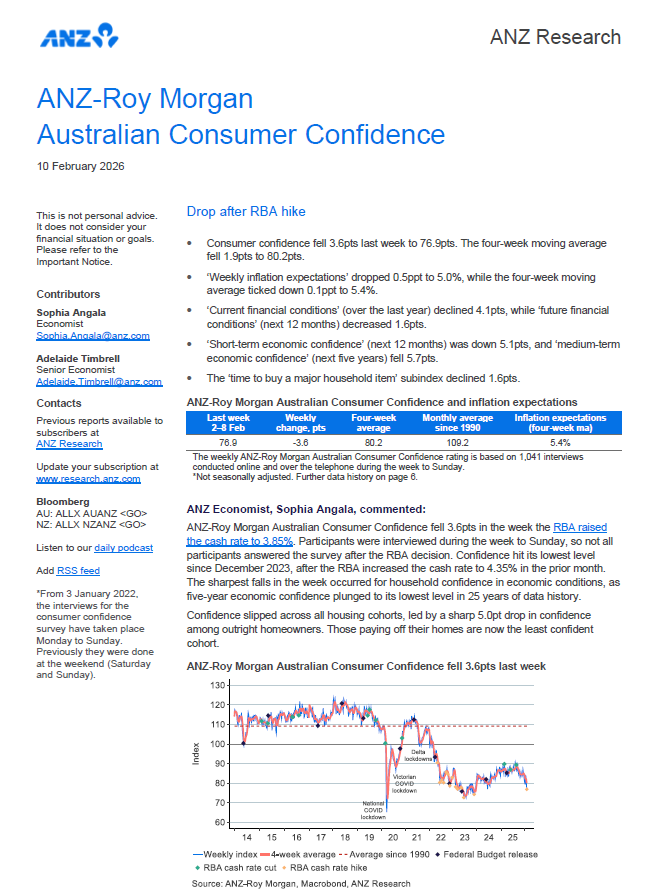
ANZ-Roy Morgan Australian Consumer Confidence fell 3.6pts in the week the RBA raised the cash rate to 3.85%. Participants were interviewed during the week to Sunday, so not all participants answered the survey after the RBA decision. Confidence hit its lowest level since December 2023, after the RBA increased the cash rate to 4.35% in the prior month. The sharpest falls in the week occurred for household confidence in economic conditions, as five-year economic confidence plunged to its lowest level in 25 years of data history.
Confidence slipped across all housing cohorts, led by a sharp 5.0pt drop in confidence among outright homeowners. Those paying off their homes are now the least confident cohort.
Check out the latest results for our weekly surveys on Business Confidence, Consumer Confidence, and Voting Intention as follows:
Roy Morgan Business Confidence Statistics
ANZ – Roy Morgan Consumer Confidence Statistics
Federal Voting – Government Confidence Rating
Related Research Reports
The latest Roy Morgan Consumer Confidence Monthly Report is available on the Roy Morgan Online Store. It provides demographic breakdowns for Age, Sex, State, Region (Capital Cities/ Country), Generations, Lifecycle, Socio-Economic Scale, Work Status, Occupation, Home Ownership, Voting Intention, Roy Morgan Value Segments and more
Consumer Confidence – Monthly Detailed Report in Australia.
Business Confidence – Monthly Detailed Report in Australia.
Consumer Banking Satisfaction - Monthly Report in Australia.
For comments or more information please contact:
Roy Morgan - Enquiries
Office: +61 (03) 9224 5309
askroymorgan@roymorgan.com
Margin of Error
The margin of error to be allowed for in any estimate depends mainly on the number of interviews on which it is based. Margin of error gives indications of the likely range within which estimates would be 95% likely to fall, expressed as the number of percentage points above or below the actual estimate. Allowance for design effects (such as stratification and weighting) should be made as appropriate.
| Sample Size | Percentage Estimate |
| 40% – 60% | 25% or 75% | 10% or 90% | 5% or 95% | |
| 1,000 | ±3.0 | ±2.7 | ±1.9 | ±1.3 |
| 5,000 | ±1.4 | ±1.2 | ±0.8 | ±0.6 |
| 7,500 | ±1.1 | ±1.0 | ±0.7 | ±0.5 |
| 10,000 | ±1.0 | ±0.9 | ±0.6 | ±0.4 |
| 20,000 | ±0.7 | ±0.6 | ±0.4 | ±0.3 |
| 50,000 | ±0.4 | ±0.4 | ±0.3 | ±0.2 |


